

Short Answer
Smuggling across the Canadian border during the War of 1812 involved the illegal transport of goods between the United States and British North America. Driven by wartime trade restrictions and blockades, merchants on both sides engaged in clandestine commerce to obtain needed supplies and profits. This smuggling not only undermined government policies but also supplied both American and British forces, affecting the course of the war.
Historical Context
The War of 1812 was fought between the United States and Great Britain, with British North America (Canada) as the main British territory on the continent. The conflict arose from long-standing disputes over impressment, trade restrictions, and American expansionism. Before the war, the United States had imposed the Embargo Act of 1807 and later the Non-Intercourse Act, which restricted trade with Britain and France, inadvertently encouraging smuggling. The Canadian border, stretching from the Atlantic to the Great Lakes, was vast and largely uncontrolled, with rivers, lakes, and forest trails that facilitated illegal crossings. Both governments attempted to regulate trade, but enforcement proved difficult.
What Happened
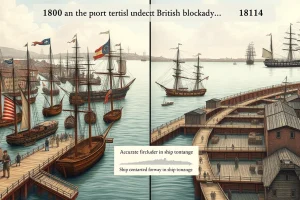
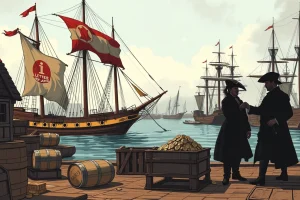
During the war, smuggling continued and intensified. American merchants traded with British Canada to obtain goods made scarce by the British blockade of American ports, while Canadian merchants sought American agricultural products. Key smuggling routes included Lake Champlain, the St. Lawrence River, the Niagara Peninsula, and the Detroit area. Smugglers used small boats, oxen-drawn sledges, and foot trails, moving goods such as salt, flour, pork, whiskey, and occasionally gunpowder and military supplies. The British sometimes encouraged smuggling to supply their forces, while American authorities attempted to suppress it, but local populations often shielded smugglers. Notable smuggling centers included the area around Massena, New York, and the St. Regis reservation. Indigenous peoples, who crossed the border freely, also participated in this trade.
Why It Matters
Smuggling had immediate effects on both economies and military operations. It provided supplies to British forces and allowed Americans to obtain goods they desired, undermining the blockade. It also fostered corruption and local disregard for national laws. Historically, it illustrates the limits of central authority over frontier regions. The practice influenced the post-war settlement, as trade reopened and tensions eased.
Definition
Smuggling across the Canadian border refers to the illegal transport of goods across the international boundary between the United States and British North America without paying customs duties or evading trade restrictions during the War of 1812.
Background
The practice stemmed from the trade restrictions imposed by both nations. The American embargo of 1807 and subsequent non-importation acts led to widespread smuggling even before the war. The British Orders in Council similarly restricted American trade with Europe. The war extended these restrictions, making smuggling more desperate and more lucrative.
How It Worked
Smugglers used various methods: concealing goods in ordinary trade shipments, crossing at night in small boats, or passing through unguarded forest trails. They relied on local guides and sometimes on corrupt customs officials. The border was not effectively patrolled by either side, allowing smuggling to operate with relative ease.
Competing Viewpoints
American authorities viewed smuggling as treasonous because it supported the enemy and deprived the treasury of revenue. British authorities condemned smuggling when it aided enemy forces, but they often tolerated or even encouraged smugglers who brought essential supplies to Canada. Local residents along the border saw smuggling as a legitimate livelihood, particularly when legitimate trade was restricted.
Role in the War of 1812
Smuggling supplied both sides with goods needed for the war effort. It sustained British forces in Canada, allowing them to continue military operations, while also providing Americans with access to British markets and goods. This flow of supplies likely prolonged the conflict and created diplomatic complications, as both governments accused the other of tolerating the practice.
Consequences and Historical Interpretation
After the war, the Treaty of Ghent reopened normal trade, reducing the incentive for smuggling. However, the pattern of cross-border trade continued in various forms. Historians have debated the extent of smuggling’s impact, with some emphasizing its economic role in sustaining armies and others focusing on its political implications for state authority. It remains a key example of the difficulty of enforcing economic restrictions on a vast frontier.
Primary Sources
Primary sources for this topic include customs records, military correspondence, and diplomatic dispatches. For example, the papers of British governor Sir George Prevost and American officials like James Madison contain references to smuggling. Customs house records from ports such as Boston and New York document seizures and prosecutions. The Library and Archives Canada and the U.S. National Archives hold these materials. However, many records are incomplete due to the clandestine nature of the activity, and much of what is known comes from official complaints rather than direct accounts by smugglers.
Further Reading
- Hickey, Donald R. The War of 1812: A Forgotten Conflict. University of Illinois Press, 1989.
- Borneman, Walter R. 1812: The War That Forged a Nation. Harper Perennial, 2004.
- Laxer, James. Staking Claims to a Continent: John A. Macdonald, Abraham Lincoln, Jefferson Davis, and the Making of North America. House of Anansi Press, 2016. (For broader economic context, though not solely about smuggling).
References
- Hickey, Donald R. The War of 1812: A Forgotten Conflict. University of Illinois Press, 1989.
- Borneman, Walter R. 1812: The War That Forged a Nation. Harper Perennial, 2004.
- Laxer, James. Staking Claims to a Continent. House of Anansi Press, 2016.
FAQ
What goods were most commonly smuggled across the Canadian border?
Agricultural products like flour, pork, and whiskey, as well as manufactured items such as textiles, salt, and occasionally gunpowder and military supplies.
Who typically acted as smugglers?
Local farmers, merchants, and sometimes professional smugglers, often with the help of Indigenous guides who knew the terrain. Some had the tacit support of local communities.
How did governments attempt to stop smuggling?
The United States deployed troops and naval patrols along key routes and established customs checkpoints, while Britain also sought to control smuggling. However, enforcement was limited by the length of the border and local resistance.
Leave a Reply