Short Answer
The American banking system was central to financing the United States military effort during the War of 1812, yet its rapid expansion and eventual suspension of specie payments exposed deep vulnerabilities in the young nation’s financial infrastructure. The war forced policymakers to confront questions about public credit, paper currency, and the proper role of banks, ultimately leading to the charter of the Second Bank of the United States in 1816. This article examines how American banks functioned during the war, the consequences of their actions, and the lasting impact on U.S. finance.
Historical Context
Before 1812, the United States relied on a decentralized banking system. The First Bank of the United States, chartered in 1791, had expired in 1811 after a renewal effort failed, leaving only state-chartered banks. The Democratic-Republican Party, particularly influential in the South and West, held deep suspicions of centralized banking and paper money, while Federalists in New England had supported the First Bank but opposed the war. The embargo of 1807 and subsequent trade restrictions had already reduced federal revenue from tariffs, creating a fiscal strain. When war was declared in June 1812, the Treasury under Secretary Albert Gallatin faced the immediate challenge of funding a conflict with limited revenue and a fragmented banking system.
What Happened
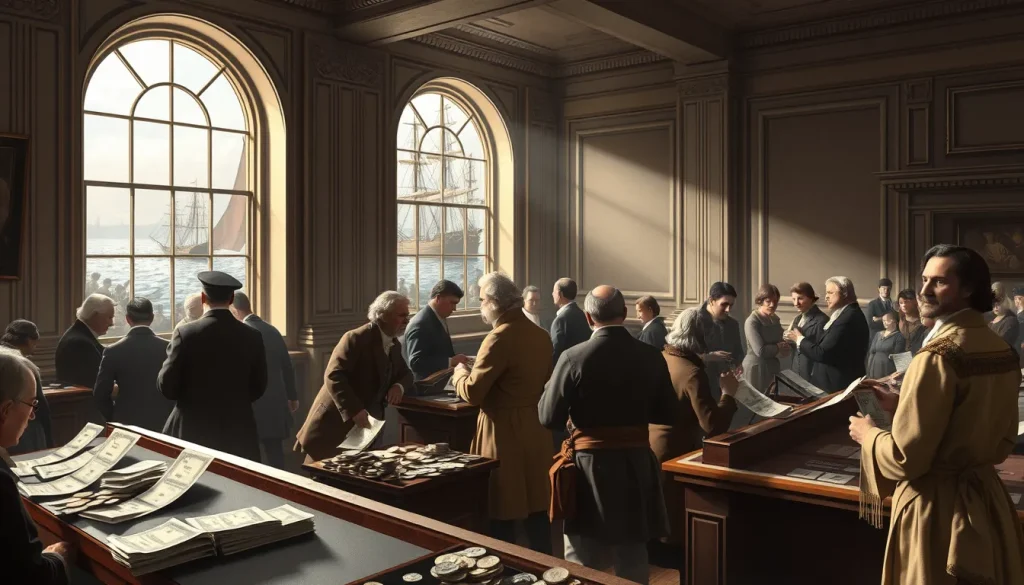
At the outset of the war, Treasury Secretary Gallatin sought loans from banks, but subscriptions were uneven. The government issued treasury notes—short-term, interest-bearing obligations that circulated as currency and could be used to pay taxes—to meet immediate expenses. Between 1811 and 1815, the number of state banks increased sharply from about 117 to 246, while the aggregate of bank notes and deposits rose from $42.2 million to $79 million, an 87% increase. Banks in the Middle States, particularly those in Philadelphia and New York, bought government securities and expanded their note issues.
As the war progressed and the British blockade tightened, pressure on the banking system mounted. In 1814, banks outside New England began suspending specie payments—refusing to convert notes into gold or silver on demand. The three banks of New Orleans suspended in April; after the British burned Washington in August, banks in the District suspended, and by the end of August, banks in Philadelphia and the Middle States followed. Only New England banks maintained convertibility. The suspension led to the depreciation of paper currency and created chaos in trade and public finance. Treasury Secretary George W. Campbell struggled to secure loans, and by 1814 the government was nearly insolvent. However, the credit expansion did allow the government to continue paying for supplies and wages, even as the value of money declined.
Why It Matters
The banking crisis of 1814 directly influenced President James Madison to reverse his earlier opposition to a national bank. In December 1814, Madison called for a new institution to stabilize the currency and manage public finance, leading Congress to charter the Second Bank of the United States in 1816. The war experience demonstrated the dangers of an uncoordinated state-bank system and fueled debates over the balance of federal and state authority. Historians view the war as a turning point in American financial history: it highlighted the necessity of a centralized monetary authority and contributed to the post-war economic downturn, including the Panic of 1819. The role of banks in financing the war remains a subject of debate, with some scholars emphasizing the pragmatic credit creation that enabled military operations, while others stress the inflationary consequences and long-term costs.
Definition
In this context, “American banks” refers to the network of state-chartered banks that operated under varying regulations and issued their own paper notes. These banks accepted deposits, made loans, and created credit. They lacked the coordinating oversight of a central bank after 1811. During the War of 1812, these banks became the primary vehicles for government borrowing and for expanding the circulating medium.
Background
The United States had experimented with a national bank twice by 1811, but the First Bank’s charter lapsed due to political opposition and fears of concentrated power. State banks proliferated in the early nineteenth century, with 117 operating in 1811. The Democratic-Republican Party, influenced by Jeffersonian ideals, favored agrarianism and distrusted banks and paper money as tools of commercial elites. Federalists, centered in New England, were more sympathetic to banking but opposed the war. This political division hindered the creation of a coherent financial policy on the eve of conflict.
How It Worked
The U.S. Treasury relied on loans from banks, which purchased government securities with their own notes. These notes then entered circulation as currency. When bank notes were presented for redemption, they could be exchanged for specie, but banks often held only fractional reserves. The government also issued treasury notes, which were effectively a form of paper money. Banks expanded their lending to the government, and as they issued more notes, the money supply grew. However, when creditors lost confidence, they demanded specie, forcing banks to suspend payments. The suspension temporarily relieved banks of the obligation to convert, but it also led to depreciation and a loss of public trust.
Competing Viewpoints
During the war, there were sharp disagreements over financing. Treasury Secretary Gallatin advocated for a combination of loans and internal taxes, but Congress—dominated by war hawks—was reluctant to impose direct taxes. Federalists in New England opposed the war and refused to lend support, leaving the Middle States to bear the burden. Some argued that borrowing and credit expansion were patriotic and necessary, while others feared inflation and the growth of an unaccountable banking system. Later historians have differed in their assessments. Libertarian economist Murray Rothbard criticized the credit expansion as inflationary and harmful, while others see it as a pragmatic solution to an immediate fiscal emergency.
Role in the War of 1812
American banks were essential to sustaining the war effort. They provided loans that funded the army and navy, and their notes served as a medium for government payments. Banks in the Middle States were particularly active, while New England banks often remained aloof. By 1814, the suspension of specie payments meant that the government’s finances were in disarray, but the continuation of credit allowed the war to proceed. The banking system, though flawed, prevented immediate financial collapse. Its failures also prompted the creation of the Second Bank, which sought to restore order and provide a more stable currency.
Consequences and Historical Interpretation
The war experience led directly to the chartering of the Second Bank of the United States in 1816, which was designed to regulate state banks and provide a stable national currency. The suspension and inflation of the war years contributed to the Panic of 1819, a severe economic depression. Scholars interpret the War of 1812 as a crucial episode in the evolution of American finance, revealing the limits of state-regulated banking and the need for federal oversight. The debates over banking during this period echoed in later constitutional conflicts, such as McCulloch v. Maryland (1819), which affirmed the federal government’s implied powers over banking and currency. The financial history of the war, once neglected, is now recognized as essential to understanding the nation’s economic development.
Primary Sources
Key primary sources include the reports and correspondence of Treasury Secretaries Albert Gallatin and Alexander Dallas. Gallatin’s letters detail loan negotiations and the issuance of treasury notes. The Annals of Congress record congressional debates on taxation, borrowing, and banking policy. The 1820 report by Treasury Secretary William H. Crawford reviewed the financial history of the war and attributed the suspension of specie payments to bank inflation and the spread of small notes. Additionally, the papers of President James Madison and various state bank records, such as those of the Bank of Philadelphia, provide insight into the financial operations of the period. These sources must be read critically, as they reflect the biases of their authors and the limited information available at the time.
Further Reading
- The Financial History of the War of 1812, by Lisa R. Morales (2009 dissertation, University of North Texas).
- A History of Banking in the United States, by William Graham Sumner (1896).
- Banks and Politics in America from the Revolution to the Civil War, by Bray Hammond (1957).
- Reconstructing the National Bank Controversy: Politics and Law in the Early American Republic, by Eric Lomazoff (2018).
References
- Morales, Lisa R. “The Financial History of the War of 1812.” Dissertation, University of North Texas, 2009. Link
- Sumner, William Graham. A History of Banking in the United States. 1896. Link
- Schwartz, David. “Coin, Currency, and Constitution: Reconsidering the National Bank Precedent.” Michigan Law Review 118, no. 6 (2020). Link
- Carney, John. “Did a Tax-Budget Battle Almost Kill the US in 1812?” CNBC, March 27, 2012. Link
FAQ
Why did many American banks suspend specie payments in 1814?
Banks suspended specie payments because they had issued more notes than they could back with gold and silver reserves. The mounting pressures of wartime inflation, the British blockade, and the burning of Washington triggered a loss of confidence, leading banks outside New England to refuse redemption in August 1814.
How did the banking system finance the War of 1812?
The U.S. Treasury obtained loans from state banks, which purchased government securities with their own notes. These notes circulated as currency, while the government also issued treasury notes. This credit expansion provided the funds needed to pay for military supplies and salaries, albeit with inflationary consequences.
What was the connection between the banking crisis and the creation of the Second Bank of the United States?
The chaotic state of finance during the war, including the widespread suspension of specie payments, led President Madison to reconsider his earlier opposition to a national bank. In 1816, Congress chartered the Second Bank of the United States to stabilize the currency and provide a more centralized fiscal system.



Leave a Reply