
Short Answer
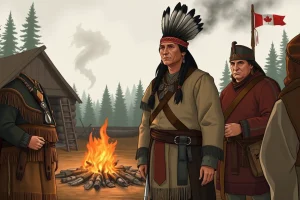
Tecumseh (c. 1768–1813) was a Shawnee chief and war leader who sought to unite Indigenous peoples of the Northwest Territory into a confederacy to resist American expansion. His alliance with the British during the War of 1812 made him a key figure in the defense of Upper Canada. His death at the Battle of the Thames in 1813 marked the collapse of his confederacy but established his enduring legacy as a symbol of Indigenous resistance.
Historical Context
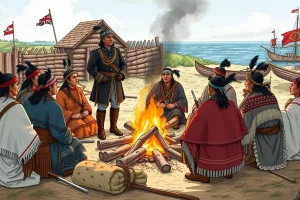
Following the American Revolution, the new United States aggressively expanded westward, treating Indigenous lands as conquered territory. Treaties such as the 1783 Treaty of Paris and the 1795 Treaty of Greenville forced tribes to cede vast lands north of the Ohio River. The influx of settlers, military campaigns, and the destruction of game placed immense pressure on Indigenous communities. In response, various leaders sought to create pan-Indian alliances, drawing on spiritual movements and shared grievances. The British, seeking to protect their Canadian colonies and maintain influence, provided Indigenous nations with trade goods and intermittent military support, creating a volatile frontier.
What Happened
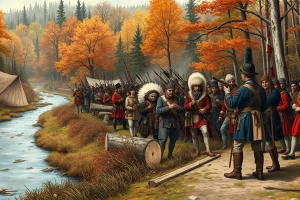
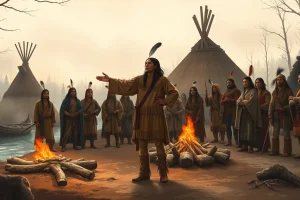
Tecumseh emerged as a prominent warrior in the 1780s, fighting in border skirmishes. He refused to sign the Treaty of Greenville, believing that land belonged to all Indigenous peoples and could not be ceded by individual tribes. Around 1805, his brother Lalawéthika, later known as Tenskwatawa or the Prophet, experienced a vision that launched a nativist religious movement. Together, they founded Prophetstown in Indiana in 1808, attracting followers from various tribes and building a confederacy aimed at halting American encroachment. Tecumseh traveled extensively to recruit support, delivering powerful speeches. In 1811, while Tecumseh was away, Governor William Henry Harrison attacked Prophetstown, leading to the Battle of Tippecanoe. The battle was a tactical defeat for the confederacy, but Tecumseh continued to rally resistance. When the War of 1812 broke out, Tecumseh and his warriors allied with the British, contributing to the capture of Fort Detroit and subsequent military operations. He was killed on October 5, 1813, at the Battle of the Thames, where American forces defeated the British and their Indigenous allies.
Why It Matters
Tecumseh’s confederacy represented the most serious attempt to unify Indigenous nations against American expansion in the early republic. His military skills and oratory earned respect from both allies and adversaries. Although his death and the battle’s outcome ended significant armed resistance in the Northwest, his efforts influenced future Indigenous movements and his memory became a powerful symbol of resistance. In Canada, he is celebrated as a defender of Upper Canada; in the United States, he is remembered as a leader of great vision and tragic fate.
Early Life
Tecumseh was born around 1768, likely near the Scioto River in present-day Ohio, to Shawnee parents. His father, Puckeshinwa, was a chief who was killed at the Battle of Point Pleasant in 1774. Tecumseh was raised by his siblings after his mother left with other tribe members. He learned warfare from his older brother Cheeseekau and the ethics of Shawnee culture from his sister Tecumapease. By his teenage years, he participated in raids against American settlers. He witnessed the violence of frontier warfare and developed a deep opposition to American land claims.
Role Before the War
During the 1790s, Tecumseh fought in battles, including the defeat of General Arthur St. Clair in 1791 and the Battle of Fallen Timbers in 1794. He refused to sign the Treaty of Greenville, which ceded much of Ohio. In the early 1800s, he emerged as a band leader and, influenced by his brother’s religious revival, became the political and military leader of a pan-Indian confederacy. He argued that the land was held in common by all Indigenous peoples and that no single tribe had the right to cede it. He established Prophetstown as the center of the movement and conducted diplomatic missions to tribes across the region.
Role During the War
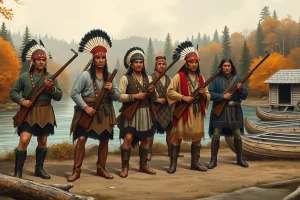
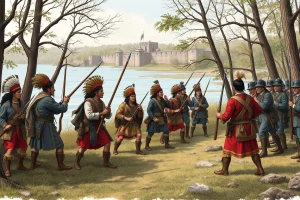
When the War of 1812 began, Tecumseh and his warriors allied with the British, hoping to protect their lands from American expansion. He played a decisive role in the Siege of Detroit in August 1812, where his strategic positioning of troops helped force the American surrender. Afterward, he worked with British Major-General Isaac Brock to defend Upper Canada. Following Brock’s death and a series of American successes, Tecumseh continued to fight alongside the British, but growing disagreements with Brock’s successor, Henry Procter, strained the alliance. He insisted on making a stand against the Americans, leading to the Battle of the Thames, where he was killed.
Major Actions
Tecumseh’s major military actions include his participation in the 1791 victory over St. Clair, the Battle of Fallen Timbers, the Battle of Tippecanoe (where he was not present but whose confederacy was attacked), the Siege of Detroit, and the Battle of the Thames. His diplomatic achievements, such as the formation of the confederacy and his speeches to tribes and American officials, were equally significant. He also was known for his humanity, allegedly forbidding the torture of prisoners.
Contemporary Accounts
Contemporary observers praised Tecumseh’s charisma and military ability. British Major-General Isaac Brock described him as ‘a more sagacious or a gallant warrior does not, I believe, exist.’ American governor William Henry Harrison acknowledged his influence, saying that Tecumseh was ‘one of those uncommon geniuses which spring up occasionally to produce revolutions.’ Some accounts of his speech at Vincennes in 1810 were recorded by American officials, highlighting his oratorical power and his arguments against land cessions.
Later Life
Tecumseh did not have a later life; he died on the battlefield. His remains were never identified, and the location of his grave is unknown. His brother Tenskwatawa survived him but lost influence after the war.
Historical Legacy
Tecumseh is remembered as a heroic leader who attempted to unite Indigenous peoples against overwhelming odds. In Canada, he is honored as a defender of the country and a military leader. In the United States, he is a symbol of Native American resistance and a figure of historical study. His confederacy, though ultimately unsuccessful, inspired later movements and remains a subject of scholarly debate regarding its aims and potential.
Primary Sources
Primary sources for Tecumseh’s life include his speeches as recorded by American officials such as William Henry Harrison and other witnesses. These transcripts are held in American archives and published in books like Messages and Documents of the Indiana Territory. British military records, including correspondence from Isaac Brock and Henry Procter, document his military role. The diaries and memoirs of contemporaries, such as those of trader and later Indian agent, provide additional perspectives. These sources must be evaluated for bias, as they reflect both American and British viewpoints.
Further Reading
- Tecumseh: A Life by John Sugden (1997)
- Tecumseh and the Prophet: The Heroic Struggle for America’s Heartland by Peter Cozzens (2020)
- The Shawnee and the War for America by Colin G. Calloway (2007)
- Prophetstown: The Battle of Tippecanoe and the War of 1812 by Adam Jortner (2012)
- Dictionary of Canadian Biography entry on Tecumseh
References
- James H. Marsh and Tabitha de Bruin, ‘Tecumseh,’ The Canadian Encyclopedia, accessed 2025, https://thecanadianencyclopedia.ca/en/article/tecumseh.
- History.com Editors, ‘Tecumseh: Chief, Facts & Battles,’ History, accessed 2025, https://www.history.com/articles/tecumseh.
- Dictionary of Canadian Biography, ‘TECUMSEH (Tech-kum-thai),’ accessed 2025, https://www.biographi.ca/en/bio/tecumseh_5E.html.
- John Sugden, Tecumseh: A Life (New York: Henry Holt, 1997).
FAQ
What was Tecumseh's main goal?
Tecumseh sought to create a pan-Indian confederacy to halt American expansion into Indigenous lands, based on the belief that land was held in common by all Indigenous peoples.
How did Tecumseh die?
Tecumseh was killed on October 5, 1813, at the Battle of the Thames in present-day Ontario, while fighting alongside British forces against American troops.
Why did Tecumseh ally with the British?
Tecumseh allied with the British during the War of 1812 because Britain provided military support and trade goods, and he believed that a British victory would protect Indigenous land from American expansion.
Leave a Reply