Short Answer
The War of 1812 produced a large and often overlooked refugee crisis, most notably involving enslaved African Americans who fled from the United States to British military lines. This article focuses on that group, the thousands of freedom seekers who escaped bondage in the Chesapeake region and elsewhere, enlisted in British forces, and eventually resettled in British colonies. Their flight and resettlement had lasting consequences for American slavery, British policy, and diplomatic relations between the United States and Great Britain.
Historical Context
The War of 1812 (1812–1815) was fought between the United States and Great Britain, with British North America (Canada) and Indigenous nations also involved. By 1814, as the British navy gained control of the Chesapeake Bay, its warships and raiding parties conducted amphibious operations along the coasts of Virginia and Maryland. This brought the war directly to plantations and farms, where a large enslaved population lived under the institution of chattel slavery. British naval commanders, seeking to disrupt American resources and encourage desertion, offered freedom and protection to enslaved people who came over to their side. This policy built on earlier precedents, such as Lord Dunmore’s 1775 proclamation during the American Revolution, but the scale and organization were more systematic during the War of 1812.
What Happened
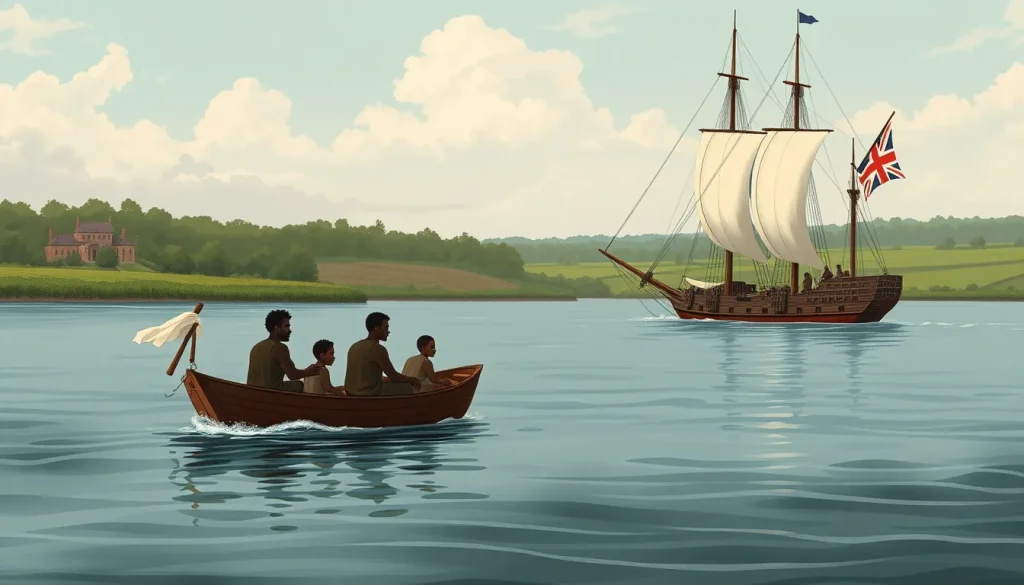
British forces began operating in the Chesapeake in the spring of 1813. As ships moved up the bay, enslaved men and women from Maryland, Virginia, and elsewhere escaped to British vessels. By 1814, the British had established a major base at Tangier Island in the Chesapeake, which became a destination for fugitives. On April 2, 1814, Admiral Alexander Cochrane issued a proclamation offering immediate emancipation to any enslaved person who would join the British military, and promised to settle their families in British colonies. Hundreds flocked to the British lines.
Many of these refugees enlisted in the Colonial Marines, an all-Black regiment that fought in several engagements, including the Battle of Baltimore and the attack on Washington, D.C., in 1814. They often served as guides, spies, and raiders against American plantations, liberating other enslaved people as they went. By the end of 1814, some 3,608 enslaved individuals had escaped to British ships, according to British records.
In January 1815, as the war was ending, British forces under Rear Admiral George Cockburn seized Cumberland Island off the coast of Georgia. Many Black refugees from the Chesapeake had been transported there. On March 5, 1815, nearly 500 of these refugees evacuated aboard the HMS Regulus, sailing first to Bermuda and then onward to Trinidad. Others were sent to Nova Scotia, where they became known as Black Refugees. The war formally ended with the ratification of the Treaty of Ghent on February 16, 1815, but the process of resettling the refugees continued for months.
Why It Matters
The refugee movement had immediate effects on the war effort. The British used the escaped slaves as a military asset, and the loss of enslaved labor damaged American plantations. It also created a diplomatic controversy after the war. The Treaty of Ghent called for the return of property, including slaves, but the British refused to return those who had been guaranteed freedom, leading to a dispute over compensation that was not fully resolved until 1828. For the refugees themselves, the flight to British lines meant an uncertain but real liberation. In places like Trinidad and Nova Scotia, they built new communities, though they faced hardships and discrimination. Historians have debated the extent of the refugees’ agency, with some emphasizing their self-emancipation and others stressing British manipulation. The story of these refugees remains central to understanding the war’s impact on slavery and on African American history.
Definition
In the context of the War of 1812, the term “refugees” most commonly designates the enslaved African Americans who fled to British military lines and subsequently resettled in British territories. They were not merely displaced persons; they were freedom seekers whose flight constituted a direct challenge to the institution of slavery. The term also encompasses other displaced civilians, such as inhabitants of frontier areas who fled from military operations, but the Black refugees are the best documented and most consequential group.
Background
The British policy of offering freedom to enslaved people had a long colonial history. During the American Revolutionary War, Lord Dunmore’s 1775 proclamation promised freedom to slaves who sided with Britain. The War of 1812 revived this policy, partly because the British navy needed manpower and partly as a tactic to weaken the American economy. In the Chesapeake, where slavery was deeply entrenched, British vessels cruising the bay became symbols of liberation. The proximity of the enemy enabled many enslaved individuals to make a break for freedom, often paddling canoes to ships or slipping away during raids. The British government and its commanders, especially Admiral Alexander Cochrane, formalized the policy with proclamations and instructions to treat escaped slaves as free persons rather than property.
How It Worked
Enslaved individuals escaped to British ships individually or in groups. Upon reaching a British vessel, they were registered, given food and clothing, and often assigned to labor or military service. Those who were able-bodied men could enlist in the Colonial Marines, a regiment raised from Black volunteers. Their families were provided for and eventually transported to British colonies. The British established depots at places like Tangier Island in the Chesapeake and later Cumberland Island, where refugees were gathered, organized, and prepared for resettlement. After the war, transport ships carried them to Bermuda, Trinidad, and Nova Scotia. In exchange for their military service, they received land grants, provisions, and freedom from the British Crown, although the reality of life in these colonies was often harsh and marked by racial discrimination.
Competing Viewpoints
Historians have interpreted the refugee experience in different ways. Some scholars, like Frank Cassell, argue that the mass escapes demonstrate the profound desire for freedom among enslaved people and their agency in seizing the opportunity presented by war. Others, such as Christopher George, have portrayed the refugees as more passive pawns of British policy, highlighting the hardships they faced in the British colonies and the questionable motives of commanders. More recent scholarship, including the work of Harvey Amani Whitfield, emphasizes the refugees’ self-emancipation and their active role in shaping their own lives, while also acknowledging the constraints they faced. The debate centers on whether the refugees were primarily liberated agents or victims of a cynical British strategy.
Role in the War of 1812
Black refugees played an important role in the British war effort. Beyond their military service in the Colonial Marines, they served as guides, spies, and laborers. Their knowledge of the local terrain and waterways proved valuable during raids and amphibious operations. They also participated in the burning of Washington, D.C., in August 1814, and fought in the Battle of Baltimore. The loss of enslaved labor to the British severely disrupted agricultural production in the Chesapeake, contributing to American economic hardship. The refugees also had a symbolic impact, demonstrating to both Americans and enslaved people that the British offered a tangible path to freedom. Their presence on British ships and bases forced American leaders to address the issue of slavery in the context of the war, although they ultimately failed to change the institution’s legal status.
Consequences and Historical Interpretation
The refugee crisis had several long-term consequences. The British refusal to return the escaped slaves after the Treaty of Ghent led to a protracted diplomatic dispute, with American slaveholders demanding compensation. The British argued that the treaty did not require the return of those who had been freed under military proclamations. Eventually, a claims commission was established, and payment was made in 1828. For the refugees, resettlement was not a seamless transition: they faced poverty, discrimination, and a struggle to build new lives in British colonies. In Nova Scotia, the Black Refugees were settled in segregated communities and received less support than white Loyalists. In Trinidad, some former soldiers established “Meriken” communities. The historical memory of these refugees was long overlooked, but modern scholarship has highlighted their significance. They stand as a testament to the war’s transformative impact on enslaved people and to the complex interplay of slavery, warfare, and diplomacy in the early nineteenth century.
Primary Sources
Key primary sources include the April 1814 proclamation of Admiral Alexander Cochrane, which offered freedom and settlement to enslaved people willing to join the British cause. The muster rolls and ships’ logs of Royal Navy vessels, such as HMS Regulus and HMS Victorious, document the names and fates of many refugees. The Halifax List, compiled in Nova Scotia, records the arrival of Black Refugees in that colony and provides names, ages, and origins. American claims for compensation filed by slaveholders after the war, many preserved in the U.S. National Archives, also offer documentation. These sources are inherently biased: the British military records emphasize order and manpower, while American claims overstate the value of property. Nevertheless, they provide the primary evidence for reconstructing the refugee experience.
Further Reading
- Frank A. Cassell, “Slaves of the Chesapeake Bay Area and the War of 1812,” Journal of Negro History 57, no. 2 (April 1972): 144–155.
- Harvey Amani Whitfield, From American Slaves to Nova Scotian Subjects: The Case of the Black Refugees, 1813–1840 (Toronto: Pearson Prentice Hall, 2005).
- Thomas Malcomson, “Freedom by Reaching the Wooden World: American Slaves and the British Navy during the War of 1812,” The Northern Mariner 22, no. 4 (October 2012): 361–392.
- John Weiss, The Merikens: Free Black American Settlers in Trinidad 1815–16 (rev. ed., London, 2002).
- U.S. National Park Service, “Black Freedom during the War of 1812: From the Chesapeake, Cumberland Island, and Beyond,” Parts 1–2.
References
- William F. Kelly, “Black Freedom during the War of 1812: From the Chesapeake, Cumberland Island, and Beyond, Part 1,” U.S. National Park Service, https://nps.gov/articles/000/black-freedom-seeking-during-the-war-of-1812-from-the-chesapeake-cumberland-island-and-beyond-part-1.htm.
- William F. Kelly, “Black Freedom Seeking During the War of 1812: From the Chesapeake, Cumberland Island, and Beyond, Part 2,” U.S. National Park Service, https://www.nps.gov/articles/000/black-freedom-seeking-during-the-war-of-1812-from-the-chesapeake-cumberland-island-and-beyond.htm.
- Maryland State Archives, “The Enemy Nearly All Round Us: African Americans and the War of 1812,” https://msa.maryland.gov/msa/mdstatehouse/war1812/html/afam_war.html.
- Thomas Malcomson, “Freedom by Reaching the Wooden World: American Slaves and the British Navy during the War of 1812,” The Northern Mariner 22, no. 4 (2012): 361–392, https://www.cnrs-scrn.org/northern_mariner/vol22/tnm_22_361-392.pdf.
- Frank A. Cassell, “Slaves of the Chesapeake Bay Area and the War of 1812,” Journal of Negro History 57, no. 2 (April 1972): 144–155, https://msa.maryland.gov/megafile/msa/speccol/sc5300/sc5339/000261/000000/000003/restricted/2717218.pdf.
FAQ
Why did enslaved people flee to the British during the War of 1812?
British offers of freedom and the proximity of Royal Navy ships gave enslaved people a practical opportunity to escape bondage. Admiral Cochrane's 1814 proclamation explicitly promised emancipation to those who joined the British military.
How many refugees were there?
British records indicate that at least 3,608 enslaved individuals escaped to British ships during the war, though the actual number may be higher. They came mainly from Virginia, Maryland, and later the Gulf Coast.
What happened to the refugees after the war?
The British transported them to Bermuda, Trinidad, and Nova Scotia. Some ex-Colonial Marines and their families settled in Trinidad, where they became known as Merikens. In Nova Scotia, they formed Black refugee communities but faced harsh conditions.

Leave a Reply