

Short Answer
Free men of color—known in French as gens de couleur libres—were a significant part of the mixed force that defended New Orleans against a British invasion during the War of 1812. Two volunteer battalions of free black militiamen served under Major General Andrew Jackson in the campaign from December 1814 to January 1815, culminating in the decisive American victory at Chalmette on January 8, 1815. Their participation was both militarily important and symbolically charged, reflecting long-standing traditions of black military service in colonial Louisiana and raising questions about citizenship and racial equality in the early republic.
Historical Context
Louisiana’s French and Spanish colonial governments had long relied on free black militias for defense, often granting them privileges in exchange for military service. By 1810, New Orleans was home to nearly 5,000 free people of color, many of mixed European and African ancestry, who formed a distinct semi-autonomous community. After the Louisiana Purchase of 1803, these gens de couleur sought to preserve their status and rights under American rule. Governor William C. C. Claiborne, aware of the strategic importance of the region, authorized the formation of a militia corps of free men of color on September 6, 1812. The original legislation limited the unit to four companies, restricted membership to native-born free men of color who owned real estate, and stipulated that white officers would command. This cautious step reflected white anxieties about arming black men, but the threat of British attack in 1814 pushed aside such reservations.
What Happened
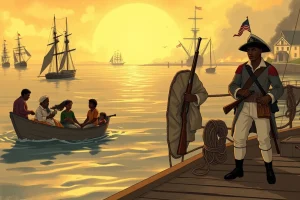
When British forces under General Edward Pakenham threatened New Orleans in December 1814, General Andrew Jackson mobilized every available resource. The First Battalion of Free Men of Color, expanded to six companies and commanded by white officers, including Lieutenant Colonel Michel Fortier and Major Pierre Lacoste, was mustered into federal service on December 16, 1814. A second battalion, composed largely of free black refugees from Saint-Domingue (Haiti), was organized in mid-December under Major Louis d’Aquin. Together, these units joined a heterogeneous army that included U.S. regulars, Tennessee and Kentucky militia, Baratarian privateers, and Choctaw warriors. The free men of color played a key role in constructing and defending the earthworks known as Line Jackson, and they participated in the skirmishes leading up to the main battle.
On January 8, 1815, the British launched a frontal assault against the American ramparts. The two battalions of free men of color held positions along the line and helped repel the attack. Jordan Noble, a teenage drummer in the Seventh U.S. Infantry, kept the beat during the engagement, becoming a celebrated figure. The American victory was decisive; the British suffered over 2,000 casualties against fewer than 100 American losses. Jackson praised the conduct of his entire force in his official reports, singling out the free men of color for their “unwavering” support.
Why It Matters
The service of free men of color at New Orleans had immediate military significance—it helped secure the city and the Mississippi Valley. More enduringly, it became a touchstone in the long struggle for African American rights. The men served voluntarily, believing that loyalty and military sacrifice would translate into citizenship and social acceptance. Yet their hopes were largely unfulfilled. In the decades after the war, they received little recognition or reward, and the story of their contribution faded from public memory until the mid-nineteenth century. The battle also highlighted the broader contradiction of a republic fighting for independence while maintaining slavery. Jackson had promised freedom to enslaved men who joined—but few were actually freed, and many returned to bondage. The experience of free men of color shaped the community’s later strategies for advancement, shifting from martial claims to legal and commercial ones.
Definition
In the context of early nineteenth-century Louisiana, “free men of color” referred to people of African descent who were not enslaved. Many were of mixed European and African ancestry and belonged to a distinct social class with certain legal rights, including property ownership and the right to bear arms under certain conditions. The term gens de couleur libres distinguished them from enslaved African Americans and white citizens. Their identity was shaped by colonial French and Spanish traditions, which recognized military service as a path to privilege.
Background
The tradition of free black militia in Louisiana dated back to the colonial era. Under French and Spanish rule, free men of color served in segregated units, often gaining economic benefits and social standing in exchange for defense duties. The practice was common throughout the Caribbean, where free men of color formed significant portions of colonial militias. After the Louisiana Purchase, the free black community of New Orleans sought to maintain this martial heritage. In 1804, fifty-five members of the free colored militia wrote to Governor Claiborne, offering their services to the United States as a volunteer corps, but the American government was initially hesitant. The War of 1812, and the threat of a British invasion of Louisiana, finally pushed authorities to revive these units.
How It Worked
The First Battalion of Free Men of Color was organized under the 1812 law, with officers initially drawn from white elites, though free men of color could hold the rank of captain within the battalion. The unit was expanded from four to six companies when federalized in December 1814. The Second Battalion, formed largely from Saint-Domingue refugees, had its own command structure under Major d’Aquin. Both battalions were infantry units, equipped with muskets and bayonets, and wore uniforms distinct from white units. They trained alongside other militia and regulars, and their primary role was to hold defensive positions along Line Jackson. According to muster rolls, the First Battalion included a band of up to nine musicians, reflecting the cultural heritage of the community. During the campaign, the free men of color performed garrison and picket duties, and on the day of the battle, they manned the ramparts and repulsed British assaults.
Competing Viewpoints
Historians have debated the motivations of the free men of color who volunteered. Some, like Theodore Roosevelt, questioned why they would fight for a government that discriminated against them. Others, such as Donald Midkiff, argue that they sought “recognition and acceptance” as a means of securing citizenship and social standing. Contemporary observers like Andrew Jackson praised their loyalty, but many white Louisianians were uncomfortable with arming black men. Later chroniclers often minimized their role, subsuming their story into the heroic narrative of Jackson’s victory. Only in recent decades has scholarship focused on the unique perspective of these soldiers, emphasizing their agency and long-term impact.
Role in the War of 1812
The free men of color were part of the larger American defense of the Gulf Coast. Their presence augmented Jackson’s forces at a critical moment, when the regular army was small and the state militia unreliable. The two battalions contributed perhaps 300–600 men to the overall force of about 3,500, and they helped hold the line at the decisive point on January 8. Their service also had strategic significance: it demonstrated that the United States could mobilize diverse populations, including free blacks, to repel a British invasion. Yet their role was often obscured in official reports, which emphasized white militia and volunteers. The War of 1812 thus became both a high point and an ambivalent moment for African American military participation.
Consequences and Historical Interpretation
In the aftermath of the battle, the free men of color received little material compensation. A few, like Jordan Noble, gained local celebrity, but most returned to their former lives with no lasting change in status. The state legislature did not extend additional rights to free men of color, and by the 1820s, restrictions on their liberties increased. The memory of their service largely disappeared until the mid-nineteenth century, when African American leaders invoked it to support claims for citizenship. During the Civil War, Union and Confederate authorities alike sought to recruit black soldiers, and the Battle of New Orleans was cited as proof of black martial capability. Modern historians have emphasized the paradox of fighting for a republic that denied them equality, and they have traced how this experience influenced the free black community’s shift from military to legal strategies for advancement.
Primary Sources
Key contemporary sources include the muster and pay rolls of the First and Second Battalions of Free Men of Color, which document the names, ranks, and service of the men. Andrew Jackson’s correspondence and official report of the battle praise the conduct of the free black troops. The letter from fifty-five members of the free colored militia to Governor Claiborne in 1804 is an important articulation of their expectations. Jordan Noble’s drum, preserved in the Louisiana State Museum, serves as a physical artifact. Charles E. Kinzer’s article on the battalion’s band provides a detailed analysis based on these records. The Louisiana Gazette and other newspapers covered the aftermath of the battle. These sources are valuable but often reflect the biases of white authors or military authorities.
Further Reading
- Charles E. Kinzer, “The Band of Music of the First Battalion of Free Men of Color and the Siege of New Orleans, 1814–1815,” American Music 10, no. 3 (1992).
- Donald K. Midkiff, “Recognition and Acceptance: An Examination of the Louisiana Volunteer Battalions on Line Jackson” (MA thesis, University of New Orleans, 2020).
- Gene Allen Smith, “Accounts of African American Service During the War of 1812,” National Park Service, 2017.
- Nathaniel Millett, “The Free Men of Color of New Orleans and the Battle of New Orleans,” Louisiana History (if available).
References
- Gene Allen Smith, “Accounts of African American Service During the War of 1812,” National Park Service, last updated August 14, 2017, https://www.nps.gov/articles/accounts-of-african-american-service-during-the-war-of-1812.htm.
- Charles E. Kinzer, “The Band of Music of the First Battalion of Free Men of Color and the Siege of New Orleans, 1814–1815,” American Music 10, no. 3 (Autumn 1992): 348–369.
- Donald K. Midkiff, “Recognition and Acceptance: An Examination of the Louisiana Volunteer Battalions on Line Jackson” (MA thesis, University of New Orleans, 2020), https://scholarworks.uno.edu/td/2762.
- R. Scott Rapp, “The Free Men of Color and the Battle of New Orleans,” Louisiana History (if relevant).
FAQ
Who were the free men of color who fought at the Battle of New Orleans?
They were free African-descended men, many of mixed heritage, residing in New Orleans. They formed two militia battalions that served under Andrew Jackson in the defense of the city in 1814-1815.
Why did free men of color volunteer to fight for the United States?
They believed that loyal military service would secure their rights, privileges, and acceptance as citizens. This was rooted in colonial traditions where militia service conferred social status, and they hoped to continue that under American rule.
What was the outcome for free men of color after the battle?
Despite their service, they received little lasting recognition or social advancement. Some, like Jordan Noble, gained local fame, but overall their contributions were largely forgotten until the mid-19th century.
Leave a Reply