

Short Answer
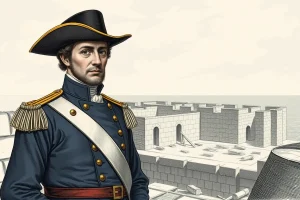
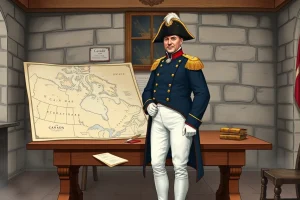
Sir James Lucas Yeo (7 October 1782 – 21 August 1818) was a Royal Navy officer who served with distinction in the French Revolutionary and Napoleonic Wars before commanding British naval forces on the Great Lakes during the War of 1812. As commodore of the Lake Ontario squadron, Yeo faced the American fleet under Isaac Chauncey, overseeing the construction of warships and directing operations that helped preserve British control of the lake. His cautious leadership and strategic decisions remain central to historical debates about the naval war on the frontier.
Historical Context
The War of 1812, fought between the United States and Great Britain, included a critical naval struggle on the Great Lakes. Control of Lake Ontario was essential for supplying British armies in Upper Canada and for projecting power between Kingston and the Niagara frontier. The American naval base at Sackets Harbor, across the lake, became the main threat. Both sides raced to build warships, leading to a naval arms race. The British initially had a small force, but in early 1813 the Admiralty appointed an experienced officer to take command of the lakes, selecting James Lucas Yeo for this demanding post.
What Happened
Yeo arrived in Canada in March 1813 to assume command of British naval forces on the Great Lakes, with his headquarters at Kingston. He immediately faced a well-supplied American squadron commanded by Commodore Isaac Chauncey. Over the following months, Yeo and Chauncey repeatedly maneuvered for advantage, but large-scale engagements were rare due to each side’s tactical caution and the limitations of their ships’ armament. Yeo participated in raids, including the attack on Sackets Harbor in May 1813 and the capture of Fort Oswego in May 1814, which temporarily reduced American naval capability. Throughout 1813–1814, Yeo supervised the construction of larger warships, including the Prince Regent and Princess Charlotte, to counter American vessels. However, his relationship with Governor General Sir George Prevost deteriorated, especially after the British defeat on Lake Champlain in September 1814. The war ended in early 1815, and Yeo returned to England.
Why It Matters
Yeo’s command on Lake Ontario was crucial in preventing the American navy from gaining undisputed control of the lake, which would have allowed invasion of Upper Canada. His shipbuilding program ensured a rough parity with the Americans, forcing the campaign into a stalemate. Historians have debated Yeo’s tactics, with some criticizing his perceived timidity and others arguing that his caution was justified given his inferior firepower and supply shortages. His legacy is commemorated in Canada as a key British naval commander of the war.
Early Life
James Lucas Yeo was born in Southampton, Hampshire, England, on 7 October 1782, the son of a naval victualler. He received some formal education before joining the Royal Navy at age ten, thanks to the patronage of Admiral Phillips Crosby. He served as a midshipman aboard HMS Windsor Castle and earned rapid promotion, becoming an acting lieutenant by 1796. He was confirmed as a lieutenant in 1797 after commanding the sloop Albacore. Yeo served in the West Indies, where he contracted yellow fever, and later in the Adriatic, where he distinguished himself at Cesenatico in 1800.
Role Before the War
During the Napoleonic Wars, Yeo continued to rise. In 1805, while serving as first lieutenant of the frigate Loire, he led a landing party that captured two Spanish shore batteries at Muros Bay, Spain, earning promotion to commander. In 1807, he commanded the post-ship Confiance and in 1809 led a successful expedition against French privateers at Cayenne, French Guiana, capturing the fortified colony. For this achievement, he received a Portuguese knighthood in the Order of Aviz and was later knighted by King George III. In 1811, he took command of the frigate Southampton. While cruising in the Bahamas in November 1812, he captured the American brig Vixen, but both ships were wrecked on an uncharted reef. Although court-martialed, Yeo was exonerated of blame.
Role During the War
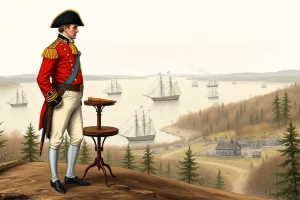
In March 1813, Yeo was appointed commander-in-chief on the lakes of Canada, a position that gave him command of the British naval forces on Lake Ontario and the upper Great Lakes. He established his base at Kingston and faced the challenges of an undermanned and under-equipped fleet. His flagship was the 23-gun Wolfe, and his squadron included the Royal George, Prince Regent, and later the Princess Charlotte. Yeo’s mission was to counter the American squadron under Isaac Chauncey, protect British communications, and support military operations. His command was complicated by a strained relationship with Governor General Sir George Prevost, who favored caution and limited naval cooperation.
Major Actions
Yeo’s first major operation was the attack on Sackets Harbor on 29 May 1813, in cooperation with British troops. Although the raid destroyed naval stores, the American squadron was not trapped, and the engagement ended inconclusively. On several occasions during the summer and autumn of 1813, Yeo and Chauncey’s squadrons met on Lake Ontario, but both commanders avoided decisive action. On 28 September 1813, the two fleets engaged near the Niagara River, with the British Wolfe exchanging fire with the American Pike; the action broke off without clear result. In May 1814, Yeo led the naval bombardment and landing that captured Fort Oswego, an important American supply depot. This proved to be his most significant victory, though it did not eliminate the American naval presence.
Contemporary Accounts
American officers often dismissed Yeo’s caution. One described the two commodores as “lying alongside of each other, like two dogs, always growling and snapping but never biting.” British officers and sailors generally respected Yeo’s seamanship, though some regretted his unwillingness to press an attack. In his after-war report to the Admiralty, Yeo attributed British successes less to British skill than to American “stupidity,” a statement reflecting his frustration. These contemporary perspectives illustrate the difficulty of assessing naval performance on the lakes.
Later Life
After the war, Yeo returned to England in 1815. He received a knighthood in the Order of the Bath in 1815 and was given command on the West Coast of Africa, tasked with suppressing the slave trade. His health had been damaged by tropical diseases contracted earlier in his career. In August 1818, while serving off Africa, he died of fever at sea. His body was preserved in spirits and returned to England, where he was buried in the Royal Garrison Chapel, Portsmouth, on 8 September 1818.
Historical Legacy
Historians have evaluated Yeo’s command with mixed judgments. Some, like William James and later naval historians, praised his energy and shipbuilding initiative, while others criticized his overly defensive posture. Modern scholarship, such as Robert Malcomson’s studies of the Lake Ontario campaign, argues that Yeo’s caution was a rational response to material deficiencies and the strategic necessity of preserving his fleet. In Canada, Yeo is remembered as a key British commander, and he was designated a National Historic Person in 1937, with a plaque in Kingston, Ontario.
Primary Sources
The most important primary sources include Yeo’s official correspondence with Governor General Prevost and the Admiralty, held in the National Archives of the United Kingdom (ADM 1/2736, ADM 1/2740). His after-action reports and letters are printed in William Wood, ed., Select British Documents of the Canadian War of 1812 (Champlain Society, 1920–1928). A contemporary memoir appeared in the Naval Chronicle in 1814, offering a favorable view. These sources must be read with awareness of the authors’ perspectives, as both Yeo and his critics wrote with self-interest and national bias.
Further Reading
- Malcomson, Robert. Lords of the Lake: The Naval War on Lake Ontario, 1812–1814. Toronto: Robin Brass Studio, 1998.
- Hitsman, J. Mackay. The Incredible War of 1812: A Military History. Toronto: University of Toronto Press, 1965.
- Dudley, William S., ed. The Naval War of 1812: A Documentary History (multiple volumes). Washington: Naval Historical Center, 1985–2002.
- Bamford, Don. Kingston and the War of 1812. Toronto: Dundurn, 2018.
References
- Laughton, J. K., and Michael Duffy. “Yeo, Sir James Lucas (1781–1818).” Oxford Dictionary of National Biography, Oxford University Press, 2004, doi:10.1093/ref:odnb/30217.
- Lafferty, Renée. “Sir James Lucas Yeo.” The Canadian Encyclopedia, Historica Canada, 2004 (updated 2013), thecanadianencyclopedia.ca/en/article/sir-james-lucas-yeo.
- “James Lucas Yeo.” Wikipedia, accessed May 15, 2025, en.wikipedia.org/wiki/James_Lucas_Yeo.
- Parks Canada. “Yeo, Sir James Lucas National Historic Person.” Directory of Federal Heritage Designations, pc.gc.ca/apps/DFHD/page_nhs_eng.aspx?id=1216.
- “Memoir of the Public Services of Sir James Lucas Yeo, Knt. Captain in the Royal Navy.” Cambridge University Press eBooks, 2010, doi:10.1017/cbo9780511731785.004.
FAQ
Why was James Lucas Yeo sent to command on Lake Ontario?
Yeo was an experienced Royal Navy officer who had distinguished himself in the Napoleonic Wars. The Admiralty chose him in early 1813 to take command of the British squadron on Lake Ontario, which was crucial for defending Upper Canada from American naval attack.
What were Yeo's most significant actions during the War of 1812?
Yeo conducted raids, including the attack on Sackets Harbor in May 1813 and the capture of Fort Oswego in May 1814. He also oversaw the construction of larger warships and engaged the American fleet on Lake Ontario several times, though he avoided decisive battles.
How do historians judge James Lucas Yeo's leadership?
Opinions vary. Some criticize Yeo for excessive caution, while others argue his restraint was justified by material shortages and the strategic need to preserve his fleet. Modern scholars often emphasize the logistical and tactical challenges he faced on the lakes.
Leave a Reply