
Short Answer
Introduction: Two Wars for Independence at Once
The War of 1812 is often called America’s “second war of independence”—a young nation’s bid to defend its sovereignty, its sailors, and its honor against the British Empire. But for the roughly 1.4 million people of African descent living in the United States in 1812, the war meant something more personal and more urgent: it was a chance to claim freedom.
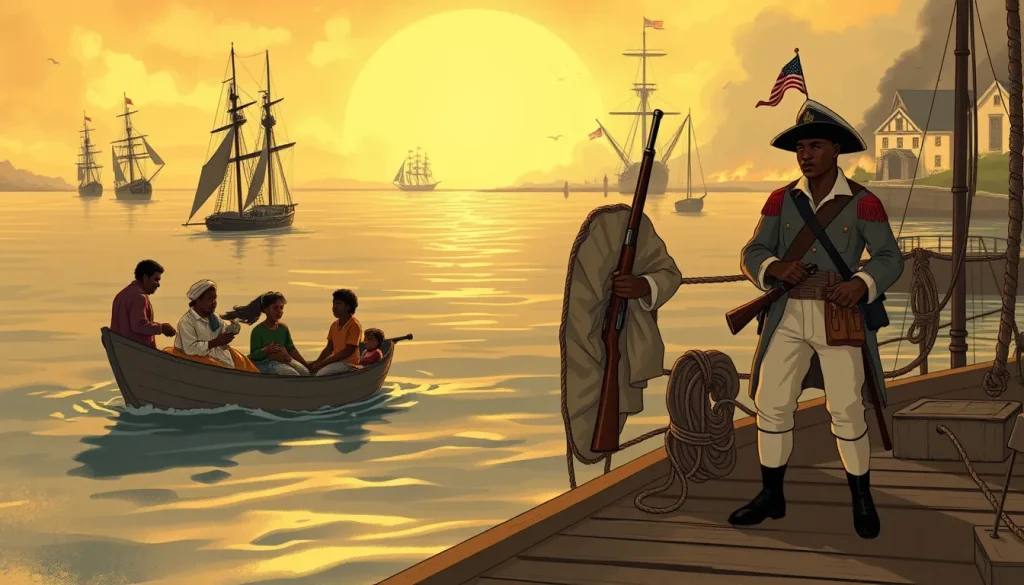
That chance cut in two directions. Thousands of free and enslaved Black men served the United States—on warships and privateers, at forts and fortifications, in the ranks at New Orleans—fighting for a country that denied them citizenship. Thousands more made the opposite calculation. When British warships appeared off the Chesapeake and the Atlantic coast offering emancipation, somewhere between 3,000 and 5,000 enslaved men, women, and children escaped to Union Jack vessels in what historians now recognize as the largest wartime emancipation of enslaved Americans before the Civil War.
The result is one of the richest—and least remembered—chapters in African American history: a story of valor and betrayal, escape and resettlement, broken promises and enduring communities that stretch from Nova Scotia to Trinidad. This article explores how African Americans experienced the War of 1812, why their choices mattered, and how the conflict shaped the long struggle for Black freedom in America.
African America on the Eve of War
To understand Black participation in the war, start with the brutal arithmetic of 1812.
- The enslaved majority. Of the roughly 1.38 million African Americans counted in the 1810 census, about 1.19 million—nearly 87 percent—were enslaved, concentrated overwhelmingly in the South. The cotton economy was expanding, and with it the domestic slave trade that was tearing families from the Chesapeake and selling them southwest.
- A growing free population. About 186,000 Black Americans were free, most living in northern cities like Philadelphia, New York, and Boston, where gradual abolition laws had taken root. Free Black communities built churches, schools, mutual aid societies, and businesses—men like Philadelphia sailmaker James Forten, a Revolutionary War veteran, became prosperous and civically powerful.
- Legal barriers to service. The federal Militia Act of 1792 limited militia service to “free able-bodied white male citizens.” The Army generally refused Black enlistment, and the Marine Corps barred Black men outright. The one major exception was the Navy, where pragmatic labor needs trumped racial ideology.
Race and war had already collided before 1812. One of the incidents that pushed the nations toward conflict—the 1807 Chesapeake–Leopard affair, in which a British warship attacked an American frigate and seized four sailors—directly involved Black Americans: three of the four men impressed were African American sailors. The impressment crisis that helped cause the war had a Black face from the start.
Black Americans in United States Service
The Integrated Navy
Ironically, the most racially integrated institution in the early republic was one of its most dangerous workplaces: the U.S. Navy. Sailing required skill, and skilled Black sailors were common in Atlantic maritime life. Desperate for crews, naval recruiters signed them on. Historians estimate that African Americans made up somewhere between 10 and 20 percent of U.S. naval crews during the war—an extraordinary figure in a nation that formally excluded Black men from most other branches of its military.
Black sailors also crewed the privateers that swarmed against British shipping. When captured, some ended up in Britain’s notorious Dartmoor Prison, where hundreds of Black American prisoners organized their own theatrical troupes and markets behind the walls.
The Battle of Lake Erie—and a Commander’s Change of Heart
The most famous example of Black naval service came on September 10, 1813, at the Battle of Lake Erie. Commodore Oliver Hazard Perry’s squadron included a substantial number of Black sailors—by some accounts, a quarter of his men. Perry had initially complained about the men sent to him. His superior, Commodore Isaac Chauncey, answered with one of the war’s most striking statements: he had “yet to learn that the color of the skin, or the cut and trimmings of the coat, can affect a man’s qualifications or usefulness.”
After his victory, Perry reversed himself, reporting that his Black sailors “seemed absolutely insensible to danger.” Men like Cyrus Tiffany, a Black sailor remembered for his courage in the battle, paid for that valor with their lives.
Bladensburg and the Defense of the Chesapeake
In August 1814, as British forces marched on Washington, the American army collapsed at Bladensburg, Maryland, in a rout mockingly called the “Bladensburg Races.” The one force that stood and fought was Commodore Joshua Barney’s flotilla—sailors and ship’s guns dragged ashore, including African American seamen. They held their ground until Barney was wounded and captured.
Among the Black sailors who described the battle was Charles Ball, an enslaved Marylander serving in the Navy, whose published narrative later gave readers a vivid first-person account of Black service—and of the absurdity of fighting for a nation that held him in bondage. When the British burned the Capitol and the White House days later, Maryland slaveholders feared what came next: not just invasion, but liberation.
A month later, at the defense of Baltimore in September 1814, an escaped slave named Frederick Hall, serving under the alias William Williams in the 38th U.S. Infantry, was mortally wounded defending Fort McHenry during the bombardment that inspired “The Star-Spangled Banner.” He died of his wounds—a man the nation refused to recognize as a citizen, dying in its defense. (In a grim irony, the anthem’s rarely sung third verse, with its taunt that “no refuge could save the hireling and slave,” is often read by historians as Francis Scott Key swiping at the escaped slaves now fighting for the British.)
Volunteers for the Defense
When Washington burned, Philadelphia braced for attack—and its Black community answered. In September 1814, Black leaders including James Forten and the Reverend Richard Allen of Mother Bethel AME Church helped mobilize an estimated 2,500 Black volunteers who labored on the city’s defensive fortifications, continuing a tradition of Black civic-military contribution reaching back to the Revolution.
New Orleans: The Free Men of Color
The war’s final—and most celebrated—battle featured its most remarkable Black units. New Orleans possessed a large, proud community of free people of color, descendants of French and Spanish colonial traditions, swelled by refugees from the Haitian Revolution. When General Andrew Jackson arrived to defend the city in late 1814, short on men and options, he did something a Tennessee slaveholder rarely did: he publicly appealed to them.
In his September 1814 address to the free men of color of Louisiana, Jackson promised them the same pay, clothing, and bounty—160 acres of land—as white soldiers. Two battalions, together roughly 600 men, answered the call. One was led by Major Joseph Savary, a free man of color and veteran of Haiti’s revolutionary wars. A teenage free Black drummer, Jordan B. Noble, sounded the cadence in the ranks.
The battalions fought through the campaign, including the climactic Battle of New Orleans on January 8, 1815, where Jackson’s famously polyglot army—regulars, militia, free Black battalions, Choctaw warriors, and Jean Lafitte’s Baratarian pirates—shattered a veteran British force. Jackson afterward praised the Black troops’ conduct.
Then came the betrayal. The promises of equal treatment quietly evaporated; the Black veterans were denied their bounty lands, and only after decades of petitions did some veterans and heirs receive land warrants in the 1840s and 1850s. Many never did. It was a pattern that would repeat across American history: Black service demanded in crisis, Black reward denied in peace.
The Other Choice: Escape to the British
Britain’s Strategy and Cochrane’s Proclamation
The British understood something American slaveholders dreaded: slavery was the South’s weakness. Drawing on the precedent of Lord Dunmore’s 1775 emancipation offer in the Revolution, British commanders turned the institution against its owners.
On April 2, 1814, Vice Admiral Sir Alexander Cochrane issued a proclamation inviting all persons “disposed to emigrate” from the United States aboard British vessels, offering a choice: enlist in His Majesty’s forces, or be sent “as free settlers to the British possessions in North America or the West Indies.”
The proclamation had an earthly goal—recruiting laborers, pilots, and soldiers familiar with the coastline—but its effect was revolutionary word of mouth, passed from plantation to plantation down the waterways of the Chesapeake and the South.
The Corps of Colonial Marines
The most dramatic product of this policy was the Corps of Colonial Marines: escaped slaves trained and armed as British soldiers. The first corps took shape in 1814 on Tangier Island in the Chesapeake, where the British built Fort Albion as a base. Uniformed, disciplined, and fighting within sight of the shorelines where they had been enslaved, Black Marines joined British raids along the coast and stood picket duty against their former masters. A second corps formed on the Gulf coast as the British advanced on New Orleans.
The psychological impact was enormous. Here were men who had escaped bondage, returned in red coats with muskets—the slaveholding South’s greatest nightmare made flesh.
The Great Escape
The escapes came in waves:
- The Chesapeake, 1813–1814. As Admiral George Cockburn’s forces raided up and down the bay, enslaved people slipped away by canoe and on foot, often whole families together, rowing out under fire to British ships. Escaped men piloted raiding parties through waters they knew intimately. Historian Alan Taylor, in his landmark The Internal Enemy, estimates some 3,400 people escaped in the Chesapeake region alone.
- The Deep South, 1814–1815. When British forces occupied Cumberland Island, Georgia, during the New Orleans campaign, hundreds more fled Low Country plantations to British lines, even after the peace treaty had been signed—but before news of it arrived.
The British generally kept their promise. Despite pressure from American officials, British commanders refused to surrender people to whom they had pledged freedom, evacuating them instead to Canada, Bermuda, and the Caribbean.
“The Internal Enemy”
Southern slaveholders’ response revealed how deeply the war rattled the slave regime. Militia units meant to fight the British were diverted to patrol the enslaved. Planters wrote frantic letters about slave escapes; the phrase “internal enemy” entered slaveholder correspondence to describe their own captive laborers. The War of 1812 exposed, in front of the world, the contradiction at the heart of American liberty: a republic “fighting for freedom” while a fifth of its people lived in chains.
The Treaty of Ghent and the Battle Over the Refugees
When negotiators signed the Treaty of Ghent on December 24, 1814, slaveholders made sure slavery followed them to the peace table. Article I required each side to return captured territory “without causing any destruction or carrying away… any Slaves or other private property.”
The United States demanded the return—or the compensation—of the thousands who had escaped. Britain refused, arguing that those who had reached British protection under a proclamation of freedom could not be classified as property to be “carried away.” The dispute dragged on for years:
- The two nations submitted the question to the arbitration of Tsar Alexander I of Russia.
- In 1822, the Tsar ruled in favor of the American position: Britain owed compensation.
- Under a settlement finalized in 1826, Britain paid roughly $1.2 million to the United States—which was distributed to slaveholders as compensation for human beings the British government refused to return.
The refugees themselves were never given back. But the episode stands as one of the more telling transactions in the early republic’s history: the United States government secured cash for owners, not justice for the freed.
Freedom’s Aftermath: The Black Refugees
Nova Scotia and New Brunswick
Roughly 2,000 Black refugees reached the maritime colonies during and after the war, founding or swelling communities such as Preston (briefly home to the largest free Black settlement in British North America), Hammonds Plains, and Beechville near Halifax, and settlements in New Brunswick.
Freedom, they discovered, did not mean equality. Settlers received smaller, rockier lots than white Loyalists; wages were suppressed; discrimination was constant. The catastrophic “year without a summer” in 1816 made subsistence farming nearly impossible. In 1821, several hundred refugees abandoned Nova Scotia for a new start in Trinidad—part of a diaspora within a diaspora.
Trinidad’s “Merikins” and Bermuda
The Colonial Marines were settled by company in southern Trinidad in 1815–1816, in settlements still known as the Company Villages. Their descendants—the “Merikins”—became a distinct community whose American heritage survived in memory and tradition for generations. Other refugees passed through Bermuda, where some labored on the Royal Naval Dockyard before moving on.
The Negro Fort
The war’s most chilling aftermath came on the Apalachicola River in Spanish Florida. There, the British had built and armed a fort at Prospect Bluff; when they withdrew in 1815, they left it—along with artillery and supplies—to their Black allies, including Colonial Marines veterans. The “Negro Fort,” as Americans called it, became a beacon for escaped slaves from Georgia and a terror to slaveholders.
In July 1816, U.S. gunboats attacked. A heated cannonball struck the fort’s powder magazine, and the explosion killed the great majority of the roughly 300 people inside—men, women, and children—in one of the deadliest single moments of American military history. Survivors were executed or re-enslaved; others fled deeper into Seminole country, seeding the conflicts that became the Seminole Wars. American liberty and American slavery, again, fought on the same field.
The War’s Legacy for African Americans
The War of 1812 left a complicated inheritance for Black America:
- A demonstrated record of Black military valor. From Lake Erie to New Orleans, Black Americans had fought with distinction—ammunition abolitionists would later use. William Cooper Nell’s 1855 The Colored Patriots of the American Revolution extended its argument to 1812, insisting that Black loyalty to the nation demanded Black citizenship.
- A precedent for wartime emancipation. The flight of thousands of enslaved people to arms-bearing enemy lines prefigured the Civil War’s “contraband” policy and the mass enlistment of Black soldiers in the Union Army. The slaveholders’ “internal enemy” of 1814 became the Confederacy’s nightmare of 1863.
- A hardening of racial exclusion at home. Rather than rewarding Black service, the postwar nation contracted opportunity. The Army formally codified its exclusion of Black enlistees in 1820; states tightened restrictions on free Black movement, voting, and militia service. Louisiana’s storied free Black militia survived only until 1834.
- Fuel for the colonization movement. The growing, assertive free Black population—partially forged in the war—alarmed white elites and helped inspire the American Colonization Society (1816), which proposed removing free Black Americans to Africa. Most Black leaders, Forten among them, rejected it: America was their home; they had fought for it.
- Living descendant communities. The descendants of the refugees still shape the communities they built: historically Black towns in Nova Scotia like Preston, and the Merikin heritage of Trinidad’s Company Villages.
Timeline: African Americans in the War of 1812
| Date | Event |
|---|---|
| June 1812 | U.S. declares war on Britain; Black sailors serving throughout the U.S. Navy and on privateers |
| September 1813 | Battle of Lake Erie—Black sailors serve with distinction under Perry |
| April 2, 1814 | Admiral Cochrane’s proclamation offers freedom to escaped slaves |
| May 1814 | Corps of Colonial Marines formed at Tangier Island |
| August 1814 | Barney’s integrated flotilla fights at Bladensburg; Washington burned |
| September 1814 | Defense of Baltimore—William Williams mortally wounded at Fort McHenry; ~2,500 Black volunteers fortify Philadelphia |
| December 24, 1814 | Treaty of Ghent signed; dispute over escaped slaves begins |
| January 8, 1815 | Battle of New Orleans—two battalions of free men of color fight under Jackson |
| 1815–1816 | Black refugees resettled in Nova Scotia, New Brunswick, Bermuda, and Trinidad |
| July 1816 | U.S. forces destroy the “Negro Fort” on the Apalachicola |
| 1821 | Hundreds of Black refugees leave Nova Scotia for Trinidad |
| 1822–1826 | Slaveholders compensated (~$1.2 million) after arbitration; refugees remain free |
Key Figures at a Glance
- Charles Ball — Enslaved Marylander and U.S. Navy sailor whose memoirs provide a rare first-person Black account of the war, including Bladensburg.
- William Williams (Frederick Hall) — Escaped slave who enlisted in the Army under an alias and died of wounds suffered defending Fort McHenry.
- Joseph Savary — Free man of color and veteran of the Haitian Revolution who led a Black battalion in the New Orleans campaign.
- Jordan B. Noble — The teenage “Drummer Boy of New Orleans,” who went on to serve in later American wars.
- James Forten & Richard Allen — Philadelphia Black leaders who mobilized thousands of Black volunteers for the city’s 1814 defense.
- Admiral Alexander Cochrane — British commander whose 1814 proclamation triggered the war’s great wave of self-emancipation.
Frequently Asked Questions
Did African Americans fight in the War of 1812? Yes—on both sides. Thousands served the United States, especially in the Navy (an estimated 10–20 percent of crews) and in the free Black battalions at New Orleans. Thousands more escaped slavery to the British, some enlisting in the Corps of Colonial Marines.
Why did enslaved people escape to the British? Admiral Cochrane’s April 1814 proclamation offered them a choice between military service and resettlement as “free settlers” in British territory. For people in bondage, British ships represented the only realistic path to freedom—and slaveholders’ own “internal enemy” became a British military asset.
What were the Corps of Colonial Marines? British military units recruited from escaped American slaves, trained and armed alongside Royal Marines. The Chesapeake corps operated from Tangier Island; a Gulf corps formed during the New Orleans campaign. After the war, most were settled in Trinidad.
How many slaves escaped during the war? Estimates typically range from about 3,000 to 5,000 people—the largest emancipation event in American history before the Civil War. The Chesapeake alone accounted for over 3,000 escapes, by historian Alan Taylor’s estimate.
What happened to the Black refugees after the war? About 2,000 settled in Nova Scotia and New Brunswick (communities like Preston and Hammonds Plains); the Colonial Marines settled in Trinidad’s “Company Villages” as the Merikins. Britain refused to return them to slavery, instead paying the U.S. about $1.2 million in compensation, which went to slaveholders.
Did Black soldiers fight at the Battle of New Orleans? Yes. Two battalions of free men of color—roughly 600 men—fought under Andrew Jackson, who had promised them equal pay, clothing, and land bounties. The promises were largely broken; some veterans received their land only decades later.
How did the war shape later Black history? It established the recurring pattern of Black military service followed by denied rewards, pioneered wartime mass escape as a tool of emancipation, and foreshadowed the Civil War’s much larger alliance between Black freedom and federal arms.
Conclusion
The War of 1812 produced no Emancipation Proclamation, no constitutional amendments, no great turning point in Black Americans’ legal status. Andrew Jackson’s Black soldiers went home without their land; the free Black community faced tightening restrictions; the slaveholders got their compensation. Measured that way, the war changed little.
But measured by what Black Americans did—rather than what was done to them—the war was transformative. Thousands proved, in the nation’s own fleet and armies, that Black courage was not in question; only the nation’s willingness to reward it was. Thousands more proved something even more consequential to the slave regime: that enslaved people were not passive property but actors who would seize freedom the moment the opportunity rowed within reach. Fifty years before the Civil War, the War of 1812 previewed how American slavery would finally die—not by proclamation alone, but by the flight and fight of the enslaved themselves.
Further Reading
- Alan Taylor, The Internal Enemy: Slavery and War in Virginia, 1772–1832
- Gene Allen Smith, The Slaves’ Gamble: Choosing Sides in the War of 1812
- Harvey Amani Whitfield, Blacks on the Border: The Black Refugees in British North America, 1815–1860
- Donald R. Hickey, The War of 1812: A Forgotten Conflict
- William Cooper Nell, The Colored Patriots of the American Revolution (1855)

Leave a Reply