Short Answer
The action between the American sloop-of-war USS Hornet and the British brig-sloop HMS Peacock, fought off the mouth of the Demerara River (in present-day Guyana) on 24 February 1813, was a brief but decisive single-ship engagement of the War of 1812. Under Master Commandant James Lawrence, Hornet overwhelmed her British opponent in about fifteen minutes, so severely damaging Peacock that the British vessel sank shortly after surrendering. The victory reinforced the young U.S. Navy’s reputation for superior gunnery and became a celebrated event in American popular culture, even as Lawrence’s subsequent death at the Chesapeake–Shannon action coloured later memory.
Historical Context
By early 1813, the War of 1812 had produced several notable American naval triumphs, including Constitution’s victories over HMS Guerriere and HMS Java. These single-ship actions, though strategically limited, boosted American morale and challenged British naval supremacy. The Royal Navy responded by tightening its blockade of the American coast, but far-flung stations such as the South American and Caribbean stations still exposed British warships to isolated encounters. The Hornet was part of a small American squadron sent to cruise in the Atlantic and, if possible, the Pacific. After escorting the frigate Constitution to Brazil, Hornet operated independently, blockading the British sloop Bonne Citoyenne at Bahia and then moving north along the South American coast in search of prizes. This cruise set the stage for the encounter with Peacock off British Guiana.
What Happened
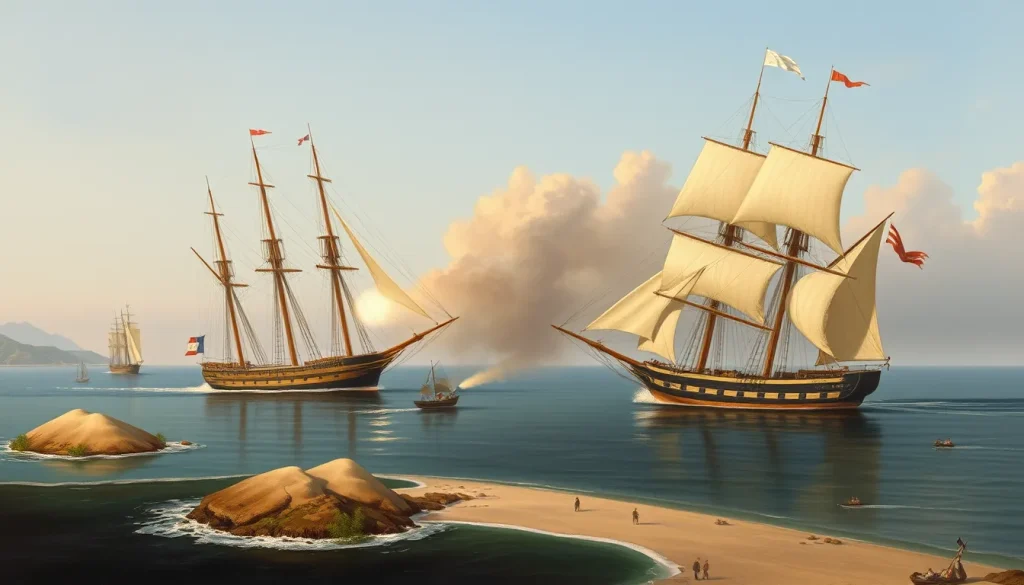
On 24 February 1813, Hornet, cruising off the Demerara River, sighted a British merchant brig and gave chase. As Lawrence worked around sandbanks to close in, he discovered two British warships: the brig-sloop HMS Espiegle anchored in the river and the approaching brig-sloop HMS Peacock. Though briefly caught between the two, Espiegle made no attempt to intervene, leaving Peacock to fight alone. At about 5:30 p.m., the two warships exchanged broadsides at close range—described as “half pistol shot.” Peacock’s fire went high, causing some casualties at Hornet’s mastheads, while Hornet’s gunnery riddled Peacock’s hull. Captain Peake was killed early in the action, and his first lieutenant surrendered after about fifteen minutes, at roughly 5:50 p.m. Peacock was sinking fast; despite efforts to save her, she went down in shallow water, taking with her several American prize crew members and British prisoners. Hornet, now overcrowded with survivors, sailed for the United States, arriving at Martha’s Vineyard on 19 March 1813.
Why It Matters
The Hornet–Peacock action demonstrated that American naval competence was not limited to heavy frigates but extended to smaller sloops of war. It provided another propaganda victory for the United States at a time when the war on land was going poorly. Lawrence was promoted to captain and given command of the frigate Chesapeake, where he was killed three months later in the infamous duel with HMS Shannon. The victory also highlighted training and preparedness: Peacock’s crew reportedly concentrated more on the ship’s appearance than on gunnery practice, in contrast to Hornet’s well-drilled gun crews. Historians generally view the engagement as a result of better American gunnery and ship handling rather than a significant strategic shift; the Royal Navy’s blockade remained intact. In the longer term, the action became part of the naval legend that influenced American naval policy and public memory of the war.
Prelude
On 26 October 1812, Hornet sailed from Boston in company with the frigate Constitution, intending to raid British commerce. After arriving off Salvador, Brazil, on 13 December, they found the British sloop Bonne Citoyenne anchored there, carrying a large amount of bullion. Bainbridge challenged her captain to fight Hornet, but the British captain declined, citing his valuable cargo. Constitution left Hornet to blockade Bonne Citoyenne and then defeated HMS Java on 29 December. When the British 74-gun ship HMS Montagu arrived on 24 January 1813, Hornet retreated into neutral Portuguese waters and slipped away at night, moving north along the coast. On 14 February, she captured the British packet Resolution with $20,000 in specie. After destroying the prize, Hornet cruised off Surinam and then stood for Demerara, where she encountered Peacock on 24 February.
Forces and Commanders
USS Hornet was a ship-sloop of about 450 tons, mounting eighteen 32-pounder carronades and two long 12-pounders, with a crew of roughly 162–165 men. Commanded by Master Commandant James Lawrence, Hornet was well maintained and its crew well trained in gunnery. HMS Peacock was a Cruizer-class brig-sloop of about 386 tons, typically armed with sixteen 24-pounder carronades and two long 6-pounders (some sources list eighteen 24-pounder carronades), with a crew of about 110–122 men. Her commander, Commander William Peake, had reportedly emphasized the ship’s polish and appearance over fighting efficiency. Although the two vessels were both rated as 18-gun sloops, Hornet carried heavier carronades (32-pounders vs. 24-pounders) and had a larger crew, giving her a significant advantage in firepower and boarding strength. The British ship’s gunnery was notably poor in the action, leading to its rapid defeat.
Battlefield and Map Context
The action took place off the mouth of the Demerara River, on the coast of what was then British Guiana (present-day Guyana). The area is characterized by mudbanks and shallow shoals, particularly the Caroband Bank, which restricted the movement of larger vessels. Hornet had to navigate around these banks to chase a merchant brig, which is how she encountered Peacock coming from seaward. The Espiegle was anchored inside the river and could observe the fight but did not participate, likely unable to leave its anchorage in time or unwilling to risk grounding. The water depth was shallow enough that after Peacock sank, her foremast remained above the surface, allowing several survivors to escape by climbing it.
Battle Chronology
~3:30 p.m. – Hornet sights Peacock on her weather quarter while beating around the Caroband Bank.
4:20 p.m. – Peacock hoists her colours.
5:10 p.m. – Hornet tacks and hoists her colours.
5:25 p.m. – The two ships pass each other on opposite tacks at half pistol shot, exchanging broadsides. Peacock’s fire goes high; Hornet’s fire smashes into Peacock’s hull.
~5:35 p.m. – Hornet wears and rakes Peacock from her starboard quarter; Peacock’s mainmast falls.
5:50 p.m. – Peacock strikes her colours and signals distress.
~6:00 p.m. – Peacock sinks in five and a half fathoms (about 33 feet) of water, despite rescue attempts.
19 March 1813 – Hornet reaches Martha’s Vineyard with the surviving prisoners.
Casualties and Losses
Casualty figures vary among contemporary sources and later accounts. Hornet reported one seaman killed and three or four wounded (one mortally). Peacock lost her commander, William Peake, and four or five seamen killed outright, with about thirty-three wounded (three mortally). Several men drowned when Peacock sank, including three Americans from the prize crew and nine British sailors. The naval historian William James recorded that Peacock’s “young and gallant commander” and four seamen were killed, with many wounded; he also noted that Hornet lost one killed and two lightly wounded, plus one mortally and one severely burned by a cartridge explosion. The discrepancy between 1 killed vs. 5 killed for the Americans arises from counting those who drowned during the sinking. In total, Peacock’s losses were about 17–20 killed (including drowned) and 33 wounded.
Result
Hornet won a decisive victory, forcing Peacock to surrender and sink within about fifteen minutes of opening fire. The American ship suffered minimal damage and casualties, while the British ship was completely wrecked. The action was a clear demonstration of superior gunnery, ship handling, and preparation.
Strategic Consequences
Strategically, the engagement had limited impact on the overall course of the war. The British maintained their blockade and continued to dominate the seas. However, the victory provided a morale boost to the United States and reinforced the reputation of the U.S. Navy as a professional and effective force. Lawrence’s subsequent promotion and transfer to Chesapeake led to his death at the action with Shannon, which overshadowed his earlier success. The sinking also prompted the Royal Navy to reevaluate the training and condition of its smaller vessels, though broader reforms were slow. In American memory, the battle became a symbol of naval prowess and contributed to the post-war expansion of the U.S. Navy.
Primary Accounts
The most detailed contemporary account came from James Lawrence’s official report, which was published in American newspapers. British officer William James provided an extensive account in his Naval History of Great Britain (1824), which included comparative force tables and a critical assessment of the action. Surviving British officers and crew of Peacock gave testimony about the conditions aboard, noting the crew’s inexperience and the ship’s poor gunnery. Amos Doolittle’s engraving “The Hornet and Peacock, or, John Bull in Distress” (published 27 March 1813) depicted the action and became a popular propaganda piece. These sources provide a multi-faceted view, though each has its own biases: American accounts celebrated the victory, while British accounts sought to explain the defeat.
Battlefield Today
The site of the action off the Demerara River is now part of the territorial waters of Guyana. No official memorial marks the engagement, and the exact location is not precisely known, though it lies in the waters off the current capital, Georgetown. The area is heavily silted and has shifted over two centuries, making any underwater archaeological work challenging. The site is not a designated heritage site, and no remains of Peacock have been located. The battle is commemorated in museum collections through paintings and engravings, such as those held by the U.S. Naval History and Heritage Command and the Yale University Art Gallery.
Primary Sources
Key contemporary documents include: (1) Captain James Lawrence’s despatch to the Secretary of the Navy, dated after his return to the United States, detailing the action and its casualties (available in American State Papers and Navy Department records, held by the U.S. National Archives); (2) William James’s Naval History of Great Britain (1824), which provides a detailed British perspective and a comparative table of the two ships; (3) surviving British officers’ reports, including correspondence from Lieutenant John M. T. (acting captain after Peake’s death) to the Admiralty, which lamented the poor gunnery; (4) contemporary American newspapers, such as the Boston Gazette and Niles’ Weekly Register, which reprinted Lawrence’s report and celebrated the victory; and (5) Amos Doolittle’s engraved print, which visually interpreted the event. All these sources carry the biases of their authors; Lawrence’s report emphasizes American efficiency, while James criticizes Peacock’s condition and personnel.
Further Reading
- Hickey, Donald R. The War of 1812: A Forgotten Conflict. University of Illinois Press, 1989.
- Lambert, Andrew. The Challenge: Britain Against America in the Naval War of 1812. Faber & Faber, 2012.
- Latimer, Jon. 1812: War with America. Harvard University Press, 2007.
- James, William. The Naval History of Great Britain: From the Declaration of War by France in 1793 to the Accession of George IV. Vol. 6, London, 1824.
- Toll, Ian W. Six Frigates: The Epic History of the Founding of the U.S. Navy. W.W. Norton, 2006.
References
- Rickard, J. “USS Hornet vs HMS Peacock, 24 February 1813.” History of War, 27 September 2011. https://www.historyofwar.org/articles/battles_hornet_peacock.html.
- Naval Historical Center. “USS Hornet sinks HMS Peacock, 24 February 1813.” Department of the Navy. https://www.ibiblio.org/hyperwar/OnlineLibrary/photos/events/war1812/atsea/hnt-peck.htm.
- “USS Hornet vs HMS Peacock – War of 1812.” The War of 1812. https://thewarof1812.org/battles/uss-hornet-vs-hms-peacock/.
- James, William. “USS Hornet engages HMS Peacock.” In The Naval History of Great Britain, vol. 6, London: Baldwin, Cradock & Joy, 1824. Accessed via 1812 Privateers. https://www.1812privateers.org/NAVAL/hornet.html.
- “Sinking of HMS Peacock.” Wikipedia. https://en.wikipedia.org/wiki/Sinking_of_HMS_Peacock.
FAQ
How did USS Hornet defeat HMS Peacock so quickly?
Hornet's superior gunnery and ship handling allowed her to deliver a devastating close-range broadside, followed by a raking fire that destroyed Peacock's hull and killed its captain within minutes.
Why didn't HMS Espiegle intervene in the battle?
Espiegle was anchored in the Demerara River and made no attempt to leave; her captain later claimed he was not aware of the action, though the battle was visible from his position.
What happened to James Lawrence after this victory?
Lawrence was promoted and given command of the frigate USS Chesapeake, where he was killed in action against HMS Shannon on 1 June 1813, uttering the famous words 'Don't give up the ship.'
Leave a Reply