

Short Answer
Indigenous alliances during the War of 1812 were a complex network of military and diplomatic relationships that profoundly influenced the course and outcome of the conflict across the Great Lakes, the St. Lawrence Valley, and the American South. Most Indigenous nations, including the Shawnee, Ojibwe, Odawa, Potawatomi, Mohawk, and many others, allied with Great Britain, while a smaller number—such as the Cherokee, Choctaw, and some Creek towns—sided with the United States. These alliances determined the fate of key battles, shaped the strategies of both British and American commanders, and had lasting consequences for Indigenous sovereignty and land rights.
Historical Context
After the American Revolution, the Treaty of Paris (1783) transferred vast lands west of the Ohio River to the United States, disregarding Indigenous territorial claims that had been recognized under the Royal Proclamation of 1763. U.S. expansionism and settler encroachment led to decades of conflict, including the Northwest Indian War, culminating in the Battle of Fallen Timbers (1794) and the Treaty of Greenville (1795), which ceded much of present-day Ohio. In response, Indigenous leaders sought to build pan-tribal confederacies to resist American expansion. The Shawnee brothers Tecumseh and Tenskwatawa (the Prophet) revived this effort in the early 1800s, establishing Prophetstown in present-day Indiana as a center for intertribal resistance. At the same time, British authorities, facing the Napoleonic Wars, recognized the strategic value of Indigenous alliances to defend Canada against potential American invasion. Tensions over impressment, trade restrictions, and British support for Indigenous resistance to U.S. expansion contributed to the American declaration of war on June 18, 1812.
What Happened
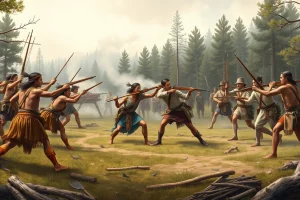
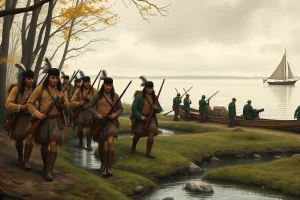
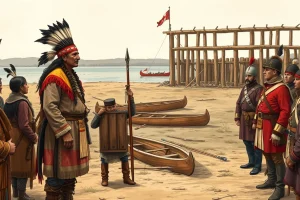
When war broke out, Indigenous warriors quickly became indispensable to British military efforts. On July 17, 1812, a force of about 400 Odawa, Ojibwe, Sioux, Menominee, and Winnebago warriors, along with Canadian voyageurs and regulars, captured Fort Michilimackinac, a key post commanding the Straits of Mackinac. This early victory encouraged more Indigenous peoples to join the British cause. In August, Tecumseh and over 600 warriors (Shawnee, Ojibwe, Odawa, and Potawatomi) accompanied Major General Isaac Brock to the siege of Detroit. Tecumseh’s strategic maneuvers and the threat of massive Indigenous reinforcements convinced American Brigadier General William Hull to surrender Fort Detroit on August 16 without a fight. The fall of Detroit opened the western frontier to raids and disrupted American plans to invade Canada.
Throughout 1813, Indigenous allies fought alongside British forces at key engagements. At Frenchtown (River Raisin) in January, a combined British and Indigenous force defeated American troops, leading to the massacre of wounded prisoners—a event that rallied Americans with the cry “Remember the River Raisin.” Tecumseh played a prominent role in the siege of Fort Meigs in April–May, reportedly saving American prisoners from execution. After the American naval victory on Lake Erie in September 1813, British forces under Major General Henry Procter withdrew eastward, despite Tecumseh’s urging to stand and fight. On October 5, 1813, at the Battle of the Thames, American forces under William Henry Harrison defeated the British and their Indigenous allies. Tecumseh was killed in the battle, and his confederacy collapsed.
In the southern theater, a civil war erupted within the Creek confederacy in 1813, pitting the militant “Red Sticks” against Creek towns that had accommodated American influence. The Red Sticks attacked Fort Mims in August 1813, prompting American reprisals. Tennessee militia under Andrew Jackson, aided by Cherokee, Choctaw, and friendly Creek allies, decisively defeated the Red Sticks at the Battle of Horseshoe Bend on March 27, 1814. In the Gulf theater, Choctaw warriors served with Jackson’s forces at the Battle of New Orleans in January 1815. Throughout the war, Indigenous peoples made strategic choices based on their own interests: many joined Britain to resist American expansion, while others allied with the United States in hopes of protecting their communities or settling rivalries.
Why It Matters
The Indigenous alliances were central to the military dynamics of the War of 1812. British forces, outnumbered and often short of regular soldiers, relied on Indigenous warriors for intelligence, skirmishing, and psychological intimidation. American commanders feared the reputed brutality of Indigenous warfare, which affected tactical decisions. The alliances also shaped the war’s outcome: British victories on the frontier often depended on Indigenous support, while the loss of Tecumseh and his confederacy at the Thames opened the Northwest to American control. In the South, the Creek War enabled the United States to exact massive land cessions at the Treaty of Fort Jackson in August 1814, even from Indigenous peoples who had fought on the American side. The war’s end brought the Treaty of Ghent (December 24, 1814), which largely restored pre-war boundaries but ignored Indigenous territorial claims. Britain’s abandonment of its Indigenous allies in the peace negotiations marked a turning point, as they lost British protection they had relied upon. Over the following decades, the United States forcibly removed most Indigenous nations east of the Mississippi, a process exemplified by the Indian Removal Act of 1830. Historians often interpret the War of 1812 as the last conflict in eastern North America in which Indigenous peoples could play a decisive role in shaping the future of the continent.
Definition
An Indigenous alliance during the War of 1812 refers to a formal or informal agreement between an Indigenous nation or coalition and either Great Britain or the United States to cooperate militarily and politically during the conflict. These alliances often included promises of trade goods, provisions, and arms from the European power, and in the British case, tacit or explicit support for Indigenous territorial claims. They were not monolithic; each nation made its own decisions based on local circumstances, historical relationships, and internal politics.
Background
The alliance system between Indigenous peoples and European colonial powers predated the United States. France and Britain both cultivated Indigenous partners for trade and war. After the British conquest of Canada in 1760, the Crown maintained the Covenant Chain with the Iroquois and other nations. The Royal Proclamation of 1763 recognized Indigenous lands and prohibited settlement without consent. The American Revolution disrupted this system, as the United States sought to expand. British Indian departments, such as the Indian Department in Upper Canada, worked to preserve alliances, distributing presents and organizing councils. By 1812, many Indigenous nations in the Great Lakes region looked to Britain as a counterweight to American expansion, even though they remembered British betrayal at the Treaty of Paris. The rise of Tecumseh’s confederacy offered a broader Indigenous political unity that resonated across the frontier.
How It Worked
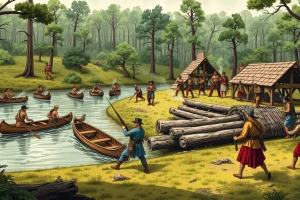
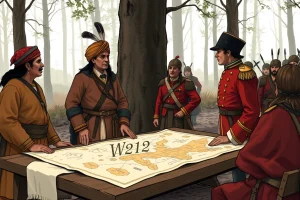
Indigenous alliances functioned through a mix of formal councils, treaty arrangements, and personal relationships. British commanders often negotiated with Indigenous war chiefs, offering trade goods, ammunition, and provisions as incentives. In return, Indigenous warriors provided reconnaissance, scouting, and light infantry support. They often operated autonomously, choosing when and how to engage. Communication was mediated by Indian Department officials and interpreters who spoke Indigenous languages. The British also relied on Indigenous knowledge of terrain, as well as their ability to strike fear into American soldiers and settlers. However, alliances were fragile: Indigenous leaders expected British support for their land claims, while British officers sometimes viewed Indigenous warriors as expendable. Tensions arose over strategy, especially when British forces withdrew or sought peace. The structure varied by region; in the South, alliances with American forces involved similar dynamics, with some Creek and Cherokee leaders supplying warriors to American campaigns.
Competing Viewpoints
Historians and contemporaries have interpreted these alliances differently. American narratives often portrayed Indigenous allies as “savages” or tools of the British, emphasizing massacres and atrocities, such as the River Raisin and Fort Dearborn incidents. British officials emphasized their role as protectors of Indigenous lands against American aggression, though some privately doubted the loyalty of their allies. Indigenous perspectives, as recorded in speeches like Tecumseh’s or those of Iroquois leaders, stressed their agency and the desire to defend their homelands. Modern scholarship, influenced by Indigenous studies, argues that Indigenous peoples were not passive pawns but active strategists who used alliances to pursue their own goals. The alliances’ outcomes—the failure to preserve a permanent Indigenous homeland—have led to competing interpretations: some see it as a tragic betrayal by Britain, others as a predictable result of colonial power politics.
Role in the War of 1812
Indigenous alliances were decisive in the northwestern theater. Tecumseh’s confederacy provided the military strength that allowed British forces to capture Detroit and hold the frontier in 1812. Indigenous allies also contributed to victories at Queenston Heights, Beaver Dams, and the defense of Lower Canada at Châteauguay and Crysler’s Farm in 1813–1814. In the South, the Creek War diverted American forces and resources, and allied Cherokee and Choctaw warriors aided Jackson’s campaigns. Without Indigenous support, the British would have been unable to mount a credible defense of Upper Canada, and American control of the Great Lakes region could have been established much earlier. The presence of Indigenous allies also affected American public opinion and morale, shaping the war’s political narrative.
Consequences and Historical Interpretation
The immediate consequences of Indigenous alliances were mixed. For the British, they provided a vital military advantage but also complicated peace negotiations. The Treaty of Ghent made no mention of Indigenous territories, and Britain abandoned its promise to secure an independent Indigenous state. For Indigenous peoples, the war ended with devastating losses: Tecumseh’s death fractured the confederacy, and the Treaty of Fort Jackson forced the Creeks to cede over 20 million acres. In the years after the war, the U.S. government sought to extinguish Indigenous land titles, leading to removal. Historians see the War of 1812 as a turning point because it marked the end of a period when Indigenous nations could influence the balance of power in eastern North America. The loss of British protection and the collapse of pan-tribal unity set the stage for the systematic dispossession of Indigenous lands in the 19th century. Yet, Indigenous resistance and adaptation during the war also demonstrated resilience and diplomatic skill, shaping modern Indigenous identities and historical memory.
Primary Sources
Key primary sources include British Indian Department records, which document alliances, councils, and provisions. Tecumseh’s speeches, recorded by British officers, reflect his vision of Indigenous unity. American military reports and correspondence, such as those from William Henry Harrison, detail the impact of Indigenous tactics. The Treaty of Ghent and the Treaty of Fort Jackson are crucial diplomatic documents. Indigenous oral traditions and later testimonies provide perspectives largely absent from official records. However, these sources are limited by translation biases, the loss of Indigenous voices, and the fact that most documents were produced by British or American officials. Researchers can access these materials at institutions like Library and Archives Canada, the National Archives (U.S.), and the British National Archives.
Further Reading
- Benn, Carl. The Iroquois in the War of 1812. University of Toronto Press, 1998.
- Edmunds, R. David. The Shawnee Prophet. University of Nebraska Press, 1983.
- Heidler, David S., and Jeanne T. Heidler. The War of 1812: A Forgotten Conflict. Johns Hopkins University Press, 2002.
- Sugden, John. Tecumseh: A Life. Henry Holt, 1998.
- Willig, Timothy D. “Restoring the Thin Red Line: British Policy and the Indians of the Great Lakes, 1783–1812.” PhD diss., University of Massachusetts Amherst, 2003.
References
- “First Nations and Métis Peoples in the War of 1812.” The Canadian Encyclopedia. https://thecanadianencyclopedia.ca/en/article/first-nations-in-the-war-of-1812.
- “Exhibit: Indigenous Contributions to the War of 1812.” Crown-Indigenous Relations and Northern Affairs Canada. https://www.rcaanc-cirnac.gc.ca/eng/1348771334472/1607906032957.
- Heidler, David S., and Jeanne T. Heidler. “Courting victory: British, Native and American alliances.” National Park Service. https://www.nps.gov/articles/courting-victory.htm.
- “Native American Involvement in the War of 1812.” American Battlefield Trust. https://www.battlefields.org/learn/articles/native-american-involvement-war-1812.
- Willig, Timothy D. “Restoring the Thin Red Line: British Policy and the Indians of the Great Lakes, 1783–1812.” University of Massachusetts Amherst, 2003. https://doi.org/10.7275/10753.
FAQ
Why did most Indigenous nations ally with the British during the War of 1812?
Many Indigenous nations in the Great Lakes region viewed the British as the lesser threat compared to American expansionism. The British had a history of recognizing Indigenous land rights under the Royal Proclamation of 1763 and offered trade goods and military support. Britain also promised to protect Indigenous territories, whereas American settlers and land speculators aggressively encroached on their lands.
Did any Indigenous peoples fight for the United States?
Yes. In the southern theater, the Cherokee, Choctaw, and some Creek towns allied with the United States, especially against the Red Stick faction of the Creek nation during the Creek War. These allies fought with Andrew Jackson and were later included in the forced removals.
What happened to Indigenous allies after the war ended?
The Treaty of Ghent in 1814 ignored Indigenous territorial claims, and Britain abandoned its allies, leaving them without support. The Treaty of Fort Jackson forced land cessions from the Creeks, and over the following decades the United States enacted policies of removal, such as the Indian Removal Act of 1830, that forcibly relocated most eastern Indigenous nations westward.
Leave a Reply