
Short Answer
The War of 1812 (1812–1815) pitted American forces against the British Empire, its Canadian colonial allies, and numerous Indigenous nations across the North American continent. The weapons employed during this conflict ranged from smoothbore flintlock muskets and rifles to field guns and naval ordnance, reflecting the military technology of the Napoleonic era. This article examines the firearms, edged weapons, and artillery used by all belligerents, their characteristics, and their impact on the war’s outcome.
Historical Context
By 1812, European and North American armies relied on flintlock ignition systems, which used a shard of flint to strike steel and produce sparks that ignited a priming charge. The standard infantry weapon was the smoothbore musket, capable of firing about two to three rounds per minute but with limited accuracy beyond seventy-five meters. Rifles, which featured spiral grooves in the barrel, offered greater accuracy but required more time to load and were more susceptible to fouling. The British Army had standardized on the .75-caliber Brown Bess musket, while the United States had begun domestic production of muskets at the Springfield and Harper’s Ferry armories, copying French designs. The War of 1812 occurred during a period of industrial expansion, allowing both nations to produce weapons in larger quantities, though many militiamen and Indigenous warriors carried older or captured arms.
What Happened
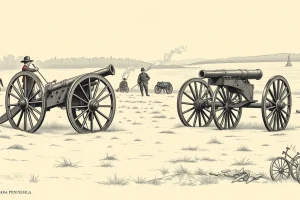
American regular infantry were typically armed with the Springfield Model 1795 musket, a .69-caliber smoothbore based on the French Charleville musket. This weapon was sturdy and reliable but suffered from a tendency for bullets to bounce within the barrel, reducing accuracy. American riflemen carried the Harper’s Ferry Model 1803 rifle, a .54-caliber flintlock that was accurate to 200 yards but lacked a bayonet and loaded slowly. Cavalry units were issued the Model 1805 pistol and Starr sabers, though few dragoons were actually engaged in the war. American artillery utilized 6-pounder and 12-pounder cannons, as well as howitzers, and the Columbiad, a heavy coastal gun.
British forces employed the Brown Bess musket, in both Long Land and India patterns, which was widely regarded as a reliable weapon. British riflemen used the Baker rifle, which had a shorter barrel but was accurate at ranges up to 300 yards. British officers and sergeants carried swords, such as the 1796 Light Cavalry Sabre and the 1803 Pattern infantry sword. The Royal Navy used a variety of guns, including long 18-pounders and 32-pounder carronades, which were heavy and effective at short range.
Canadian forces, comprising regular British units, Canadian militia, and Indigenous allies, used a mix of weapons. Indigenous warriors often used muskets, rifles, tomahawks, and war clubs, sometimes carrying trade guns supplied by the British. The Indian Department issued over 26,000 firearms to Indigenous allies between 1813 and 1816, including muskets, rifles, and decorated “chief’s guns.”
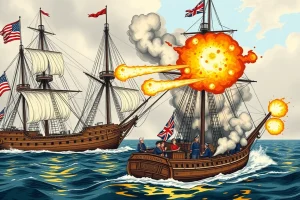
Naval engagements featured powerful broadsides from ship guns. The war also saw the use of the Congreve rocket, a British experimental weapon that, while unreliable, inspired fear and was used in the Bombardment of Fort McHenry.
Why It Matters
The weapons of the War of 1812 shaped battlefield tactics and outcomes. British regulars, well-drilled with muskets, demonstrated the power of disciplined volley fire, while American riflemen proved effective in skirmishing but vulnerable in close combat. The superiority of the British heavy frigates, such as HMS Shannon, over American frigates was partly due to their heavier armament and experienced crews. The conflict highlighted the need for standardized and more accurate firearms, spurring American investment in armory production and the later adoption of the percussion cap and rifled muskets. The war also underscored the importance of artillery in both land and naval operations, and it contributed to the mythic status of certain weapons, such as the “Kentucky rifle,” in American memory.
Definition
In the context of the War of 1812, weapons include all firearms, edged tools, and artillery used by the United States, Great Britain, its Canadian colonies, and Indigenous nations between 1812 and 1815. This includes muskets, rifles, pistols, swords, bayonets, tomahawks, and various cannons and naval guns.
Background
The flintlock was the predominant firing mechanism, introduced in France in the early 1600s. Smoothbore muskets were the standard infantry weapon because they could be loaded quickly and fitted with bayonets. Rifles were known but slower to load, making them suitable for specialized skirmishers and light infantry. Artillery pieces were classified by the weight of the ball they fired, with 6-pounders being common field guns. Naval artillery included long guns and carronades, the latter being short-range but devastating.
How It Worked
Flintlock weapons operated by using a piece of flint held in a cock that struck a steel frizzen, creating sparks to ignite gunpowder in a pan. The flame then traveled through a touchhole to ignite the main charge in the barrel. Loaded with a paper cartridge containing gunpowder and a lead ball, the process was straightforward. Muskets were smoothbore, rendering them accurate to about 50–100 yards, though massed volleys could be effective at longer ranges. Rifles had spiral grooves that spun the bullet, improving accuracy but increasing loading time and fouling, as the bullet had to be forced down the barrel.
Competing Viewpoints
Historians have debated the relative effectiveness of rifles versus muskets. Some point to the success of American riflemen at the Battle of New Orleans, while others note that British and American infantry primarily used muskets with bayonet charges. There is also discussion about the impact of British supply of firearms to Indigenous allies, with some arguing it enhanced their effectiveness, while others stress that traditional weapons like tomahawks remained important. Another area of contention is the role of artillery, with some claiming that the American use of heavier guns was decisive, while others emphasize the mobility of lighter British guns.
Role in the War of 1812
Land battles were dominated by infantry muskets and bayonets. The British relied on disciplined volley fire and steady lines, while American regulars and militia often used riflemen to harass British formations. Field artillery played a crucial role in sieges and in the defense of forts, such as at Fort McHenry. Naval combat was decided by the weight of broadsides; American frigates like USS Constitution (nicknamed “Old Ironsides”) had heavier guns and thicker hulls, enabling them to defeat several British warships. The war also saw the use of small gunboats on the lakes, armed with one or two guns.
Consequences and Historical Interpretation
The war demonstrated the need for standardized, interchangeable parts in American manufacturing, leading to reforms at Springfield and Harper’s Ferry. The failure of the Model 1812 musket, which never reached troops in quantity, prompted further development. The conflict also accelerated the adoption of rifled weapons, though it would take decades for them to become standard. Historians agree that the war, despite being largely inconclusive, stimulated American military and industrial growth. Weapons like the Brown Bess and the Springfield musket became symbols of the soldiers’ hardship and resilience.
Primary Sources
Contemporary documents on the weapons include British Board of Ordnance records, American Ordnance Department reports, and officers’ correspondence. The British “Exercise for the Use of the Firelock” (often called the “Drill Manual”) describes the handling of the Brown Bess. American sources include the “Instructions for Field Artillery” and the “Manual for Riflemen” written by officers. Letters from soldiers, such as those in The War of 1812 in the Old Northwest (edited by David Curtis Skaggs), describe the condition of weapons. These sources provide firsthand accounts, though they often reflect the biases of rank and nationality. Readers can consult the National Archives in Washington, D.C., Library and Archives Canada, and the British National Archives at Kew.
Further Reading
- Hickey, Donald R. The War of 1812: A Short History. University of Illinois Press, 2012.
- Benn, Carl. The War of 1812. Osprey Publishing, 2002.
- Elting, John R. Amateurs to Arms: A Military History of the War of 1812. Da Capo Press, 1991.
- “Arms and the Men of the War of 1812.” The Canadian Encyclopedia, accessed 2025.
References
- Wikipedia contributors. “List of War of 1812 weapons.” Wikipedia, last modified 2025. https://en.wikipedia.org/wiki/List_of_War_of_1812_weapons
- “Equipment in the War of 1812.” American Battlefield Trust, 2024. https://www.battlefields.org/learn/articles/equipment-war-1812
- “Weapons of War of 1812.” War of 1812 Website (warof1812.ca). https://www.warof1812.ca/weapons.html
- Howell, Austin Gage. “Weapons in the War of 1812.” NCpedia, 2013. https://ncpedia.org/weapons-war-1812
FAQ
What was the most common musket used by American infantry?
The Springfield Model 1795, a .69-caliber smoothbore copied from the French Charleville, was the standard American musket.
How did rifles differ from muskets in the War of 1812?
Rifles had grooved barrels that spun the bullet, improving accuracy but slowing loading and preventing bayonet mounting. Muskets were smoothbore, faster to load, and could mount bayonets.
Did Indigenous forces use traditional weapons alongside firearms?
Yes, many Indigenous warriors used muskets and rifles supplied by both the British and Americans, while also relying on tomahawks, war clubs, and spears.



Leave a Reply