
Short Answer
Shipbuilding during the War of 1812 (1812–1815) was a defining element of the conflict, particularly on the Great Lakes and Lake Champlain, where both the United States and Great Britain raced to construct and maintain naval squadrons. Because the war’s inland campaigns depended on moving troops, supplies, and artillery across water, the ability to build or rebuild warships quickly and effectively often outweighed the size of standing navies. This article examines the principal shipbuilding centers, the people and methods involved, and how this industrial effort influenced the war’s outcome and its aftermath.
Historical Context
When the United States declared war on Great Britain in June 1812, the Royal Navy dominated the Atlantic, but the interior of North America presented a different set of challenges. The vast freshwater lakes of the St. Lawrence basin – Ontario, Erie, Champlain, and the Upper Lakes – offered highways for invasion and supply, but both sides lacked permanent naval forces there. The British had maintained small provincial marine vessels since the Seven Years’ War, but by 1812 many were aging and inadequately armed. The United States had no ships on the lakes at all. Geography dictated that any effective military operation in the northern frontier would require the construction of vessels capable of moving men and ordnance, and the war quickly became a shipbuilding race.
Neither side possessed established yards or infrastructure suitable for large-scale naval construction in the wilderness. Materials such as timber, iron, rope, and sails had to be transported overland, often from distant ports. Skilled shipwrights were scarce, and the working season was short. Yet the strategic importance of the lakes – especially Lake Ontario and Lake Erie – made shipbuilding a central part of the conflict’s planning. Both nations invested heavily in new construction, with the American effort directed by Secretary of the Navy Paul Hamilton and later William Jones, and the British effort led by Admiral Sir John Borlase Warren and his successors.
What Happened
The American response began in late 1812 under Captain Isaac Chauncey, who was assigned command of naval forces on Lakes Ontario and Erie. Chauncey established a major yard at Sackets Harbor on Lake Ontario, which became the principal base for American vessels on that lake. Simultaneously, on Lake Erie, the U.S. Navy contracted with local mariners and shipwrights, most notably Daniel Dobbins of Erie, Pennsylvania, and later New York shipbuilders Noah and Adam Brown. The Browns, self-taught but experienced in building privateers, brought a force of carpenters and innovative construction methods to Presque Isle (present-day Erie) in early 1813. They built the brigs Lawrence and Niagara, along with several gunboats and smaller craft, in a matter of months. By August 1813, Commodore Oliver Hazard Perry had a squadron that defeated the British at the Battle of Lake Erie, a victory that secured the lake and greatly strengthened the American position.
On Lake Ontario, Chauncey’s ships and those built at Sackets Harbor engaged the British, who maintained a yard at Kingston and another at York (Toronto). The shipbuilding race on Lake Ontario escalated through 1814, with both sides launching larger vessels, including frigates and eventually ships of the line. The American side laid down two 74-gun ships of the line, the New Orleans and Chippewa, at Sackets Harbor and Storrs Harbor, respectively, but they were never completed and launched. The British also began large vessels, and by 1814 the lake fleets had become formidable. However, the strategic situation changed with the collapse of the British naval advantage and the failure of the American campaign on the Niagara frontier.
On Lake Champlain, the United States built a small fleet at Whitehall and Vergennes that proved decisive in September 1814 when Lieutenant Thomas Macdonough defeated a British squadron at Plattsburgh Bay. This victory helped end the invasion threat. In 1814, the U.S. Navy also launched the Independence, a 74-gun ship of the line, but it arrived too late to play a major role.
Why It Matters
Shipbuilding determined control of the inland waterways, which in turn influenced the success or failure of military campaigns. The American victories on Lake Erie and Lake Champlain prevented British offensives and boosted American morale. Conversely, the British maintained a naval advantage on Lake Ontario for much of the conflict, which limited American operations in Upper Canada. The shipbuilding effort also had significant economic and social consequences, including the growth of ports such as Sackets Harbor, Erie, and Kingston, and the employment of skilled craftsmen and laborers. Ultimately, the postwar disarmament of the Great Lakes, formalized in the Rush-Bagot Agreement of 1817, reflected both the exhaustion of the naval race and the recognition that maintaining standing naval forces on the lakes was impractical. Historians disagree on whether the war’s shipbuilding permanently transformed ship design; some argue that the innovations were temporary, while others point to lasting influences on construction techniques and shipbuilders’ careers.
Definition
Shipbuilding during the War of 1812 refers to the construction and repair of naval vessels, both combatant warships and support craft, by the United States, Great Britain, and colonial forces for operations on the Great Lakes, Lake Champlain, and other inland waterways. This effort involved designing, framing, planking, rigging, arming, and launching ships, often under extreme time pressure and in remote locations with limited supplies.
Background
Before the war, the Great Lakes had seen little naval construction since the British and French conflicts of the eighteenth century. The Royal Navy maintained a small provincial marine, but it was not a priority. The American government had no standing fleet on the lakes. The outbreak of war required immediate naval capability. Both sides had to start from scratch, facing similar challenges: timber was abundant but unskilled labor was not; iron, rope, and canvas had to be imported; and the short ice-free season limited construction windows.
How It Worked
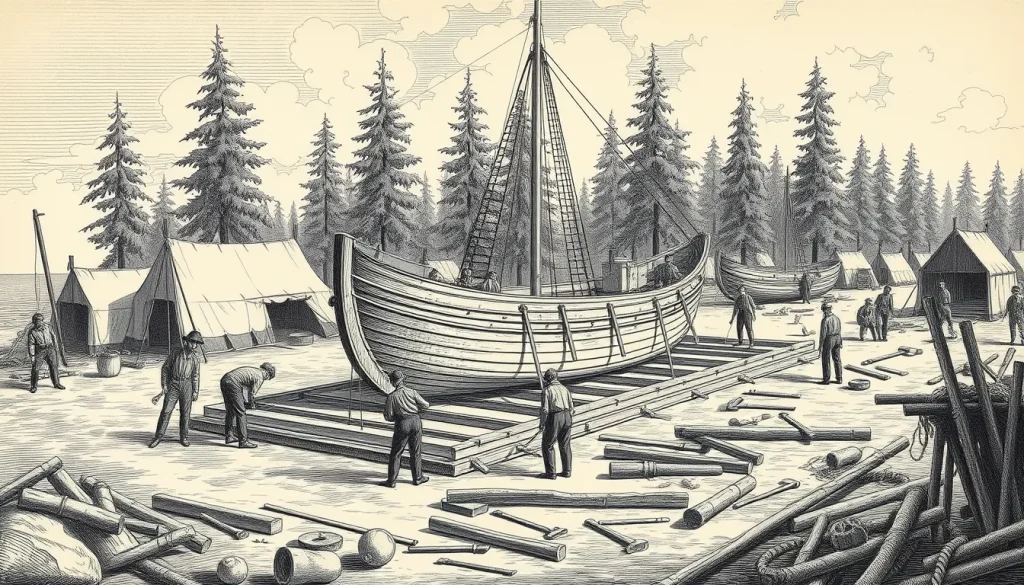
The construction process in 1812–1815 differed from European shipbuilding of the era in its expediency. Shipwrights used locally felled oak, pine, and cedar; iron fastenings were often hand-wrought and sometimes replaced with wooden pegs. Prefabrication was not used, but standardized designs and simple hull forms helped speed work. Noah Brown, for example, arrived at Presque Isle with a team of carpenters and immediately laid keels for two brigs, using patterns and a system of rapid assembly. Labor was recruited from the local population and from shipyards on the U.S. coast. The shipyards were sometimes little more than open camps, with sawpits, forges, and launching ways built from trees. On Lake Ontario, Sackets Harbor grew into a substantial naval base with storehouses, barracks, and a ropewalk (a facility for making rope).
Armament was a major problem. Guns and gun carriages were transported overland from coastal cities. For Lake Erie, cannons from the Philadelphia and Pittsburgh areas had to be hauled across the Appalachian plateau. Crews were often mixed: regular navy sailors, militia, and even soldiers. The ships themselves were designed to be shallower than ocean-going equivalents, as the lakes were relatively shallow and harbors had sandbars.
Competing Viewpoints
Historians have debated whether the War of 1812 introduced fundamental changes in ship construction. Some contend that the war’s pressures led to innovations in hull design, particularly the development of fast, heavily armed brigs like the Niagara and Lawrence. Others argue that the designs were essentially adaptations of existing merchant-ship types, and that the war did not create a permanent shift in shipbuilding techniques. Archaeological studies, such as the examination of the Navy Bay Wreck at Kingston and the analysis of warship remains from the period, have yielded evidence of traditional construction methods that persisted after the war. The Kopp thesis (2012) concludes that the war had only a minor impact on ship construction techniques, and did not revolutionize Great Lakes shipbuilding.
Another point of contention is the effectiveness of the respective shipbuilding efforts. American historians often emphasize the rapidity and success of the U.S. program, pointing to victories at Lake Erie and Lake Champlain. British historians and Canadian scholars note that the British built their fleet with considerable skill, but faced greater logistical challenges and ultimately could not match the American industrial capacity. The 1814–15 escalation to ships of the line on Lake Ontario was seen by some as a wasteful arms race, while others argue it was a rational strategic necessity.
Role in the War of 1812
Shipbuilding directly shaped the course of the war. The American fleet built at Presque Isle enabled Perry’s victory at the Battle of Lake Erie (September 10, 1813), which isolated British forces in Upper Canada and opened the way for recapture of Detroit. The British defeat forced a retreat to Lake Ontario, but British shipbuilding at Kingston maintained enough strength to contest control of that lake. The American victory on Lake Champlain in 1814, achieved with ships built largely at Vergennes, prevented a British invasion from Canada and contributed to the peace negotiations. The shipbuilding race on Lake Ontario, where both sides constructed frigate-class vessels and even larger ships, never produced a decisive engagement, but it consumed enormous resources on both sides.
Consequences and Historical Interpretation
The postwar fate of these warships was varied. Some, like the Niagara, were kept in service and eventually scuttled or rebuilt; others, such as the New Orleans and Chippewa, remained on the stocks for decades and were never completed. The Rush-Bagot Agreement of 1817 limited naval armaments on the Great Lakes, effectively ending the naval race and demilitarizing the border. The shipbuilders and workers who had participated in the war’s construction programs often returned to mercantile shipping, and some of the techniques used during the war influenced later Great Lakes vessels. Historians now view the shipbuilding effort as a key factor in the war’s outcome, but they continue to debate how much it transformed the shipbuilding industry and whether the lessons were retained.
Primary Sources
The most accessible collection of primary documents is The Naval War of 1812: A Documentary History, edited by William S. Dudley and others, which publishes official reports, letters, and orders from both American and British naval commanders. Key documents include Commodore Isaac Chauncey’s correspondence with Secretary of the Navy William Jones, detailing shipbuilding progress on Lakes Ontario and Erie; Oliver Hazard Perry’s dispatch after the Battle of Lake Erie, reporting the victory; and Daniel Dobbins’s reports on construction at Erie. These sources are indispensable for understanding the logistical and strategic constraints. Limitations include the absence of many lower-level records and the biases of the official reports, which often emphasize successes.
Further Reading
- Dudley, William S., et al., eds. The Naval War of 1812: A Documentary History, Vol. 2. Washington, D.C.: Naval Historical Center, 1992.
- Kopp, Nadine. “The Influence of the War of 1812 on Great Lakes Shipbuilding.” Master’s thesis, East Carolina University, 2012.
- Prom, William J. “The Brothers Brown.” Naval History Magazine 36, no. 1 (February 2022).
- Maloney, William. History of the Great Lakes, Volume I. Toronto: 1899.
- Gibson, Gary M. “The New Orleans Class Ships of the Line: A Design and Construction History.” The Napoleon Series, 2015.
References
- Dudley, William S., et al., eds. The Naval War of 1812: A Documentary History, Vol. 2. Washington, D.C.: Naval Historical Center, 1992. PDF.
- Kopp, Nadine. “The Influence of the War of 1812 on Great Lakes Shipbuilding.” Master’s thesis, East Carolina University, 2012. Repository link.
- History of the Great Lakes, Volume I. Toronto: 1899. Online edition.
- Gibson, Gary M. “The New Orleans Class Ships of the Line: A Design and Construction History.” The Napoleon Series, 2015. PDF.
- Prom, William J. “The Brothers Brown.” Naval History Magazine 36, no. 1 (February 2022). USNI link.
FAQ
Why was shipbuilding so important during the War of 1812?
Control of the Great Lakes and Lake Champlain was essential for military operations and supply lines. Both sides needed fleets to transport troops and to challenge enemy control, so rapid shipbuilding was critical to strategic success.
Where did the main shipyards operate?
Key American yards included Sackets Harbor (Lake Ontario), Presque Isle/Erie (Lake Erie), and Vergennes (Lake Champlain). British yards were at Kingston and York on Lake Ontario, and at Pointe-au-Père on Lake Champlain.
What were the shipbuilding challenges?
Builders faced scarcity of skilled labor, iron, rope, sails, and gunpowder, which had to be hauled overland. Remote locations and short construction seasons also limited progress.
Did the war lead to a permanent shift in shipbuilding?
Historians debate this. Some argue that wartime techniques influenced later Great Lakes shipping, while others see minimal lasting impact. The Rush-Bagot Agreement reduced military naval construction, but merchant shipbuilding continued to evolve.


Leave a Reply