Short Answer
Political cartoons of the War of 1812 are visual satires produced during the conflict (1812–1815) primarily in the United States and Britain. These prints used caricature and allegory to comment on military events, political decisions, and national identity. They are historically significant because they provide contemporary insight into wartime opinion, propaganda, and the development of American political cartooning.
Historical Context
The War of 1812 was triggered by British maritime policies, impressment of American sailors, trade restrictions related to the Napoleonic Wars, and tensions over British support for Indigenous resistance in the Northwest. The young United States faced a powerful British Empire, and the conflict became a test of national sovereignty. Political caricature had flourished in Britain through artists like James Gillray and Thomas Rowlandson, while the American print market was still emerging. The war provided a rich subject for graphic satire, as both sides sought to influence public opinion.
What Happened
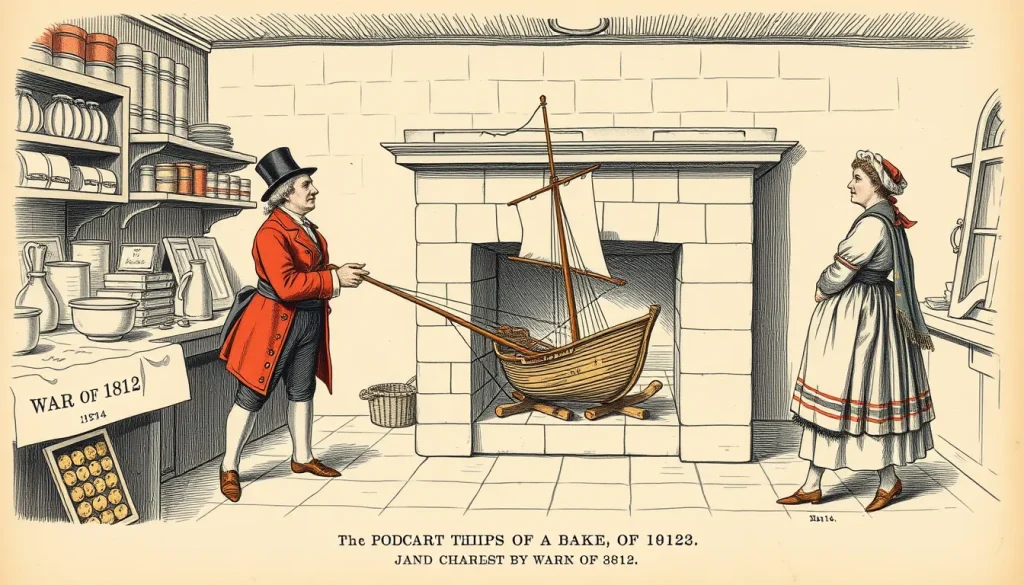
American political cartooning began in earnest with William Charles (1776–1820), a Scottish immigrant who sold prints in New York and later Philadelphia. His 1813–1814 output included Bruin Become Mediator or Negotiation for Peace, John Bull and the Alexandrians, The Hartford Convention or Leap or No Leap, and John Bull Making a New Batch of Ships to Send to the Lakes. These hand-colored etchings mocked British King George III, General Robert Ross, and Admiral George Cockburn, while celebrating American heroes such as Oliver Hazard Perry and Thomas Macdonough. British caricaturists like William Elmes also produced prints, including The Yankey Torpedo (1813), which ridiculed American naval tactics. The cartoons were sold in print shops, displayed in windows, and circulated widely, reaching audiences that included both the literate elite and the broader public.
Why It Matters
The cartoons mattered immediately because they boosted American morale during a war with many setbacks, such as the burning of Washington in 1814. They helped crystallize nationalist sentiment and framed Federalist opposition as unpatriotic. Over time, they became primary sources for historians studying wartime culture, political discourse, and the evolution of graphic satire. They also influenced later cartoonists, establishing conventions that persisted in American political art.
Definition
Political cartoons are visual satires that use exaggeration, symbols, and allegory to comment on current events, political figures, or policies. During the War of 1812, they often personified nations (John Bull for Britain, Columbia for the United States) and used metaphor to simplify complex issues.
Background
Caricature and political prints had a long tradition in Europe. British artists like Gillray and Rowlandson perfected the form, and American printmakers adapted it to their own context. William Charles, who had emigrated from Scotland, brought British techniques to American subjects, filling a gap in the domestic market for satirical commentary. The war provided immediate material, and the demand for news and entertainment drove production.
How It Worked
Cartoonists created etched and hand-colored prints, sometimes with lengthy dialogue balloons or captions. They deployed recognizable symbolism: John Bull (stout, stubborn) represented Britain; Columbia (a female figure) stood for the United States; King George III appeared as a foolish baker or a beckoning monarch. Prints were published in series, such as Charles’s 1814 output, and sold in shops or by subscription. They were often displayed in public places, maximizing their audience.
Competing Viewpoints
American cartoons largely promoted a patriotic, pro-administration view, celebrating naval victories and condemning British aggression. British cartoons, by contrast, emphasized American weakness or the futility of the conflict, often mocking American ships and leaders. Some American prints also attacked domestic opponents: The Hartford Convention or Leap or No Leap accused New England Federalists of disloyalty and possible secession. Thus the medium was used both to unite citizens and to denounce internal dissent.
Role in the War of 1812
Cartoons served as a tool of propaganda and morale. American prints reinforced key narratives: the superiority of the U.S. Navy, the barbarity of British officers like Cockburn, and the treachery of Federalist traitors. They celebrated victories such as the Battle of Lake Erie and the defense of Baltimore. British cartoons countered with skepticism about American claims. The medium also helped shape public memory of turning points, such as the burning of Washington and the Treaty of Ghent.
Consequences and Historical Interpretation
The immediate consequence was a surge in American patriotic feeling and a demonization of political opposition. Cartoons contributed to the post-war “Era of Good Feelings” by channeling nationalist energy. Historians use these prints to understand public attitudes, propaganda techniques, and visual culture. Scholars argue that they both reflected and reinforced wartime identities, and that they borrowed heavily from British satire while creating a distinct American idiom.
Primary Sources
The most relevant primary sources are the cartoons themselves. William Charles’s prints, including John Bull Making a New Batch of Ships to Send to the Lakes and The Hartford Convention or Leap or No Leap, are held by the Library of Congress and other archives. These hand-colored etchings include captions and dialogue that reveal contemporary rhetoric. William Elmes’s The Yankey Torpedo (1813) represents the British perspective. These sources are biased by their creators’ national loyalties and intended audiences, but they offer direct evidence of wartime messaging.
Further Reading
- Reilly, Bernard F. American Political Prints, 1766–1876: A Catalog of the Collections in the Library of Congress. Boston: G.K. Hall, 1991.
- Lanmon, Lorraine Welling. William Charles: American Caricaturist. (Referenced in Library of Congress catalog.)
- “War of 1812.” America in Caricature. Lilly Library, Indiana University. Online exhibition.
- “Leap or No Leap.” Teaching American History. Source text and introduction.
References
- “The War of 1812 · America in Caricature.” Lilly Library Online Exhibitions. https://collections.libraries.indiana.edu/lilly/exhibitions/exhibits/show/america-in-caricature/war-of-1812
- “John Bull making a new batch of ships to send to the lakes / Charles, del et sculp.” Library of Congress. https://www.loc.gov/item/2002708986/
- “Leap or No Leap.” Teaching American History. https://teachingamericanhistory.org/document/leap-or-no-leap/
- “Baking a Batch of Ships.” Graphic Arts, Princeton University. https://www.princeton.edu/~graphicarts/2012/11/william_charles.html
FAQ
Who was the first American political cartoonist?
William Charles is often credited as the first American political cartoonist for his series of War of 1812 prints published in Philadelphia in 1814, though earlier satirical prints existed.
What did political cartoons typically depict during the War of 1812?
They depicted naval battles, British leaders like King George III and Admiral Cockburn, American heroes like Perry and Macdonough, and domestic political disputes such as the Hartford Convention.
How did British cartoons differ from American ones?
British cartoons often minimized American successes and mocked American abilities, while American cartoons celebrated victories and condemned British actions, fostering nationalist pride.



Leave a Reply