Short Answer
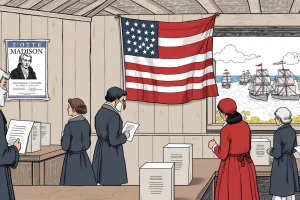
The 1812 United States presidential election, held from October 30 to December 2, 1812, took place just months after the United States declared war on Great Britain. Incumbent James Madison, the Democratic-Republican candidate, defeated DeWitt Clinton, a New York politician who united anti-war Republicans and many Federalists. This election was the first presidential contest during a major American war, and its outcome directly influenced the course of the War of 1812.
Historical Context
James Madison assumed the presidency in 1809 after a landslide victory, inheriting severe foreign policy challenges. British impressment of American sailors, restrictions on neutral trade, and violations of American sovereignty had strained Anglo-American relations throughout Jefferson’s administration. Madison initially pursued economic pressure through the Non-Intercourse Act and Macon’s Bill No. 2, but these measures failed to resolve the disputes. A rising faction of young Democratic-Republicans, known as War Hawks, demanded a more forceful response to British aggression. Led by Henry Clay of Kentucky and John C. Calhoun of South Carolina, they secured control of Congress in 1810 and pushed for military preparedness. In November 1811, Madison asked Congress to expand the army and navy. Under this pressure, he delivered a war message to Congress on June 1, 1812, and signed the declaration of war on June 18. The war was deeply divisive: New England and the mid-Atlantic states largely opposed it, while the South and West supported it. The presidential election of 1812 became an early test of public sentiment toward the conflict.
What Happened
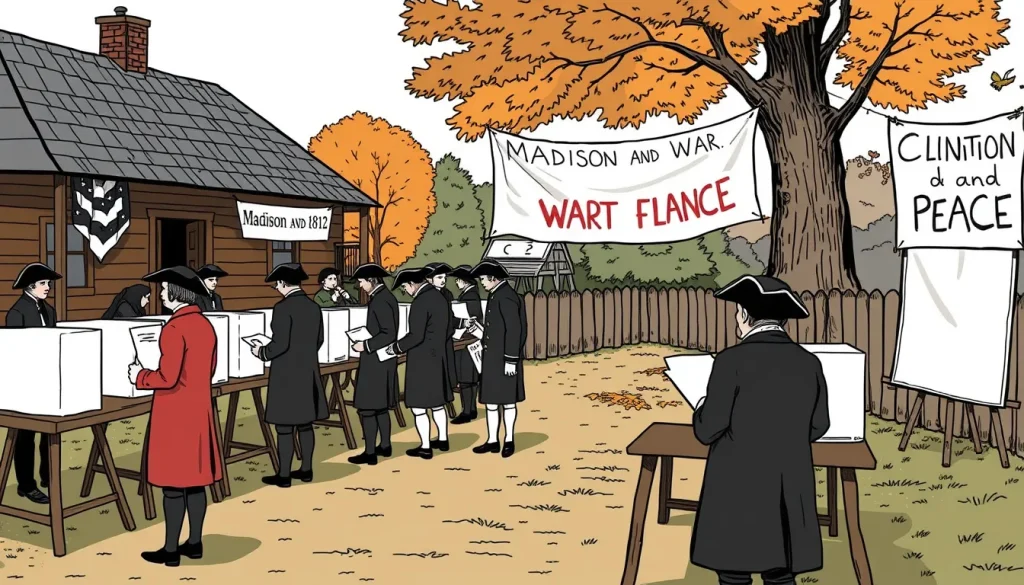
The Democratic-Republican congressional caucus renominated Madison in May 1812. With the death of Vice President George Clinton in April, the caucus chose Elbridge Gerry of Massachusetts as Madison’s running mate. The Federalist Party, weakened but still influential in New England, considered various candidates. A group of young Federalists meeting in New York in September favored supporting DeWitt Clinton, who was the lieutenant governor of New York and the nephew of the late vice president. Clinton, a Republican opposed to the war, sought to build a coalition of anti-war Republicans and Federalists. The Federalist Party eventually endorsed Clinton in several states while also running Vice President candidate Jared Ingersoll. However, a significant minority of Federalists, led by Rufus King of Massachusetts, preferred a separate Federalist ticket; King was placed on the ballot in only a few states. Clinton criticized Madison’s handling of the war to Republicans while emphasizing his opposition to the conflict when addressing Federalist audiences. The campaign was largely conducted through newspapers and legislative endorsements, as the candidates themselves rarely toured. The election results showed a sectional divide: Clinton carried New York, New Jersey, Delaware, most of New England, and parts of Maryland, while Madison swept the South, the West, and Pennsylvania. Madison received 128 electoral votes to Clinton’s 89, with King receiving none. The popular vote was about 52.3% for Madison, 45.4% for Clinton, and 2.1% for King. Madison’s victory was secured largely by the electoral votes of the new western states—Ohio, Tennessee, and Louisiana—which gave him the war they had demanded.
Why It Matters
The 1812 election set a precedent for holding regular presidential elections during wartime, affirming the constitutional process even amid national emergency. Madison’s victory allowed the United States to continue the War of 1812, though the conflict remained unpopular in many areas. The election demonstrated the deep sectional and partisan divisions in the country and revealed the Federalist Party’s inability to capitalize on anti-war sentiment. For historians, the election is a key lens for understanding early American political culture, the relationship between war and presidential power, and the fragility of the young republic’s party system.
Definition
The 1812 presidential election was the seventh quadrennial election in U.S. history, conducted between the declaration of war and the first major campaigns of the conflict. It was the first presidential election held while the United States was engaged in a significant foreign war, making it the nation’s first wartime election.
Background
By 1812, the Federalist Party had been in decline since the election of 1800, but it remained strong in New England and parts of the mid-Atlantic. The Democratic-Republican Party, though dominant, was factionalized. Madison’s initial conciliatory approach toward Britain had displeased War Hawks, while his eventual request for war alienated many commercial interests. The declaration of war, approved by Congress by the narrowest margin in American history (79–49 in the House, 19–13 in the Senate), reflected a deeply divided nation. This division shaped the electoral landscape.
How It Worked
In 1812, presidential electors were chosen by state legislatures in about half of the states, while the rest used popular votes. The Democratic-Republican candidate was selected by a congressional caucus, which was not a formal national nomination but a meeting of party congressmen. The Federalists, without a caucus, relied on informal meetings and state conventions. The electoral vote totals were determined by each state’s electors, who were pledged to specific candidates. The election process was thus heavily influenced by state-level politics and legislative maneuvering.
Competing Viewpoints
Contemporaries disagreed over whether the election was a clear referendum on the war. Federalists and anti-war Republicans argued that Madison’s narrow victory reflected widespread opposition to the conflict, while Republicans countered that his electoral majority represented public confidence. Historians have offered varying interpretations: some see the election as a victory for the pro-war faction, others emphasize the regional polarization and the role of the West in securing Madison’s reelection. Donald Zinman’s recent study argues that Madison’s victory was less precarious than previously believed, due to the weak coalition behind Clinton and the institutional advantages of the incumbency.
Role in the War of 1812
The election had direct consequences for the war effort. Madison’s reelection prevented a change of administration during a critical period, ensuring continuity in military and diplomatic decisions. It also galvanized opposition: in New England, Federalist governors refused to commit state militias to federal service, and the anti-war movement continued to mount. The election’s timing, just before the U.S. army’s disastrous campaigns along the Canadian border, meant that the war’s early setbacks were soon to dominate political discourse.
Consequences and Historical Interpretation
In the longer term, the election reinforced the two-party system even as it signaled the Federalists’ waning national strength. The Federalists made gains in the 1812 congressional elections, but their association with wartime obstruction contributed to their final collapse after the Hartford Convention in 1814–15. Madison’s second term saw the war conclude with the Treaty of Ghent in 1814, which many Americans treated as a victory despite its ambiguous terms. Historians interpret the 1812 election as a critical moment that affirmed the legitimacy of wartime elections and demonstrated the resilience of constitutional governance under duress.
Primary Sources
Key contemporary sources include President Madison’s letter to Thomas Jefferson, dated October 14, 1812, in which he described the election as the “experimentum crucis” for the popularity of the war. This letter, preserved in the Papers of James Madison, reveals his personal assessment of the stakes. Election returns and state-by-state vote tallies appear in contemporary newspapers, such as the National Intelligencer and the New York Evening Post. The writings of DeWitt Clinton, including his letters and speeches, and the correspondence of Federalist leaders like Rufus King and Harrison Gray Otis provide insights into the opposition’s strategy. These sources must be read critically, as newspapers were partisan and election returns sometimes incomplete.
Further Reading
- Zinman, Donald A. America’s First Wartime Election: James Madison, DeWitt Clinton, and the War of 1812. Lawrence: University Press of Kansas, 2024.
- Siry, Steven E. “The Presidential Election of 1812.” Master’s thesis, Morehead State University, 1980.
- Smelser, Marshall. The Democratic Republic, 1801–1815. New York: Harper & Row, 1968.
- Stagg, J. C. A. The War of 1812: Conflict for a Continent. Cambridge: Cambridge University Press, 2012.
- American Battlefield Trust. “The Election of 1812.” Accessed December 2024. https://www.battlefields.org/learn/articles/election-1812.
References
- Britannica, The Editors of Encyclopaedia. “United States presidential election of 1812.” Encyclopaedia Britannica. https://www.britannica.com/event/United-States-presidential-election-of-1812.
- American Battlefield Trust. “The Election of 1812.” https://www.battlefields.org/learn/articles/election-1812.
- Zinman, Donald A. America’s First Wartime Election. University Press of Kansas, 2024.
- Siry, Steven E. “The Presidential Election of 1812.” M.A. thesis, Morehead State University, 1980.
- “National Elections of 1812.” Encyclopedia.com. https://www.encyclopedia.com/history/news-wires-white-papers-and-books/national-elections-1812.
FAQ
How did the War of 1812 influence the 1812 presidential election?
The war was the dominant issue of the election. Incumbent James Madison ran on his decision to declare war against Great Britain, while his opponent DeWitt Clinton drew support from those who opposed the war or criticized Madison's conduct of it. The election effectively served as a referendum on the conflict.
Who were the main candidates in the 1812 election?
The main candidates were incumbent president James Madison, a Democratic-Republican, and DeWitt Clinton, a New York Republican who was supported by many anti-war Republicans and Federalists. A separate Federalist ticket with Rufus King as the presidential candidate appeared in a few states but won no electoral votes.
What was the outcome of the 1812 presidential election?
James Madison won re-election, receiving 128 electoral votes to DeWitt Clinton's 89. Madison's victory was secured by the support of the western states, which favored the war. The popular vote was close, with Madison winning about 52.3%.



Leave a Reply