

Short Answer
The Battle of Frenchman’s Creek (November 28, 1812) was a night action on the Niagara River in Upper Canada during the War of 1812. Following the American defeat at the Battle of Queenston Heights, Brigadier General Alexander Smyth planned a new invasion of Canada, but a preliminary raid to secure a landing site near Fort Erie was repulsed by British and Canadian forces. The failure ended American offensive operations on the Niagara frontier for the remainder of 1812 and solidified British defensive control of the region.
Historical Context
After the American defeat at Queenston Heights on October 13, 1812, command of the U.S. Army of the Centre on the Niagara Frontier passed from Major General Stephen Van Rensselaer to Brigadier General Alexander Smyth. Smyth, a Regular Army officer who had resented serving under a militia officer, immediately began planning a renewed invasion of Upper Canada from Buffalo and Black Rock. He assembled a force of over 4,000 troops, including regulars and militia, and issued a proclamation on November 10 promising to “plant the American standard in Canada.”
On the British side, Lieutenant General Sir George Prevost, Governor General of the Canadas, had forbidden offensive operations on the Niagara frontier, leaving local commanders to act defensively. The British and Canadian forces, under Lieutenant Colonel Cecil Bisshopp, were distributed among positions from Fort Erie to Chippawa, supported by the 41st and 49th Regiments of Foot, the Royal Newfoundland Regiment, local militia, and Indigenous allies.
What Happened
In the early hours of November 28, 1812, Smyth launched a two-pronged pre-dawn attack to prepare for a main crossing. One force under Captain William King, comprising about 150 soldiers and 70 U.S. Navy sailors, was to cross the Niagara and spike the British artillery batteries at the Red House, a position south of Fort Erie. Another force under Lieutenant Colonel Charles Boerstler, with about 200 men from the 14th U.S. Infantry, was to land north of Fort Erie and destroy the bridge over Frenchman’s Creek to prevent British reinforcements from approaching from Chippawa.
King’s force successfully crossed and overran the Red House batteries, spiking several guns. However, the detachment failed to destroy the bridge over Frenchman’s Creek, and British counterattacks under Bisshopp soon forced the Americans to retreat. A third American party, landed as a diversion, was also driven off. The fighting was confused and close-quarters, occurring in darkness across a narrow front. By daylight, the American raiders had re-embarked and crossed back to the American side, leaving the British in control of the field. The planned main invasion never materialized; Smyth’s army went into winter quarters shortly afterward.
Why It Matters
The Battle of Frenchman’s Creek, known to contemporary Americans as the “Affair opposite Black Rock,” was a defensive victory for the British and Canadian forces. It demonstrated the difficulty of executing a coordinated night crossing of a major river and the effectiveness of local British forces in defending the line. The failure crushed American expectations of a quick conquest of Upper Canada in 1812 and reinforced the strategic stalemate on the Niagara frontier. The site was designated a National Historic Site of Canada in 1921, commemorating the soldiers of both sides who fought there.
Prelude
Following the defeat at Queenston Heights, Smyth consolidated American forces in Buffalo and Black Rock and secured enough boats to embark an estimated 3,000 men for a main invasion. He ended an armistice on November 20 and planned a two-stage operation: a preliminary assault to neutralize British artillery and delay reinforcements, followed by a main crossing. On November 27, he issued final orders for the raids to begin before dawn the next day.
Forces and Commanders
American: Brigadier General Alexander Smyth commanded the overall operation. Captain William King led a force of 150 soldiers from the 12th and 13th U.S. Infantry plus 70 U.S. Navy sailors under Lieutenant Samuel Angus against the Red House. Lieutenant Colonel Charles Boerstler commanded approximately 200 men of the 14th U.S. Infantry against Frenchman’s Creek. Colonel William Winder remained in reserve with 350 men of the same regiment. Total American raiding forces numbered roughly 770, though sources vary.
British/Canadian: Lieutenant Colonel Cecil Bisshopp directed the defence. At Fort Erie were 80 men of the 49th Foot and 50 from the Royal Newfoundland Regiment. The Red House was held by 38 men of the 49th Foot and a small artillery detachment. Additional companies of the 41st Foot, the 5th Lincoln Militia, and other militia units were stationed along the river. The British also had support from Indigenous warriors, though their numbers are not precisely recorded.
Battlefield and Map Context
The action took place along the Niagara River in what is now Fort Erie, Ontario, Canada (then Upper Canada). The Red House was a fortified artillery position about two and a half miles south of Fort Erie on the road to Chippawa. Frenchman’s Creek is a small stream that enters the Niagara River north of Fort Erie. The bridge over this creek was a critical link for moving troops along the British shoreline. The battlefield lies on the west bank of the Niagara River, opposite Black Rock, New York. The modern town of Fort Erie encompasses the site.
Battle Chronology
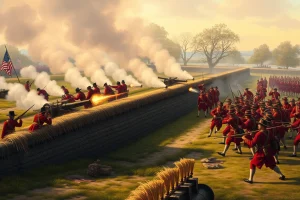
On November 28, 1812, between 2:00 and 4:00 a.m., American boats began crossing the Niagara. The Red House party under Captain King landed and attacked the British gun crews, driving them off and spiking the cannon. At the same time, Boerstler’s men landed near Frenchman’s Creek but failed to destroy the bridge due to heavy fire from British regulars and militia. As dawn broke, Bisshopp gathered available troops and launched a counterattack on the Red House, recapturing the position. The Americans, now under pressure from both the British infantry and artillery fire from across the river, began withdrawing to their boats. Many were captured during the re-embarkation, including Captain William King. By about 8:00 a.m., the last American boats departed.
Casualties and Losses
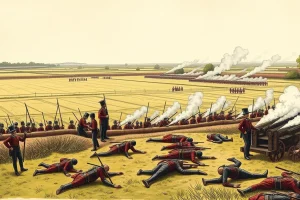
Casualty figures vary among contemporary and later accounts. The Wikipedia summary, drawing on official reports, gives British losses as 13 killed, 44 wounded, and 34 captured; American losses as 24 killed, 55 wounded, and 39 captured. Other sources, such as thewarof1812.org, report British losses of 5 killed, 19 wounded, and 35 missing, and American losses of 6 killed, 14 wounded, and 35 missing. The discrepancy reflects the chaos of night fighting and differing methods of accounting. Parks Canada states that the British action forced the American advance parties back and ended American hopes for the campaign.
Result
The Battle of Frenchman’s Creek was a clear British/Canadian defensive victory. The American raiding parties failed to destroy the bridge, failed to hold the Red House, and were compelled to retreat across the river. The main American invasion never commenced. The engagement ended the 1812 American offensive on the Niagara frontier.
Strategic Consequences
In the immediate aftermath, Smyth’s army remained encamped but did not attempt another crossing. On November 30 and December 1, Smyth again ordered troops to embark, but many refused, and the operation was postponed. The American commander was soon allowed to retire from active duty, and the Niagara frontier settled into winter quarters. The British maintained control of the Niagara River line and used the respite to reinforce their positions. The failure at Frenchman’s Creek, combined with the earlier defeat at Queenston, solidified British control of Upper Canada for the remainder of 1812.
Primary Accounts
Both sides produced official reports. American Brigadier General Smyth filed a report to the Secretary of War on the failed operation, detailing his plan and its outcome. British Lieutenant Colonel Bisshopp sent an official report to his superiors describing the defence. These documents, though biased by their authors’ perspectives, provide the basic narrative of the battle. Participant accounts and later compiled histories, such as those by J. Mackay Hitsman and Donald Hickey, offer additional detail but must be used critically.
Battlefield Today
The site of the Battle of Frenchman’s Creek is located within the town of Fort Erie, Ontario. A memorial commemorating the battle was erected and the area is now a National Historic Site of Canada. The original bridge over Frenchman’s Creek is gone, but the location remains identifiable. The Red House site is slightly south, near the old Fort Erie complex. The area is accessible to visitors, with interpretive markers placed by Parks Canada and local historical societies.
Primary Sources
Key primary sources include the official reports of Alexander Smyth (American) and Cecil Bisshopp (British) from late November 1812. These are available in contemporary published collections and archives. The correspondence of Lieutenant General George Prevost also sheds light on the British defensive strategy. American newspapers reported on the “Affair opposite Black Rock” shortly after the event. Each source reflects its author’s bias and must be evaluated for accuracy.
Further Reading
- Hitsman, J. Mackay. The Incredible War of 1812: A Military History. Revised by Donald E. Graves. Toronto: Robin Brass Studio, 1999.
- Hickey, Donald R. The War of 1812: A Forgotten Conflict. Urbana: University of Illinois Press, 1989.
- Malcomson, Robert. Historical Dictionary of the War of 1812. Lanham, MD: Scarecrow Press, 2006.
- Parks Canada. “Battle of Frenchman’s Creek National Historic Site.” Government of Canada.
- Canada’s History Society. “The Battle of Frenchman’s Creek.” Canada’s History, 2012.
References
- Canada’s History Society. “The Battle of Frenchman’s Creek.” Canada’s History, December 15, 2012. https://www.canadashistory.ca/explore/military-war/the-battle-of-frenchman-s-creek.
- Wikipedia contributors. “Battle of Frenchman’s Creek.” Wikipedia, The Free Encyclopedia. Accessed January 2024. https://en.wikipedia.org/wiki/Battle_of_Frenchman%27s_Creek.
- Rickard, J. “Skirmish of Frenchman’s Creek/ Red House, 28 November 1812.” History of War, November 22, 2007. https://www.historyofwar.org/articles/skirmish_frenchmans_creek.html.
- The War of 1812: A Guide. “Battle of Frenchman’s Creek.” Accessed January 2024. https://thewarof1812.org/battles/battle-of-frenchmans-creek/.
- Canada’s History Society. “The Battle of Frenchman’s Creek Transcript.” Accessed January 2024. https://www.canadashistory.ca/explore/military-war/the-battle-of-frenchman-s-creek/the-battle-of-frenchman-s-creek-transcript.
FAQ
What was the purpose of the American attack at Frenchman's Creek?
The raid was intended to destroy the bridge over Frenchman's Creek and spike British artillery at the Red House, to prepare a safe landing area for a larger invasion of Upper Canada.
Why is the Battle of Frenchman's Creek significant?
It ended the American offensive on the Niagara frontier for 1812 after their defeat at Queenston Heights, demonstrating British defensive strength and marking the close of the campaign.
Where is the battlefield located today?
The site is in Fort Erie, Ontario, Canada, and is designated a National Historic Site of Canada, with a memorial.



Leave a Reply