Short Answer
American politics during the War of 1812 revolved around a bitter partisan division between the ruling Democratic-Republican Party, which championed the war against Great Britain, and the Federalist Party, which denounced it as ruinous and unnecessary. This political conflict influenced military strategy, state cooperation, and the eventual peace settlement. The war also permanently weakened the Federalists and helped inaugurate the so-called Era of Good Feelings, marking a critical turning point in the evolution of the American party system.
Historical Context
Since the 1790s, American politics had been defined by the rivalry between the Federalists, who favored a strong central government and commercial ties with Britain, and the Democratic-Republicans, who championed states’ rights and agrarian interests, often looking to France. The Napoleonic Wars in Europe triggered British and French trade restrictions, including impressment of American sailors, which became central grievances for the Republicans. President Thomas Jefferson’s embargo (1807–1809) had crippled American commerce and especially hurt New England, fueling Federalist resentment. By 1811, a new generation of Republican congressmen—the war hawks—pressed for war to end British maritime depredations and to expand into Canada. The political divide over the war thus mirrored and intensified longstanding sectional and ideological fault lines.
What Happened
On June 18, 1812, President James Madison signed a declaration of war after Congress passed it largely along party lines. In the House, the vote was 79 to 49, with every Federalist voting against; in the Senate, it was 19 to 13, again almost strictly partisan. Federalists immediately condemned the conflict as “Mr. Madison’s War,” arguing that it would devastate trade and that the United States should ally with Britain against revolutionary France. Throughout the war, Federalist congressmen voted against war-related measures about 90 per cent of the time. They obstructed recruitment, opposed taxes and loans, and refused to cooperate with federal military requests. Notable instances included the governors of Connecticut, Rhode Island, and Massachusetts, all Federalists, who declined to furnish state militia for the invasion of Canada, citing constitutional limits.
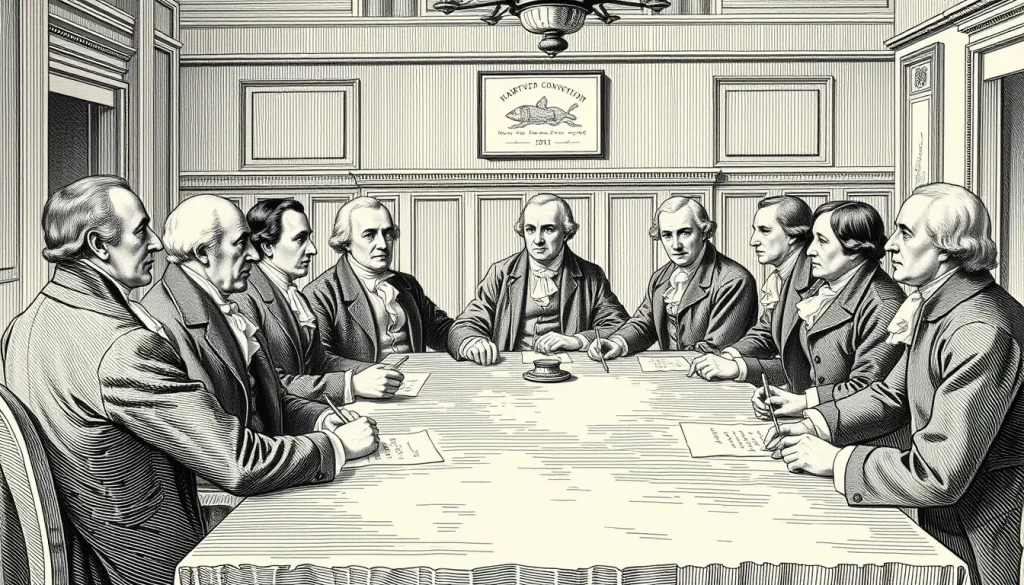
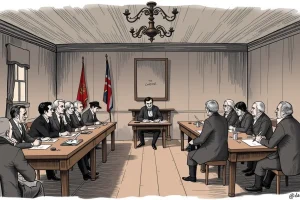
The Federalist opposition was most intense in New England, where the war disrupted commerce and British naval raids caused coastal destruction. In July 1812, riots against Federalist newspaper editors in Baltimore intensified the sense of partisan persecution. By 1814, with British forces occupying parts of Maine, New England Federalists grew desperate. In December 1814, delegates from five New England states met at Hartford, Connecticut, to discuss grievances and propose constitutional amendments designed to limit federal power and protect minority rights. Although no outright secessionist resolution passed, the convention’s moderate demands were overshadowed by rumors and accusations of treason. The war ended with the Treaty of Ghent in December 1814, which restored the status quo ante bellum. News of the treaty arrived in the United States after Andrew Jackson’s victory at New Orleans in January 1815, giving the war a victorious sheen that discredited the Federalists, who had opposed it.
Why It Matters
The political consequences of the War of 1812 were immediate and long-lasting. At the time, the war exacerbated regional tensions, nearly led to disunion, and strained the federal system. In the longer term, the war’s outcome—often interpreted as a second war of independence—fueled American nationalism and confidence. The Federalist Party, indelibly associated with disloyalty and obstruction, collapsed as a national force after 1815. The Democratic-Republicans, absorbing many former Federalists, moved toward a more moderate economic program, and the period of one-party politics known as the Era of Good Feelings began. Historians such as Donald Hickey have argued that Federalist opposition was not confined to New England but was widespread, revising older interpretations that viewed the war as a sectional conflict. The war also helped reshape the American political landscape, establishing a stronger precedent for executive leadership during wartime and influencing debates over the military and national identity.
Definition
In the context of the War of 1812, “American politics” refers to the domestic partisan struggle between the Democratic-Republican and Federalist parties over the declaration, conduct, and resolution of the war. It encompasses presidential leadership, congressional votes, gubernatorial refusals, newspaper propaganda, and the formation of protest conventions.
Background
The American party system emerged in the 1790s, with Federalists and Republicans disagreeing on the interpretation of the Constitution, foreign policy, and fiscal policy. The War of 1812 escalated these disputes to a crisis. The Republicans held the presidency and Congress, while Federalists remained strong in New England and parts of the Mid-Atlantic. The war’s economic impact and the perceived threat of invasion made politics particularly volatile.
How It Worked
The conduct of the war required congressional approval for funding, military mobilisation, and diplomatic initiatives. President Madison and his Republican allies in Congress, including Speaker Henry Clay, set strategy—especially the invasion of Canada. The Federalists, as the minority, used the institutional tools available to them: voting against measures, offering amendments, and using state governments to obstruct federal levies. They also used the press to shape public opinion, and they organised the Hartford Convention to demand constitutional changes.
Competing Viewpoints
Republicans argued that the war was necessary to defend American honour and neutral rights, and to end British support for Indian raids on the frontier. They viewed Federalists as pro-British and treacherous. Federalists contended that the war was a scheme by Madison to further Republican power, that it would ruin the economy, and that the real enemy was Napoleonic France, not Great Britain. Some Federalists even preferred secession to continued union under Republican leadership. There were also intra-party divisions: on the Republican side, John Randolph of Roanoke opposed the war as too costly; among Federalists, some, like those in the South, were less radical than New Englanders, though Donald Hickey argues that they also opposed the war.
Role in the War of 1812
American politics directly shaped the war’s course. Federalist governors withheld militia, hampering invasions of Canada. Opposition in Congress limited funding and led to reliance on privateers and loans. The political deadlock also delayed diplomacy and encouraged British expectations that America would fracture. The Hartford Convention’s demands, though moderate, came just before the peace treaty and were rendered irrelevant by the war’s end, yet they reinforced British perceptions of American weakness.
Consequences and Historical Interpretation
The war’s conclusion, perceived as a victory, discredited the Federalist opposition. The party never again seriously contested for the presidency. Historians have interpreted this period as one of consolidation in which the Republican Party absorbed Federalist economic policies, leading to a new consensus. Some historians, such as Donald Hickey, stress that Federalist extremism was not solely sectional, challenging older narratives. The War of 1812 thus stands as an early test of how a young republic could manage dissent during wartime, with lasting implications for American politics.
Primary Sources
Key primary sources include President James Madison’s war message to Congress (June 1, 1812), which enumerated grievances against Britain; the congressional debates recorded in the Annals of Congress; the reports of governors such as Caleb Strong of Massachusetts who refused militia requests; and the proceedings of the Hartford Convention (published in 1815). The John Henry letters, sold to Madison in 1812, purported to expose Federalist disloyalty but contained no verifiable evidence. Newspapers such as the Columbian Sentinel of Boston and the National Intelligencer of Washington documented partisan viewpoints. These sources are available in the National Archives, the Library of Congress, and state historical societies.
Further Reading
- Hickey, Donald R. The War of 1812: A Forgotten Conflict. University of Illinois Press, 1989.
- Burstin, Andrew, and Nancy Isenberg. “A Tale of Two Parties: Partisanship as ‘Seditious Opposition.’” National Park Service, 2021.
- Hickey, Donald R. “Federalist Party Unity and the War of 1812.” Journal of American Studies, vol. 12, no. 1, 1978, pp. 23–39.
- Mayhew, David R. “Wars and American Politics.” Perspectives on Politics, vol. 3, no. 3, 2005, pp. 473–493.
- Stagg, J.C.A. Mr. Madison’s War: Politics, Diplomacy, and Warfare in the Early American Republic, 1783–1830. Princeton University Press, 1983.
References
- Burstin, Andrew, and Nancy Isenberg. “A Tale of Two Parties: Partisanship as ‘Seditious Opposition.’” National Park Service, November 16, 2021. https://www.nps.gov/articles/tale-of-two-parties.htm.
- Hickey, Donald R. “Federalist Party Unity and the War of 1812.” Journal of American Studies, vol. 12, no. 1, 1978, pp. 23–39.
- “Federalists Oppose Madison’s War.” National Park Service, March 22, 2016. https://www.nps.gov/articles/federalist-opposition-to-the-war.htm.
- Mayhew, David R. “Wars and American Politics.” Perspectives on Politics, vol. 3, no. 3, Sept. 2005, pp. 473–493.
FAQ
Why did Federalists oppose the War of 1812?
Federalists believed the war was a partisan Republican scheme to expand power, feared economic ruin from disrupted trade, and considered France—not Britain—the greater threat. They also despised the invasion of Canada and preferred a limited naval conflict.
What was the Hartford Convention?
The Hartford Convention was a meeting of Federalist delegates from New England held in December 1814–January 1815 to address grievances about the war and proposed constitutional amendments to limit federal power. It was overshadowed by rumors of secession and ultimately discredited the Federalists.
How did the War of 1812 affect American party politics?
The war's perceived victory discredited the Federalists, leading to their decline and the rise of the Era of Good Feelings under the Democratic-Republican Party. The political debates also shaped future debates over federal power and sectionalism.



Leave a Reply