Contemporary Accounts of Fort McHenry
Explore the letters, official reports, newspapers, and naval logs that documented the September 1814 bombardment of Fort McHenry, offering American and British perspectives on a turning point in the War of 1812.

Primary sources from the era.
Explore the letters, official reports, newspapers, and naval logs that documented the September 1814 bombardment of Fort McHenry, offering American and British perspectives on a turning point in the War of 1812.
Albert Gallatin, the Swiss-born American Secretary of the Treasury, was the senior and most effective member of the U.S. delegation that negotiated the Treaty of Ghent, which ended the War of 1812. His diplomatic skill, patience, and willingness to compromise were decisive in achieving peace on terms of status quo ante bellum in December 1814.
The Andrew Jackson Papers at the Library of Congress form the largest archival collection documenting Andrew Jackson’s military career during the War of 1812, including his campaigns in the Creek War and the Gulf Coast, his orders and correspondence, and the Battle of New Orleans.
War of 1812 discharge certificates are official documents issued to regular U.S. Army soldiers upon their discharge from service between 1792 and 1815. These records, now preserved by the National Archives, provide essential details about soldiers’ service, compensation, and physical condition, and are a vital resource for genealogists and historians.
Military reports from the War of 1812 are official dispatches and letters that preserve commanders’ accounts of battles and campaigns, but they carry inherent biases and errors. Learning to read them critically—examining authorship, audience, and purpose—is essential for understanding the war’s history and avoiding misinterpretation.
The Treaty of Ghent restored the status quo ante bellum because neither the United States nor Britain had achieved its war aims, and both were eager for peace after a costly military stalemate. The treaty returned all conquered territory, left pre-war boundaries unchanged, and deliberately avoided the issues of impressment and neutral trade, which had faded as British wartime needs ended.
James Madison’s War Message to Congress, delivered on June 1, 1812, outlined British grievances including impressment, illegal blockades, and incitement of Indian warfare, and argued that Great Britain was already in a state of war against the United States, leading Congress to declare war on June 18, 1812.
During the War of 1812, both American and British/Canadian sides used newspapers, cartoons, proclamations, and rumors to shape public opinion and bolster morale. This propaganda influenced domestic politics, military recruitment, and the broader narrative of the conflict, leaving a lasting impact on freedom of the press.
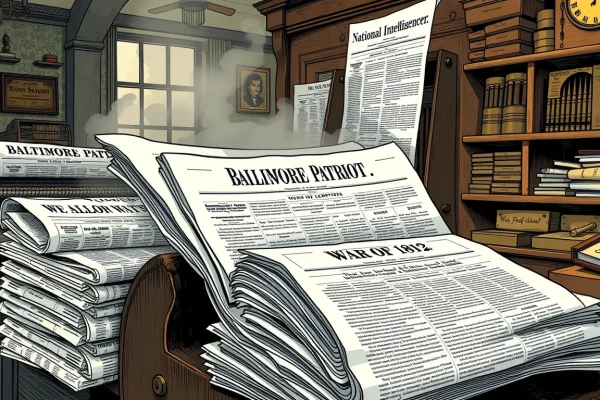
A research guide to contemporary newspapers from the War of 1812, covering their historical role, digitized collections, and how to use them as primary sources for studying the conflict.
Peace talks between the United States and Great Britain were held in Ghent, Belgium, in 1814 because it was a neutral city accessible to both delegations, and both sides sought an end to the costly War of 1812 after earlier mediation offers failed.