
Short Answer
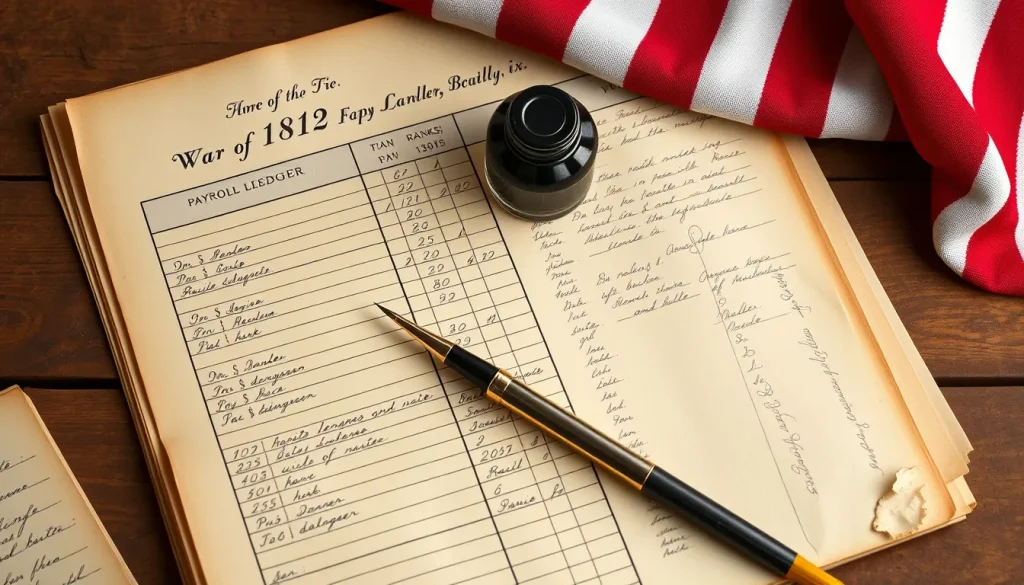
War of 1812 payroll records are official military documents that itemize the compensation owed to soldiers and militia members for their service during the conflict between the United States and Great Britain from 1812 to 1815. Created by paymasters and adjutant general offices, these records include soldiers’ names, ranks, periods of service, and amounts paid. They are a vital primary source for studying the war’s military administration and for tracing individual service, making them invaluable for genealogists and historians alike.
Historical Context
The War of 1812 required the mobilization of the United States Army, state militias, and volunteer units along the Canadian border, the Atlantic coast, and the Gulf Coast. Payrolls served both as financial accounts and as official evidence of military service. Because the national government relied heavily on state militias, state adjutant general offices and state-appointed paymasters played a central role in managing compensation. In New York, for example, Governor Daniel D. Tompkins appointed regional paymasters to distribute federal funds to militia regiments. These paymasters maintained detailed rolls for each unit, which were later transcribed and preserved. Similarly, Virginia’s Auditor of Public Accounts collected muster rolls and payrolls for militia companies to manage state expenditures and support claims for land bounties and pensions.
What Happened
The creation of payroll records occurred throughout the war as units were raised, served, and were discharged. In New York, the state Adjutant General’s Office compiled transcription of payrolls (Series B0811) from regional paymasters. These transcripts record payments to regiments of the New York State Militia, Volunteers, and Sea Fencibles (coastal defense units). Each payroll form included spaces for the captain’s name, colonel’s name, regiment, company’s home county, and station. Below that, columns listed each soldier’s name, rank, dates of appointment or enlistment, time engaged, amounts paid in lieu of clothing and travel, total paid, and remarks. Remarks often noted discharges, deaths, desertions, or pay stoppages. A companion series, B0810, consists of alphabetized payroll cards for individual soldiers, abstracted from the transcripts; each card gives the soldier’s name, rank, company, amount paid, dates, and references to the original payroll number.
In Virginia, the Auditor of Public Accounts retained muster rolls and payrolls from militia companies. These records (Accession APA 253a) include rolls for companies commanded by officers such as Captain Arthur Emmerson, whose artillery company fought at the Battle of Craney Island in June 1813. The Virginia rolls list officer and soldier names, dates of service, and pay, and are arranged alphabetically by commanding officer. Additional Virginia payroll rolls were later printed under the Act of Congress of September 28, 1850, to support land bounty claims by veterans.
Why It Matters
Payroll records are among the most detailed and systematic contemporary lists of American military participants in the War of 1812. They allow historians to reconstruct the size, composition, and service terms of militia and volunteer units, and to analyze the economic cost of the war. They also reveal everyday details: soldiers’ ranks, rates of pay, deductions for clothing, and how long they served. For genealogists, these records often provide the only proof of an ancestor’s military service. For researchers of Indigenous and Canadian history, while these specific records pertain to American forces, they indirectly illuminate the scale of the American military effort that opposing forces faced. Later historians have used payroll data to study desertion rates, regional enlistment patterns, and the economic impact of military service on families.
Document
The War of 1812 payroll records are not a single document but a collection of series housed in state archives across the United States. This article focuses on two representative groups: the New York State Adjutant General’s Office transcripts (Series B0811) and abstracts (Series B0810), and Virginia’s Auditor of Public Accounts muster rolls and payrolls (APA 253a). Each series contains individual payroll sheets for companies, batteries, or detachments, completed by paymasters and later transcribed or abstracted for administrative purposes.
Date
The original payrolls were created between 1812 and 1815, during the active period of the war. Many were later transcribed or abstracted in the 1880s, as in the case of the New York series, when the state Adjutant General’s Office organized the records to facilitate pension and bounty land claims. The Virginia records were compiled both during the war and later in the 19th century for similar purposes.
Author
The primary authors were regional paymasters of the United States Army, appointed by state governors (e.g., Daniel D. Tompkins in New York) to distribute federal funds. Regimental paymasters under them completed the rolls. In Virginia, the Auditor of Public Accounts oversaw the records. Later, clerks in the adjutant general offices and auditors created transcriptions and abstracts, making the information more accessible by alphabetizing names or copying forms.
Historical Context
As noted earlier, payrolls were a direct consequence of the mobilization for the War of 1812. The federal government supplied funds to state authorities for militia pay; states then administered the payroll process. The rolls also served as official service records, which became important after the war as veterans sought pensions and land bounties, particularly under the Pension Act of 1850 and the Land Bounty Act of 1855. Thus, these records have a dual purpose: immediate financial accounting and long-term documentation of service.
Transcript
For the New York series B0811, the transcripts are available on microfilm at the New York State Archives. The payroll cards (B0810) are digitized and accessible to New York state residents through Ancestry.com. A typical payroll entry lists the soldier’s name, rank, dates of appointment and engagement, amount paid for clothing and travel, total paid, and remarks. For example, a soldier might be listed as “John Smith, Private, appointed May 1, 1813, engaged to June 1, 1813, paid $12.00, remarks: discharged at Sackets Harbor.” This is a paraphrase of typical entries; exact text varies by payroll. For Virginia, the original muster rolls and payrolls are restricted due to fragility, but printed versions, such as the 1850 pay rolls for land bounty, are available online via the Library of Virginia. A transcript of a specific Virginia company would show the captain’s name at the top and then list each soldier’s name, rank, and service dates.
Modernized Transcript
There is no published modernized transcript of the entire body of War of 1812 payrolls. The records are largely in their original handwriting, and transcription projects have focused on name indexes rather than full modernized texts. Researchers should consult the original series or verified transcriptions made by archival staff. For Virginia, the printed payrolls from 1850 are effectively modernized transcripts of the original muster rolls, but they include only soldiers eligible for land bounties. The New York payroll cards are abstracted records and therefore already a type of modernized transcript, though they do not contain all remarks from the original payrolls.
What the Document Tells Us
These payroll records reveal the names, ranks, units, and service periods of thousands of American soldiers and militia members. They provide precise dates of appointment and engagements, which help historians understand the duration and timing of military service. They also document pay amounts, including additional payments for clothing and travel, and comments on discharge, death, desertion, and stoppages. For example, remarks may note that a soldier was “killed at Fort Erie” or “deserted,” giving evidence of casualties and disciplinary problems. The records also reveal the organization of state forces, including the company, regiment, and home county, allowing researchers to map military participation geographically.
Limitations and Bias of the Source
Payroll records are administrative documents and therefore generally free of deliberate political bias, but they have inherent limitations. They are not complete: some companies’ payrolls were lost or never submitted, and the New York series itself experienced a missing page that was only later returned. Names are often abbreviated or misspelled, and some entries list only a last name or last initial, making positive identification difficult. The records cover only American forces, not British, Canadian, or Indigenous participants. Also, they document militia and volunteer units more fully than regular army units, since regular army pay records were maintained separately and are less complete in state archives. Remarks about desertion or death may reflect administrative judgments, and financial deductions could obscure actual amounts received. Researchers should treat these records as authoritative for service dates and pay, but cross-reference with muster rolls and other sources for a fuller picture.
Citation
To cite these records, use the archival repository and series number. For example: New York State Archives, Series B0811, Transcriptions of War of 1812 payrolls for New York State Militia units; and Series B0810, War of 1812 abstracts of payrolls for New York State Militia (“payroll cards”). For Virginia: Library of Virginia, Accession APA 253a, Muster Rolls and Payrolls for the War of 1812 of the Auditor of Public Accounts. When citing specific payrolls, include the payroll number, company commander’s name, and date.
Primary Sources
Beyond the specific series discussed, other primary sources include the compiled federal payrolls for the regular army, state pension and bounty land claim files, and service records of the War Department. The New York State Archives also holds related records: Series A0020 (War of 1812 certificates of claim) and A3352 (claim applications for service). The Library of Virginia provides a searchable index of approximately 40,000 Virginia militia soldiers in its War of 1812 Muster Rolls and Payrolls Index, drawing from the pay rolls published under the 1850 act and from original muster rolls. These sources complement each other for genealogical and historical research.
Further Reading
- New York State Archives. “Transcriptions of War of 1812 Payrolls for New York State Militia Units, Series B0811.” Finding aid. https://iarchives.nysed.gov/xtf/view?docId=ead%2Ffindingaids%2FB0811.xml.
- New York State Archives. “War of 1812 Abstracts of Payrolls for New York State Militia (‘Payroll Cards’), Series B0810.” Finding aid. https://iarchives.nysed.gov/xtf/view?docId=ead%2Ffindingaids%2FB0810.xml.
- Library of Virginia. “War of 1812 Muster Rolls and Payrolls Index.” Research guide. https://lva-virginia.libguides.com/1812-index/home.
- Library of Virginia. “A Guide to the Muster Rolls and Payrolls for the War of 1812 of the Auditor of Public Accounts, 1813-1814.” Accession APA 253a. https://ead.lib.virginia.edu/vivaxtf/view?docId=lva/vi06381.xml.
- Malcomson, Robert. Historical Dictionary of the War of 1812. Lanham, MD: Scarecrow Press, 2006.
References
- New York State Archives. “Transcriptions of War of 1812 Payrolls for New York State Militia Units, Series B0811.” Accessed 2025. https://iarchives.nysed.gov/xtf/view?docId=ead%2Ffindingaids%2FB0811.xml.
- New York State Archives. “War of 1812 Abstracts of Payrolls for New York State Militia (‘Payroll Cards’), Series B0810.” Accessed 2025. https://iarchives.nysed.gov/xtf/view?docId=ead%2Ffindingaids%2FB0810.xml.
- Library of Virginia. “War of 1812 Muster Rolls and Payrolls Index.” Accessed 2025. https://lva-virginia.libguides.com/1812-index/home.
- Library of Virginia. “A Guide to the Muster Rolls and Payrolls for the War of 1812 of the Auditor of Public Accounts, 1813-1814.” Accession APA 253a. Accessed 2025. https://ead.lib.virginia.edu/vivaxtf/view?docId=lva/vi06381.xml.
- Malcomson, Robert. Historical Dictionary of the War of 1812. Lanham, MD: Scarecrow Press, 2006.
FAQ
What information is found in War of 1812 payroll records?
They typically list each soldier's name, rank, dates of appointment and service, amounts paid for clothing and travel, total pay, and remarks on discharges, deaths, or desertions.
How can I access these records for genealogical research?
Many are held at state archives, such as the New York State Archives and the Library of Virginia. Some are digitized, like New York's payroll cards on Ancestry.com (available to NY state residents) and Virginia's 1850 pay rolls for land bounty online.
Do payroll records include British or Canadian soldiers?
No, these specific records pertain only to American forces. British and Canadian military records are separate.



Leave a Reply