Short Answer
The families of soldiers during the War of 1812 included wives, children, and other dependents who accompanied regular armies, militias, and Indigenous forces. These families faced unique hardships—displacement, poverty, violence, and loss—yet they also played crucial roles in supporting military efforts and sustaining communities. Their experiences, often documented only in fragments, illustrate the war’s impact on civilian life and the social dynamics of early nineteenth-century North America.
Historical Context
In the early nineteenth century, armies on both sides of the Atlantic permitted a limited number of soldiers’ wives and children to travel with their regiments. British and American military regulations typically allowed six women per company to draw rations and receive quarters, though actual numbers often exceeded official limits. These women performed essential support tasks—cooking, laundry, nursing, and sewing—and were considered integral to the smooth functioning of a regiment. Indigenous forces, particularly among the nations allied with Britain, brought entire families on campaigns, with women managing camp life and provisioning.
Social gender norms in both the United States and British North America emphasized separate spheres, relegating women to the domestic realm. However, the exigencies of war forced many women into public roles, whether as camp followers or as heads of households in the absence of their soldier husbands. The period also saw heightened anxieties about gender boundaries, as warfare disrupted traditional expectations. These concerns were particularly pronounced among middle and upper classes, who viewed women’s participation in war as anomalous, even when it became commonplace.
What Happened
Throughout the War of 1812, soldiers’ families experienced the war in diverse and often devastating ways. Wives who accompanied British army regiments, such as those along the Niagara frontier, followed their husbands through campaigns, sometimes living in tents or barracks. When battles or enemy raids threatened, these families were forced to evacuate, often at a moment’s notice. The American burning of Newark (Niagara-on-the-Lake) in December 1813 left many women and children homeless in the snow, as described in the case of Elizabeth Campbell, widow of a British officer, who lost her home and possessions and was “exposed for three days & nights upon the snow.”
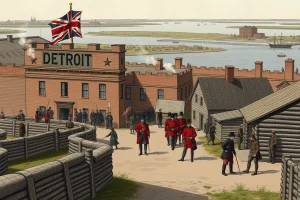
On the American side, soldiers’ families left behind on the home front faced economic hardship and social strain. With men away, women took on farm management, business operations, and other traditionally male occupations. In the Detroit River region, women of diverse backgrounds—First Nations, French, British, and American—maintained households, cared for children, and sometimes participated in supporting military logistics. Indigenous families, such as those of the Wyandot, Potawatomi, and Ojibwa, moved with their men during campaigns, and their women often provided intelligence, food, and care.
At the end of the war, countless families had been disrupted by death, displacement, and loss of property. British and Canadian authorities established compensation mechanisms for civilian losses, but many families struggled to recover. Widows’ pensions and charity provided some relief, but the full social cost of the war was borne by these families for years afterward.
Why It Matters
The immediate consequences of the war for soldiers’ families included physical displacement, loss of property, and the death or disabling of breadwinners. Longer-term effects included changes in legal status, as many widows were forced to petition for compensation and support, thereby engaging with colonial and national bureaucracies. The war also accelerated social shifts, with women assuming more visible roles in public life, albeit often later reinterpreted through the lens of domesticity. Scholars like Spencer W. Roberts argue that women’s actions during the war show them as active agents in ensuring family survival and community reconstruction, challenging earlier narratives that cast them only as passive victims. The memory of these families, once neglected in military histories, has become a subject of new research, revealing a more complete picture of the war’s social impact.
Definition
In the context of the War of 1812, a soldier’s family typically comprised a soldier’s wife and minor children, though the term could also include other dependents such as orphans or elderly parents. Families accompanied regular troops under official quotas, while militia families remained at home. Indigenous families often traveled with warriors, making their definition of family broad and mobile.
Background
Military traditions in both British and American armies allowed soldiers to marry, and wives were commonly present in barracks and camps. The British army, for example, permitted a certain number of wives per company—usually six—to receive rations and lodging. These women performed vital camp services, and many soldiers’ wives followed their husbands throughout the war, even across oceans. The American army had similar, if less structured, arrangements. Socially, soldiers often married out of economic necessity or romantic attachment, but a significant number of marriages were prompted by the pressure of local parishes seeking to avoid supporting unwed mothers. As one British officer in 1812 wrote, unmarried women sometimes ‘swore children to soldiers’ to secure parish support, leading to forced marriages or imprisonment.
How It Worked
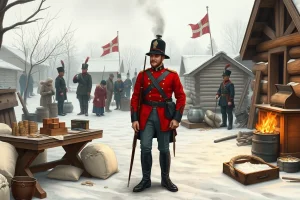
Families attached to regiments lived in close quarters, often in tents or barracks, and shared the soldiers’ rations. Women drew rations as official “women of the regiment,” and children received half-rations. They were responsible for washing, mending, cooking, and caring for the sick, including the wounded. In battle, some women accompanied troops to the rear, but others helped carry water, tend to the injured, or even join in the fighting. When regiments were stationed in fortified towns, families might live in rented quarters or huts. The army typically regulated the number of women, and those beyond the quota were sometimes sent away, though this rule was often loosely enforced. In Indigenous communities, women’s work—such as preparing hides, growing crops, and maintaining camps—was indispensable to the war effort, and families were integral to the social fabric of Indigenous military forces.
Competing Viewpoints
Contemporary officers often viewed soldiers’ wives as troublesome and burdensome, yet they also acknowledged their usefulness. Some officers lamented that women were “loose and disorderly,” while others praised their courage and resilience. Soldiers’ families themselves left few written records, and historians must rely on military orders, church records, and secondhand accounts. Later scholars have debated whether these women should be seen as victims or as active participants. Historians such as Sherri Quirke Bolcevic argue that women participated in the war through everyday means, though their contributions were often reinterpreted as domestic rather than military. Roberts’s work on Niagara women demonstrates that they shaped settlement, survival, and reconstruction. These differing perspectives reflect broader debates about gender and war, and about the extent to which women’s actions were constrained or enabled by the patriarchal structures of the time.
Role in the War of 1812
Soldiers’ families were present at nearly every major theatre of the war. In Upper Canada, wives of British regulars and Canadian militia formed refugee columns during American invasions, as seen in the burning of Niagara. In the Detroit River region, the family of Chief Tecumseh and other Indigenous leaders traveled with warriors, and women often acted as intermediaries or spies. On the American side, families of militiamen and regular soldiers managed farms and businesses, enabling the war effort to continue. The war loss claims filed after the conflict—many submitted by women—provide a rich record of their experiences, showing the types of property lost and the struggles of rebuilding. These claims also highlight the economic agency of women, as they petitioned governments for compensation and often used those funds to purchase new land or goods.
Consequences and Historical Interpretation
The postwar period saw the dispersal of many soldier families. Widows and orphans faced uncertain futures, with some receiving pensions or charity, but many slipping into poverty. The war also contributed to changing attitudes about women’s roles, as their wartime labor and resilience were gradually romanticized in national narratives. In Canada, figures like Laura Secord became icons, though their stories often overshadow the collective experiences of ordinary families. Historians now recognize that the social history of the War of 1812, including its impact on soldiers’ families, is essential to understanding the full cost of the conflict. The study of these families has grown with the availability of records such as war loss claims, muster rolls, and church registers, allowing a more nuanced and inclusive account of who fought and who suffered.
Primary Sources
Primary sources for the study of soldiers’ families are scattered but valuable. Military records include orderly books that list women attached to regiments, regimental returns that note marriages and births, and court martial records involving family issues. Pension records and war loss claims are particularly rich, as demonstrated by the case of Elizabeth Campbell, whose claim for losses in the Niagara fire is documented in Library and Archives Canada. Diaries and letters of officers and soldiers occasionally mention family details. For example, a British officer in 1812 wrote about the practice of women “swearing children to soldiers,” providing insight into marriage dynamics. Church records also document marriages, baptisms, and burials of soldiers’ families, as seen in Quebec City where Alexander Forbes married Ann Bennett, widow of Private William Rhodes, on New Year’s Day 1812. These sources, while often filtered through the concerns of authorities, offer windows into the lives of these families.
Further Reading
- Henderson, Robert. “A Soldier’s Family in the British Army during the War of 1812.” War of 1812 Website, warof1812.ca/family.htm.
- Roberts, Spencer W. “Fortitude and Resolution: Women of Niagara and the War of 1812.” Doctoral dissertation, George Mason University.
- Bolcevic, Sherri Quirke. “Rhetoric and Realities: Women, Gender, and War during the War of 1812 in the Great Lakes Region.” Master’s thesis, Bowling Green State University, 2015.
- Della Valle, Madelyn. Her Stories: Lives of Women in the Detroit River Region. Windsor: François Baby House, 1993.
- National Park Service. “Exposed for three days & nights upon the snow.” National Park Service, n.d.
References
- Henderson, Robert. “A Soldier’s Family in the British Army during the War of 1812.” Accessed 2023. https://www.warof1812.ca/family.htm.
- Roberts, Spencer W. “Fortitude and Resolution: Women of Niagara and the War of 1812.” PhD diss., George Mason University. https://swroberts.ca/far/main.
- Bolcevic, Sherri Quirke. “Rhetoric and Realities: Women, Gender, and War during the War of 1812 in the Great Lakes Region.” Master’s thesis, Bowling Green State University, 2015. http://rave.ohiolink.edu/etdc/view?acc_num=bgsu1407847108.
- National Park Service. “Exposed for three days & nights upon the snow.” Accessed 2023. https://www.nps.gov/articles/war-widow-suffers.htm.
- Della Valle, Madelyn. Her Stories: Lives of Women in the Detroit River Region. Windsor: François Baby House, 1993.
FAQ
How many wives were allowed to accompany a British regiment?
Typically six wives per company were officially allowed to draw rations, but actual numbers often exceeded this due to necessity and the inability to enforce strict quotas.
What happened to soldiers' families when a town was burned?
Families were often forced to evacuate with little notice, losing homes and belongings. For example, the burning of Niagara in December 1813 left many women and children exposed to winter weather, as detailed in war loss claims.
How did soldiers' families contribute to the war effort?
They performed essential camp duties like cooking and laundry, cared for the sick and wounded, and managed farms and businesses at home, while Indigenous women supported their communities' war efforts with provisioning and intelligence.

Leave a Reply