
Short Answer
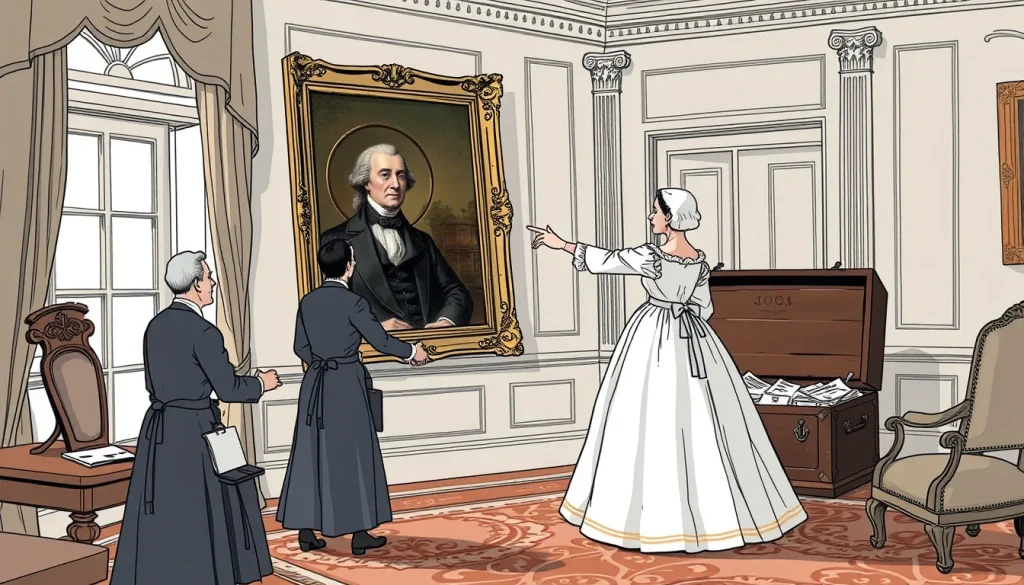
Dolley Madison, the First Lady of the United States during the War of 1812, became a central figure in the August 1814 British attack on Washington, D.C. She oversaw the evacuation of the White House, saving important state papers and the iconic Gilbert Stuart portrait of George Washington before British troops arrived and set the building on fire. Her calm and decisive actions during the crisis transformed her into a symbol of American resilience and helped define the role of the First Lady in times of national emergency.
Historical Context
The War of 1812 (1812–1815) pitted the United States against Great Britain over maritime rights, impressment, and territorial disputes. By August 1814, after the defeat of Napoleon and the end of the European war, Britain turned its military attention to North America. A powerful British fleet entered the Chesapeake Bay, and a force of about 4,000 veterans, largely under Major General Robert Ross, marched toward the American capital. The American government, led by President James Madison, expected an attack but lacked sufficient defenses. On August 24, the outnumbered American militia was routed at the Battle of Bladensburg, leaving Washington, D.C., exposed. The capital, still a young and relatively small city, had few fortifications, and the administration had only hours to prepare for the British advance. President Madison had left the city to join his troops, leaving Dolley Madison with the responsibility of safeguarding the executive mansion and its contents.
What Happened
On August 23, 1814, Dolley Madison wrote to her sister Lucy Todd from the White House, describing her preparations. She had packed cabinet papers into trunks and waited for news, determined not to leave until her husband was safe. The next morning, August 24, she heard cannon fire from the Battle of Bladensburg. Despite pleas from friends and messengers to flee, she insisted on remaining until the Gilbert Stuart portrait of George Washington—a life-sized painting—was secured. The portrait was screwed to the wall, and in the haste the frame was broken so that the canvas could be rolled and carried away. She entrusted the painting to two New Yorkers, Jacob Barker and Robert G.L. De Peyster, and also reportedly instructed that the painting be destroyed rather than captured. After the portrait was removed, Dolley finally departed in a carriage, leaving the White House just before British soldiers arrived and set fire to the building. The burning of the White House, Capitol, and other public buildings was a symbolic act of punishment by the British, and it forced President and Mrs. Madison to seek refuge at the Octagon House and later at other private residences.
Why It Matters
Dolley Madison’s actions during the evacuation of Washington had immediate practical consequences: she saved valuables and important documents from destruction. More importantly, her rescue of the Washington portrait became a powerful national symbol. The portrait—a copy of Gilbert Stuart’s famous “Lansdowne” work—now hangs in the White House and represents the continuity of the American republic. Her composure under pressure contrasted with the disarray of the military and offered a narrative of courage and loyalty. In historical memory, Dolley Madison has been celebrated as a heroine, though some scholars have questioned whether her delayed departure endangered herself unnecessarily. Her actions also helped shape the evolving role of the First Lady as a public figure, demonstrating that the president’s spouse could influence national morale during crises.
Early Life
Dolley Payne was born on May 20, 1768, in Guilford County, North Carolina, into a Quaker family. Her father freed the family’s enslaved people in 1783 and moved the family to Philadelphia. She married John Todd in 1790, but her husband and infant son died in the yellow fever epidemic of 1793. In 1794, she married James Madison, a prominent Virginia congressman. The couple later moved to Washington, D.C., when James became Secretary of State in 1801.
Role Before the War
As the wife of the Secretary of State and then as First Lady after 1809, Dolley Madison established herself as a skilled hostess and political ally. She hosted weekly drawing rooms that brought together politicians, diplomats, and citizens, helping to build a sense of national unity and enabling informal political negotiation. Her social influence was widely acknowledged, and she became a trusted advisor to her husband.
Role During the War
During the War of 1812, Dolley Madison remained in Washington while her husband traveled to military fronts. In August 1814, when British forces threatened the city, she took charge of the White House evacuation. She organized the packing of state papers and valuables, insisted on saving the Washington portrait, and maintained communication with her husband through messengers. Her courage in staying until the last moment earned her praise.
Major Actions
Dolley Madison’s most significant actions occurred on August 23–24, 1814. She ensured that cabinet papers and silver plate were loaded onto a wagon for removal. Most famously, she directed the removal of the Gilbert Stuart portrait of George Washington. According to Paul Jennings, an enslaved man in the White House, she ordered the frame to be broken and the canvas cut out. She also gave instructions to Jacob Barker to protect or destroy the painting if necessary. Her departure from the White House just ahead of the British troops prevented her capture and likely saved her life.
Contemporary Accounts
A key primary source is Dolley Madison’s letter to her sister Lucy Todd, written on August 23, 1814, and continued the next day, which vividly describes the tension and her determination to save the portrait. Paul Jennings, who was present, later published a memoir in 1865 that corroborates the rescue. The British themselves, in accounts by officers such as George Robert Gleig, confirmed the burning of the president’s house. These sources, while all with their own biases, provide a consistent picture of Dolley’s decisive role.
Later Life
After the war, Dolley Madison continued as First Lady until 1817, then retired to Montpelier plantation in Virginia. Following James Madison’s death in 1836, she faced financial difficulties and returned to Washington, D.C., where she lived until her death on July 12, 1849. She sold James’s papers and the plantation to manage debts.
Historical Legacy
Dolley Madison has been remembered primarily as the heroic figure who saved the Washington portrait, but historians also credit her with shaping the social and political role of the First Lady. Her coolness under fire became a standard of patriotic virtue, and the rescued portrait remains a tangible link to the nation’s founding era. Later historians, such as Catherine Allgor, have emphasized her political influence and the significance of her social networking in building the early Republic.
Primary Sources
The most important primary source is the letter from Dolley Madison to Lucy Todd, dated August 23 and 24, 1814, now held in the collections of the Virginia Center for Digital History and available through the Dolley Madison Project. This letter details the evacuation and the rescue of the portrait. Paul Jennings’ memoir, A Colored Man’s Reminiscences of James Madison (1865), provides a servant’s perspective and confirms the events. Additionally, a short note from Dolley to Jacob Barker, dating to August 1814, instructs him on handling the portrait. Each source must be read with awareness of its author’s viewpoint and memory.
Further Reading
- Allgor, Catherine. A Perfect Union: Dolley Madison and the Creation of the American Nation. New York: Henry Holt, 2006.
- Taylor, Elizabeth Dowling. A Slave in the White House: Paul Jennings and the Madisons. New York: St. Martin’s Press, 2012.
- Pitch, Anthony. The Burning of Washington. White House Historical Association, 2000.
- The Dolley Madison Project, Virginia Center for Digital History, University of Virginia. http://www2.vcdh.virginia.edu/madison.
References
- Dolley Madison to Lucy Todd, August 23, 1814, Encyclopedia Virginia, https://encyclopediavirginia.org/primary-documents/letter-from-dolley-madison-to-lucy-todd-august-23-1814/.
- “Dolley Madison.” White House Historical Association. https://www.whitehousehistory.org/bios/dolley-madison.
- “Saving History: The White House, Dolley Madison and the War of 1812.” National Park Service. https://www.nps.gov/teachers/classrooms/saving-history-the-white-house-dolley-madison-and-the-war-of-1812.htm.
- “Dolley Madison Comes to the Rescue.” George Washington’s Mount Vernon. https://www.mountvernon.org/george-washington/artwork/dolley-madison-comes-to-the-rescue.
- “Dolley Madison’s Life.” PBS American Experience. https://www.pbs.org/wgbh/americanexperience/features/dolley-madisons-life/.
FAQ
What did Dolley Madison save from the White House during the War of 1812?
She saved cabinet papers, silver plate, and most famously the Gilbert Stuart portrait of George Washington, which was cut from its frame and carried away to safety.
When did Dolley Madison leave the White House during the British invasion?
On August 24, 1814, after seeing the portrait removed, she departed in a carriage just before British troops arrived to set fire to the building.
How do historians view Dolley Madison's actions in 1814?
Historians generally praise her composure and decisiveness, but some note that she risked her safety by waiting so long. Her actions were later seen as key to preserving national symbols and shaping the role of First Lady.
Leave a Reply