

Short Answer
The Treaty of Ghent, signed on December 24, 1814, ended the War of 1812 between the United States and Great Britain. This article examines what Britain sought to achieve from the negotiations at Ghent, in modern-day Belgium, and how those aims evolved during the talks. Britain entered the peace process with a set of ambitious demands designed to protect Canada and its Indigenous allies, but by the final agreement these demands had been abandoned in favor of a return to pre-war borders.
Historical Context
By 1814, the War of 1812 had reached a stalemate. The United States had declared war in 1812 over British maritime practices, including impressment and trade restrictions, but had failed to conquer Canada. In Europe, the defeat of Napoleon in the spring of 1814 freed British military resources for a renewed campaign in North America. The British had burned Washington in August 1814, but American victories at Baltimore and Lake Champlain in September checked British advances. Both nations were weary of war: Britain faced a heavy tax burden and public discontent, while the United States struggled with economic disruption and internal divisions.
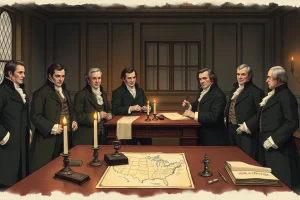
The peace negotiations at Ghent opened on August 8, 1814. The American delegation included John Quincy Adams, Henry Clay, Albert Gallatin, Jonathan Russell, and James A. Bayard. The British side was led by Admiral James Gambier, Dr. William Adams, and Henry Goulburn, who often deferred to London for instructions. At the start, Britain held a perceived advantage, but its position gradually weakened as the talks progressed.
What Happened
Britain’s initial demands at Ghent were severe. The British government sought to create an independent Indian barrier state in the Old Northwest, encompassing parts of present-day Michigan, Illinois, Ohio, and other territories. They also demanded territorial concessions in northern Maine and near present-day Minnesota, the demilitarization of the Great Lakes, and an end to American fishing privileges in Canadian waters. Additionally, they insisted on American recognition of British maritime rights, including impressment, which the United States had already abandoned as a war aim.
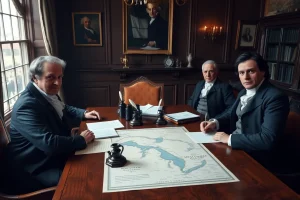
The American commissioners rejected these terms outright, and the talks nearly broke down. The British then retreated to a proposal of uti possidetis, meaning each side would retain territory it held at the time of the treaty. This offer would have given Britain control of eastern Maine and several forts west of the frontier. The Americans again refused, demanding a return to the status quo ante bellum—the pre-war boundaries. Facing military setbacks, the high cost of a continued campaign, and pressure from the Duke of Wellington—who advised that Britain could not demand territorial concessions without control of the Great Lakes—the British ministry agreed to the status quo ante. The treaty, signed on Christmas Eve 1814, restored all conquered territory, established commissions to settle boundary disputes, and promised to address Indigenous rights, though this last provision was never enforced.
Why It Matters
The Treaty of Ghent had immediate and lasting significance. It ended the fighting and restored peace, but it also left many issues unresolved. Historians debate which side achieved its goals; Britain failed to secure its territorial and maritime demands, while the United States did not gain recognition of neutral rights or an end to impressment. The treaty nonetheless marked a turning point in British-American relations, as both nations came to view each other as trading partners rather than enemies. For Indigenous peoples, the treaty’s promise of a return to pre-war status was quickly broken by continued American expansion, contributing to long-term displacement.
The outcome of the negotiations was shaped by military events, economic pressures, and the diplomatic skill of the American commissioners. Historian Donald R. Hickey has described the British demands as a “probing operation” to test American resolve. The treaty’s legacy is one of mutual compromise and a foundation for future peace.
Definition
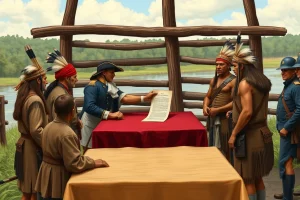
What did Britain want from the Treaty of Ghent? Britain’s aims were twofold: to protect its North American provinces and to secure maritime advantages. Specifically, London demanded the creation of an Indigenous barrier state in the Old Northwest to serve as a buffer between Canada and the United States, the cession of territory in Maine and Minnesota to improve Canada’s defenses, demilitarization of the Great Lakes, and an end to American fishing rights off British North America. These demands were designed to limit American expansion and to compensate Britain’s Indigenous allies, who had fought alongside the British during the war.
Background
Britain’s demands reflected its strategic priorities. The threat of American expansion into Canada had been a constant worry, and the British government sought a defensible frontier. The proposal for an Indian barrier state arose from treaties and promises made to Indigenous nations such as the Ojibwe, Potawatomi, and Shawnee, who had been crucial to British military efforts in the West. Additionally, control of the Great Lakes was seen as vital to prevent future invasions. Maritime rights—including impressment—remained a point of contention, though the United States had dropped this issue before the talks began, leaving the British to press for recognition of their naval supremacy.
How It Worked
The negotiations at Ghent proceeded through a series of exchanges. The British delegation presented its initial terms in writing, and the American commissioners responded with firm rejection. The British then offered uti possidetis, which the Americans also refused. A turning point came when the Duke of Wellington, consulted by the British government, advised that without naval control of the Great Lakes, Britain could not justify demanding territorial concessions. Simultaneously, the British ministry faced growing domestic opposition to wartime taxes and the prospect of recalling troops to Europe due to the Congress of Vienna. These factors led Britain to drop its demands and accept a return to pre-war borders.
Competing Viewpoints
From the American perspective, Britain’s demands were unacceptable because they would have crippled westward expansion and violated national sovereignty. The American commissioners, particularly Henry Clay, viewed the Indian barrier state as a plot to hem in the United States. In contrast, British officials saw these measures as essential for securing Canada and fulfilling commitments to Indigenous allies. Some historians argue that Britain was never committed to these demands and used them as a negotiating tactic, while others contend that they were genuine but were abandoned only when military reality made them unattainable.
Role in the War of 1812
Britain’s war aims directly influenced the war’s conclusion. The failure to achieve these aims at Ghent meant that the war ended without resolving the issues that had provoked it, such as impressment and neutral rights. For Indigenous peoples, the abandonment of the barrier state was a devastating betrayal, as they had fought to protect their lands and autonomy. The treaty’s silence on these issues contributed to the post-war decline of Indigenous power in the Old Northwest.
Consequences and Historical Interpretation
The Treaty of Ghent is often studied for what it did not accomplish. Historical interpretations vary: some emphasize that Britain’s reduction of its demands represented a diplomatic victory for the United States, while others note that Britain preserved its vital interests—Canada remained under British control, and maritime rights were left unchanged. The war and the treaty are also credited with fostering a lasting peace between the two nations, as disputes were subsequently settled by negotiation rather than arms. Scholars such as Donald R. Hickey and Bradford Perkins have framed Britain’s demands as a “probe” designed to test American resolve, with the eventual retreat from them reflecting both military stalemate and the changing priorities of the British empire.
Primary Sources
The Treaty of Ghent itself is the primary document, signed in Ghent on December 24, 1814, and ratified by the United States on February 17, 1815. The full text is available in the U.S. National Archives and through treaty collections. Correspondence between the British foreign secretary, Lord Castlereagh, and the British commissioners reveals the evolution of Britain’s demands; these letters are printed in the 20 volumes of The Diplomatic Correspondence of the American Revolution and in the American State Papers: Foreign Relations. The diary of John Quincy Adams, a key American negotiator, provides an insider’s account of the proceedings and the friction among the negotiators. A limitation of these sources is that they reflect the perspectives of the elites; the voices of Indigenous peoples are largely absent.
Further Reading
- Hickey, Donald R. The War of 1812: A Forgotten Conflict. University of Illinois Press, 1989.
- Perkins, Bradford. Castlereagh and Adams: England and the United States, 1812–1823. University of California Press, 1964.
- Engelman, Fred L. The Peace of Christmas Eve. Harcourt, Brace and World, 1962.
- Bickham, Troy. “What did the Treaty of Ghent do?” OUPblog, December 24, 2014.
- American Battlefield Trust. “The Treaty of Ghent: Ending the War of 1812.” battlefields.org.
References
- Hickey, Donald R. “Probing for Peace: Weighing the Burdens of War on Two Continents.” U.S. National Park Service. Accessed 2025. https://www.nps.gov/articles/probing-for-peace.htm.
- American Battlefield Trust. “The Treaty of Ghent: Ending the War of 1812.” Updated April 8, 2024. https://www.battlefields.org/learn/articles/treaty-ghent-ending-war-1812.
- “Ghent, Treaty of.” Encyclopedia.com. https://www.encyclopedia.com/history/united-states-and-canada/us-history/treaty-ghent.
- Bickham, Troy. “What did the Treaty of Ghent do?” OUPblog. December 24, 2014. https://blog.oup.com/2014/12/treaty-of-ghent-war-1812/.
- Randall, Willard Sterne. “A Clumsy War, A Lasting Peace: The Treaty of Ghent.” HistoryNet. 2017. https://historynet.com/clumsy-war-lasting-peace-treaty-ghent/.
FAQ
What were Britain's main demands at the Treaty of Ghent?
Britain demanded an Indian barrier state in the Old Northwest, territorial concessions in Maine and Minnesota, demilitarization of the Great Lakes, and an end to American fishing privileges in Canadian waters.
Why did Britain drop its demands?
Britain abandoned its demands due to military setbacks, the high cost of the war, and the Duke of Wellington's opinion that territorial concessions could not be justified without control of the Great Lakes.
Did the Treaty of Ghent resolve the issue of impressment?
No. The treaty said nothing about impressment, which the United States had already dropped as a war aim before negotiation. The issue was never formally addressed.



Leave a Reply