
Short Answer
The Battle of Beaver Dams, fought on 24 June 1813 near present-day Thorold, Ontario, was a decisive engagement of the War of 1812 on the Niagara frontier. An American column under Lieutenant-Colonel Charles G. Boerstler, marching from Fort George to destroy a British advanced post, was ambushed by Kahnawake and Grand River Mohawk warriors and forced to surrender to a small British detachment led by Lieutenant James FitzGibbon. The battle, notable for the warning delivered by Laura Secord, ended significant American operations in the Niagara Peninsula for the remainder of 1813.
Historical Context
By mid-1813, the war on the Canadian-American border had seesawed back and forth. In May 1813, American forces captured Fort George on the Niagara River, forcing the British under Brigadier-General John Vincent to retreat to Burlington Heights. The Americans pursued but were checked at the Battle of Stoney Creek on 6 June, where a night attack threw them into confusion. The American army then withdrew to Fort George, while the British established an outpost at DeCou’s stone house near Beaver Dams, about 20 kilometres west of the fort. From there, British regulars, Canadian militia, and Indigenous allies harassed American pickets and supply lines.
Brigadier-General John Parker Boyd, the American commander at Fort George, was under pressure to break this harassment and restore morale among his troops. He planned a surprise attack on the British post using a picked force of regulars. The attack was to be secret, but security was compromised when American officers billeted in Queenston discussed their intentions within earshot of Laura Secord, a local resident whose husband had been wounded at the Battle of Queenston Heights.
What Happened
On the evening of 23 June, Boerstler’s force of about 600 regulars, plus artillery and cavalry, left Fort George and marched to Queenston, where they quartered overnight. Laura Secord, having overheard the plan, set out early on 22 June (according to some accounts) to warn the British. She walked through the woods, eventually reaching an Indigenous camp and being guided to FitzGibbon’s outpost. Her warning corroborated reports from Indigenous scouts who had already observed the American column.
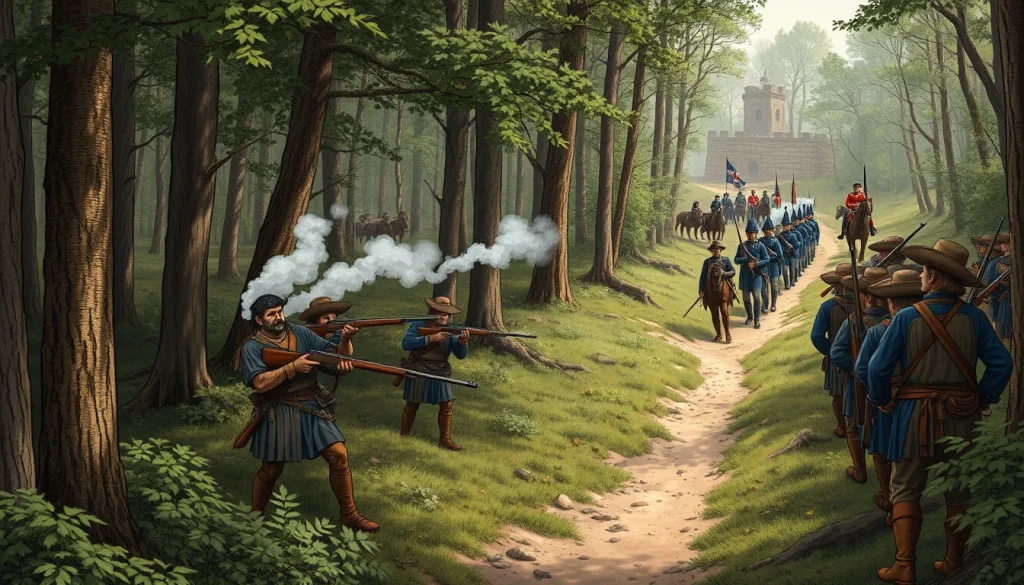
The Americans resumed their march on the morning of 24 June, moving toward Beaver Dams via a trail at the base of the escarpment. About 300 Kahnawake Mohawk warriors, under Captain Dominique Ducharme of the Indian Department, and 100 Grand River Mohawks under Captain William Kerr, had set up an ambush in thickly wooded ground about 2.4 kilometres east of Beaver Dams. FitzGibbon and 46 men of the 49th Regiment waited in reserve.
When the Americans entered the ambush zone, the warriors opened fire from the flanks and rear. Boerstler was wounded early and placed in a wagon. The fighting went on for several hours, with the Americans relying on their artillery and disciplined volleys to keep the warriors at bay. According to American accounts, they managed to break contact and reach open fields, but other witnesses dispute this. FitzGibbon then appeared under a flag of truce, claiming that the Americans were surrounded by a much larger force and that if they did not surrender, he could not restrain the warriors from massacring them. With the appearance of additional British regulars under Major Peter De Haren of the 104th Regiment, Boerstler capitulated. More than 460 Americans were taken prisoner, including the wounded Boerstler.
Why It Matters
The immediate effect of the battle was the elimination of the American threat to the British outpost and the consolidation of British control over the Niagara Peninsula. The Americans withdrew to Fort George and did not venture out in force again for the remainder of 1813. The defeat contributed to the recall of Major-General Henry Dearborn, the American commander in Upper Canada, later that year.
Historically, the battle is remembered for Laura Secord’s heroic walk and for the crucial role of Indigenous warriors. John Norton, a Mohawk leader who fought at Beaver Dams, claimed that the Indigenous forces won the battle and that FitzGibbon received undeserved credit. FitzGibbon himself acknowledged that the credit he deserved was for seizing an opportunity to use fear rather than bullets, building on the warriors’ successful guerrilla tactics. The controversy over credit has persisted, reflecting broader debates about the contribution of Indigenous allies to British victories in the War of 1812. Laura Secord’s account of her journey, written years later, is part of Canadian national mythology, and its historical accuracy is a subject of debate.
Prelude
After the American capture of Fort George on 27 May 1813, British forces retreated but soon recovered. Following the American defeat at Stoney Creek, both sides remained entrenched. The British established an advanced post at DeCou’s house near Beaver Dams, from which patrols harassed American lines. The American command decided to destroy this post with a surprise attack. The plan was kept secret, but the gathering of troops at Queenston and the loose talk of officers compromised it. Laura Secord’s warning, combined with the vigilance of Indigenous scouts, ensured that the British were prepared.
Forces and Commanders
- American: Lieutenant-Colonel Charles G. Boerstler, commanding about 600 regulars from the 6th, 13th, 14th, and 23rd U.S. Infantry Regiments, a company of artillery with a 12-pounder and a 6-pounder gun, and a troop of dragoons, plus mounted volunteers under Cyrenius Chapin.
- British and Indigenous: Lieutenant James FitzGibbon with 46 men of the 49th Regiment of Foot. Indigenous forces: about 300 Kahnawake (Caughnawaga) Mohawk warriors under Captain Dominique Ducharme, assisted by Lieutenants Isaac LeClair and J.B. de Lorimier, and 100 Grand River Mohawks under Captain William Kerr. Major Peter De Haren led a reinforcement detachment of the 104th Regiment that arrived during the battle.
Battlefield and Map Context
The battle took place in a thickly wooded area on the Niagara Escarpment, about 1.5 miles (2.4 km) east of Beaver Dams. The site is now within the city of Thorold, Ontario, near the Welland Canal. The terrain consisted of dense beech forest, which gave cover to the Indigenous warriors and made effective use of American artillery difficult. The modern battlefield is partly occupied by industrial and residential development, but a designated national historic site and memorial park commemorate the action.
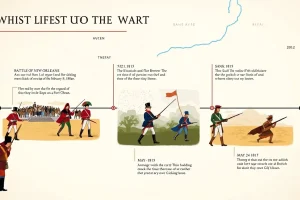
Battle Chronology
23 June, evening: American force leaves Fort George and arrives at Queenston; troops are quartered in houses, including the Secord home.
Early 24 June: Laura Secord’s earlier warning reaches FitzGibbon via Indigenous scouts. Indigenous warriors set up an ambush near Beaver Dams.
Morning: Americans march from Queenston toward Beaver Dams. They ascend the escarpment and encounter Indigenous warriors on their flanks.
Mid-morning: Ambush begins. Boerstler is wounded. Fighting lasts about three hours.
Late morning: FitzGibbon approaches under a flag of truce, urging surrender. Major de Haren arrives with reinforcements.
Afternoon: Boerstler surrenders. American prisoners are marched to British lines.
Casualties and Losses
American casualties are generally given as 25 killed and 50 wounded, with about 462 prisoners taken, including the wounded Boerstler. British and Indigenous losses are reported as between 5 and 15 killed and 20 to 25 wounded, mostly among the Indigenous warriors. Two Kahnawake chiefs, Deyahokethe and Aheatagea, were killed. The exact figures vary slightly among sources.
Result
The battle was a decisive British and Indigenous victory. The entire American expeditionary force was either killed, wounded, or captured. The British achieved this with a combination of Indigenous ambush tactics and a small number of regulars, using psychological intimidation to force a surrender.
Strategic Consequences
The American defeat at Beaver Dams ended any immediate threat to British control of the Niagara Peninsula. The Americans fell back to Fort George and remained largely on the defensive for the rest of the 1813 campaign. The British maintained their outpost at Beaver Dams and continued to harass American positions. The defeat contributed to the relief of Major-General Henry Dearborn, who was replaced later in 1813. For the British, the victory demonstrated the effectiveness of Indigenous allies and guerrilla warfare, though it also raised questions about the treatment of Indigenous fighters in the broader conduct of the war.
Primary Accounts
Key contemporary accounts include Lieutenant FitzGibbon’s official report to his superiors, which described the surrender and acknowledged the role of the Indigenous warriors. American accounts, including Boerstler’s own report, provide a different perspective, claiming that the Americans fought off the warriors and only surrendered when threatened with annihilation. The diary and later writings of Laura Secord, first published decades after the war, are an important but disputed source for her warning journey. Indigenous perspectives, such as those recorded by John Norton, emphasize the military contribution of the warriors and the lack of recognition they received.
Battlefield Today
The Battle of Beaver Dams was designated a National Historic Site of Canada in 1921. A memorial cairn and plaque are located at Battle of Beaver Dams Park on Sullivan Avenue in Thorold, Ontario. The site is managed by Parks Canada and is open to visitors, though much of the original battlefield is now covered by urban and industrial development. The park provides interpretive panels and a location for commemoration of the battle and its participants.
Primary Sources
FitzGibbon’s Report: Lieutenant James FitzGibbon’s official report to his commanding officer, written shortly after the battle, outlines the sequence of events and his role in securing the surrender. It is a key British source but may exaggerate the degree to which he influenced the outcome.
Boerstler’s Report: The American commander’s subsequent report, while wounded, gives an American perspective on the fight, emphasizing the resilience of his troops and the circumstances of the surrender.
Laura Secord’s Account: Written in 1827 and later expanded, Secord’s memoir details her walk to warn the British. Its reliability is debated due to the passage of time and the mythical status it later acquired.
General Order of 6 July 1813: This British order credited the Indigenous detachments for their role and authorized compensation to the wounded and families of the fallen. It is a rare contemporary acknowledgment of Indigenous contributions.
Further Reading
- Ernest Cruikshank, The Fight in the Beechwoods: A Study in Canadian History (1914).
- George F. Stanley, The War of 1812: A Land Perspective (National Historic Sites Service, 1975).
- Carl Benn, The Iroquois in the War of 1812 (University of Toronto Press, 1998).
- Brian Hubner, Beaver Dams: The Battle That Shaped a Nation (Historical publication, 2013).
- Parks Canada, Battle of Beaver Dams National Historic Site of Canada – Commemorative Integrity Statement (2007).
References
- Jason Ridler, “Battle of Beaver Dams,” The Canadian Encyclopedia, last edited January 25, 2023. URL: https://thecanadianencyclopedia.ca/index.php/en/article/battle-of-beaver-dams.
- Parks Canada, “Battle of Beaver Dams National Historic Site of Canada,” accessed 2024. URL: https://www.pc.gc.ca/apps/DFHD/page_nhs_eng.aspx?id=524.
- Wikipedia, “Battle of Beaver Dams,” accessed 2024. URL: https://en.wikipedia.org/wiki/Battle_of_Beaver_Dams.
- Veterans Affairs Canada, “Battle of Beaver Dams Memorial,” accessed 2024. URL: https://www.veterans.gc.ca/en/remembrance/memorials/canada/battle-beaver-dams-memorial.
- Ernest Cruikshank, The Fight in the Beechwoods: A Study in Canadian History, War of 1812 Bicentennial Edition. URL: http://www.warof1812-bicentennial.info/pamphlets/fightinthebeechwoods/fight-main.php.
FAQ
Did Laura Secord really warn the British at Beaver Dams?
Most historians accept that Laura Secord made a difficult trek to warn the British, but the exact details of her route and her meeting with FitzGibbon are not fully documented. Her account was written years later, and some elements are debated, yet the core event is widely acknowledged.
Who actually won the Battle of Beaver Dams, the British or the Indigenous warriors?
The Indigenous warriors did the fighting and inflicted most of the American casualties, but the surrender was negotiated by Lieutenant FitzGibbon. Contemporary accounts and later interpretations differ on how much credit each should receive, with John Norton notably arguing that the Indigenous warriors were denied proper recognition.
What was the significance of the Battle of Beaver Dams?
The battle ended American attempts to break out of Fort George and secured British control of the Niagara Peninsula for the rest of 1813. It also demonstrated the effectiveness of Indigenous tactical warfare and contributed to the removal of Major-General Henry Dearborn.
Leave a Reply