

Short Answer
The naval action between the American heavy frigate USS United States and the British frigate HMS Macedonian took place on 25 October 1812 in the mid-Atlantic, roughly 500 miles south of the Azores, during the War of 1812. Under Captain Stephen Decatur, the United States defeated the Macedonian, commanded by Captain John Surman Carden, after about two hours of gunnery, then carried the captured frigate into Newport, Rhode Island — the first British warship brought into an American harbour as a prize during the war. The action was one of the most one-sided single-ship encounters of the conflict and strongly shaped public morale on both sides of the Atlantic.
Historical Context
The War of 1812 began on 18 June 1812, when the United States declared war on the United Kingdom in the name of free trade and sailors’ rights. The United States Navy was tiny compared with the Royal Navy, but it included six large original frigates designed to outfight any contemporary frigate and outrun any ship of the line. After the USS Constitution‘s victory over HMS Guerriere east of Nova Scotia on 19 August 1812, President James Madison’s administration decided to unleash American frigates in cruising squadrons against British warships and merchantmen. In October 1812, Commodore John Rodgers led a squadron out of Boston that included Decatur’s United States. The meeting with Macedonian grew directly out of that cruise. The single-ship actions of autumn 1812 carried significance far beyond their military weight because they challenged the Royal Navy’s prestige and offered the American public proof that their small navy could fight the world’s dominant sea power.
What Happened
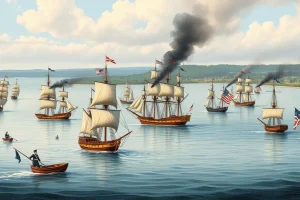
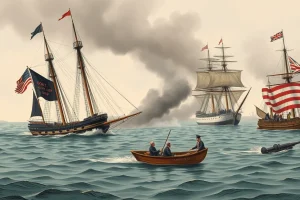
On the morning of 25 October 1812, while cruising alone in the mid-Atlantic south of the Azores, the United States sighted a sail to windward about twelve miles away. The stranger was HMS Macedonian, commanded by Captain John Surman Carden, bound for the West Indies. Both ships cleared for action. Carden held the weather gage, the windward position, and steered a long angling course to intercept the American vessel. Decatur, commanding a heavier frigate armed with long 24-pounder guns, intended to fight at long range, where his guns could strike Macedonian while her 18-pounders could not. At about 9:00 a.m., the United States fired an opening broadside that fell short; the Macedonian replied, also without immediate effect. As the range closed, Decatur’s gunnery proved devastating. The United States kept a position off her opponent’s quarter and poured in rapid, accurate broadsides, firing roughly seventy broadsides against the British ship’s thirty. Within about two hours, the Macedonian had lost her mizzenmast and the tops of her other masts, had much of her rigging destroyed, had been disabled in several guns, and had taken more than a hundred round shot in her hull. Nearly a third of her crew were casualties. With the ship a dismasted wreck and the American vessel about to rake her from ahead, Carden struck his colours at a few minutes past eleven. The United States was only lightly damaged. Decatur reported American losses of roughly twelve casualties — commonly listed as five seamen killed, his first lieutenant John Funk mortally wounded, and several others wounded — while the Macedonian suffered 36 killed and 68 wounded, although later accounts sometimes give larger totals.
Decatur sent a prize crew aboard the Macedonian, and after two weeks of repair work at sea, the captured frigate was sailed to the United States. The two ships arrived at Newport, Rhode Island, on 4 December 1812 to scenes of jubilation and national celebration.
Why It Matters
The capture of the Macedonian had little strategic effect on the naval balance of power, but its psychological and political importance was considerable. For Americans, the victory reinforced a growing sense that their navy was capable of defeating the Royal Navy in single-ship combat; the captured British frigate brought into an American port provided visible proof of that claim. For the British, the loss of a frigate was a blow to national and naval prestige, and one London newspaper remarked bitterly that the result would not have been predicted by anyone a year earlier. Decatur and his crew received a hero’s welcome, prize money of roughly $300,000 shared among the crew, and formal acknowledgment from Congress and President Madison. Later historians have debated the action’s meaning: British naval historian William James emphasised the overwhelming material superiority of the American vessel, while American accounts celebrated Decatur’s tactical skill and superior gunnery. Modern scholarship generally treats the battle as a striking example of the effectiveness of American heavy-frigate design and of Decatur’s disciplined long-range gunnery, but also notes that such victories could not alter the fundamental strategic reality of British naval supremacy.
Prelude
Before the war, United States and Macedonian had shared an anchorage in Norfolk, Virginia, where their officers exchanged visits. Captain Carden permitted his men no liberty, fearing that American sailors pressed into British service would desert, and he socialised ashore with the Decaturs. According to a later account, the two captains were said to have wagered a beaver hat on the outcome should their ships ever meet in combat. In October 1812, Commodore Rodgers’s squadron sailed from Boston on 8 October. Three days later, the United States captured the British merchant ship Mandarin; on 12 October the American frigate parted company and continued to cruise eastward alone. At dawn on 25 October, in latitude roughly 29° north and longitude 29°30′ west, lookouts on the United States reported a sail twelve miles to windward. As the ship came over the horizon, Decatur recognised the fine lines of HMS Macedonian.
Forces and Commanders
USS United States was the first of the six original frigates of the United States Navy, completed in 1797. Rated at 44 guns, she carried thirty 24-pounder long guns on her main gun deck, along with carronades and chase guns, giving a broadside of roughly 864 pounds. Her tonnage was about 1,576 tons, her complement about 428 marines and sailors, and her hull was more solidly built than that of a typical European frigate. Commander Stephen Decatur, aged thirty-three, was already celebrated for his raids during the Barbary Wars, the most famous American naval officer of his generation.
HMS Macedonian was a British Lively-class frigate of the fifth rate, launched in 1810 and never previously in action. Officially rated at 38 guns, she carried twenty-eight 18-pounder long guns on her main deck plus fourteen 32-pounder carronades on her quarterdeck and forecastle, giving a broadside of approximately 528 pounds. Her tonnage was about 1,082 tons and her complement about 301 men. Captain John Surman Carden was an experienced officer, but his ship was smaller, lighter, and more weakly armed than her opponent. The American broadside outweighed the British by more than half, and the 24-pounders of the United States also outranged the British 18-pounders.
Battlefield and Map Context
The engagement occurred in the open Atlantic, approximately 500 miles south of the Azores and west of Madeira, at about latitude 29° north, longitude 29°30′ west. There was no land, shoal, or coastline to influence tactics; the outcome was determined entirely by ship design, gun range, wind, and gunnery. The wind was from the southward, and Carden manoeuvred to keep the weather gage, seeking to close the range where his carronades might be effective. Decatur worked to keep his distance and exploit his long guns.
Battle Chronology
The battle developed in sequence after the morning sighting. At 9:00 a.m., with the ships about a mile apart, the United States fired the first broadside, which fell short; Macedonian responded, also without effect. Carden then attempted to close and manoeuvre to fire a raking broadside, but Decatur repeatedly bore away to retain the advantage of long range. The United States fired with unusual rapidity and accuracy, and by about 10:00 a.m. the Macedonian had lost much of her rigging and disabling damage was mounting. Decatur then closed more nearly and poured in the whole of his broadside. By a few minutes past eleven, Macedonian was a dismasted hulk with a hundred shot holes in her hull and a third of her crew killed or wounded. With the American frigate preparing to rake her from ahead, Carden surrendered. From the American perspective, the battle had lasted about two hours; some accounts compress the close-range phase to about ninety minutes.
Casualties and Losses
British casualties were severe: contemporary reports list 36 killed and 68 wounded out of a crew of about 301, though some later accounts give 43 killed and 71 wounded. The Macedonian was dismasted, heavily damaged in hull and rigging, and no longer seaworthy without extensive repairs. American casualties were extraordinarily light: the most common figures are five killed and seven wounded, with some accounts listing seven killed and five wounded. The United States received only about nine shot in her hull and suffered no significant structural damage. The disparity in casualties and damage reflected the superiority of the American ship and the effectiveness of Decatur’s long-range gunnery.
Result
Captain Carden struck his colours and surrendered to the United States. Decatur sent a prize crew aboard and the two vessels lay alongside each other for more than two weeks while the Macedonian was fitted with jury masts and patched sufficiently to sail. The American frigate and her prize reached Newport, Rhode Island, on 4 December 1812, where the captured British warship, brought into an American harbour, created a sensation. The Macedonian was subsequently commissioned into the United States Navy as USS Macedonian and served under the American flag for a number of years. For the action, Decatur and his crew received a share of prize money totalling roughly $300,000.
Strategic Consequences
Strategically, the battle changed little. The Royal Navy’s overwhelming numerical superiority continued, and the British blockade of American ports was not disturbed. But the action had notable consequences. The British Admiralty, recognising that American 44-gun heavy frigates outclassed their lighter British equivalents, issued orders instructing British frigates not to engage American 44-gun frigates in single combat. Captain Carden was court-martialled upon his return to England but was honourably acquitted, the court accepting that the material odds had been heavily against him. On the American side, the victory contributed to a wave of confidence in the navy that persisted through the war, even as the blockade tightened and the strategic situation worsened.
Primary Accounts
Several firsthand accounts survive. Samuel Leech, a British powder boy aboard Macedonian who later moved to the United States, published a vivid memoir, A Voice from the Main Deck (1843), describing the terror of the battle, the tearing sound of shot overhead, and the carnage on the gun deck. Stephen Decatur’s official report to the Secretary of the Navy, written shortly after the action, provided the American command’s perspective and casualty figures. The British naval historian William James, writing in his Naval History of Great Britain (first published 1822–24), gave a detailed tactical account from a British vantage point, emphasising the disparity in force and arguing that no blame attached to Macedonian‘s crew. Leech’s memoir is the most human and immediate of these accounts, with the perspective of a twelve-year-old pressed into the navy; Decatur’s report and James’s history both carry the professional biases of their authors and should be read accordingly.
Battlefield Today
Because the battle was fought in open ocean, no physical battlefield, monument, or memorial marks the site. The United States herself was laid up in 1849 at the Gosport Navy Yard at Norfolk, Virginia; in April 1861, when Union forces evacuated the yard, the old frigate was burned to the waterline to prevent her capture, and her remains were later broken up. The captured Macedonian, taken into the U.S. Navy, served for a period before being eventually sold out of service. No surviving ship of either engagement exists today, and the site of the action is marked only on charts and in historical studies.
Primary Sources
The principal contemporary documents include Stephen Decatur’s official report of 30 October 1812 to Secretary of the Navy Paul Hamilton, which gives the American account of the action and casualty figures. Captain John Carden’s report and the records of his subsequent court-martial, held in British naval archives, provide the British perspective. Samuel Leech’s A Voice from the Main Deck (1843) is the most detailed memoir by a participant on the British side. William James’s Naval History of Great Britain (1902 edition) offers a careful analysis of comparative force and gunnery from a British point of view. Contemporary newspapers on both sides of the Atlantic, including American port-city papers celebrating the triumph and London papers expressing shock and disappointment, document the public reaction. Each source must be read with attention to its author’s nationality, rank, and purpose; casualty figures and descriptions of damage vary, and official reports tend to understate losses and emphasise favourable details.
Further Reading
- Theodore Roosevelt, The Naval War of 1812 (1882).
- Donald R. Hickey, The War of 1812: A Forgotten Conflict (1989; bicentennial edition 2012).
- Andrew Lambert, The Challenge: Britain Against America in the Naval War of 1812 (Faber and Faber, 2012).
- Jon Latimer, 1812: War with America (Harvard University Press, 2007).
- Samuel Leech, A Voice from the Main Deck (1843).
- National Park Service, “American sailors humiliate their English counterparts in ship-to-ship battle,” nps.gov.
- Naval History and Heritage Command, J. Travis Moger, “A Frigate Battle through Enemy Eyes,” history.navy.mil.
References
- National Park Service, “American sailors humiliate their English counterparts in ship-to-ship battle,” https://www.nps.gov/articles/decatur-and-hms-macedonian.htm.
- J. Travis Moger, “A Frigate Battle through Enemy Eyes,” Naval History and Heritage Command, 2 May 2022, https://usnhistory.navylive.dodlive.mil/Recent/Article-View/Article/3015080/a-frigate-battle-through-enemy-eyes/.
- “USS United States vs HMS Macedonian – War of 1812,” https://thewarof1812.org/battles/uss-united-states-vs-hms-macedonian/.
- “USS United States vs HMS Macedonian,” Wikipedia, https://en.wikipedia.org/wiki/USS_United_States_vs_HMS_Macedonian.
- William James, The Naval History of Great Britain, vol. 5 (London, 1902), “USS United States engages HMS Macedonian,” https://www.1812privateers.org/NAVAL/macedonianINDEX.html.
- Samuel Leech, A Voice from the Main Deck (Boston, 1843).
- Theodore Roosevelt, The Naval War of 1812 (New York, 1882).
FAQ
Who commanded the two ships in the action?
Captain Stephen Decatur commanded the American heavy frigate USS United States, while Captain John Surman Carden commanded the British frigate HMS Macedonian.
Why did USS United States win so decisively?
The United States was larger, more heavily armed, and more solidly built, with 24-pounder long guns of greater range and a broadside of roughly 864 pounds against Macedonian's 528. Decatur also fought at long range, using superior gunnery to cripple his opponent before British short-range carronades could be brought to bear.
What happened to HMS Macedonian after the battle?
The captured frigate was repaired at sea, sailed to Newport, Rhode Island, and was commissioned into the United States Navy as USS Macedonian, serving under the American flag for a number of years before being sold out of service.

Leave a Reply