
Short Answer
The War of 1812 (1812–1815) between the United States and Great Britain ended with no change to the international boundaries of North America. The Treaty of Ghent, signed on December 24, 1814, restored all territory to its pre-war condition, a principle known as status quo ante bellum. This article examines the question of whether the war changed any borders, why the peace settlement preserved them, and how the conflict shaped the long-term evolution of the U.S.–Canadian boundary.
Historical Context
By 1812, the boundary between the United States and British North America was a patchwork of treaties, surveys, and disputed claims. The Treaty of Paris (1783) had established the border, but its implementation left many ambiguities, especially along the Great Lakes, in the Northeast (Maine–New Brunswick), and in the Oregon Country. The War of 1812 arose from long-standing grievances: impressment of American sailors into the Royal Navy, British restrictions on neutral trade, and American ambitions to annex Canada. Britain, focused on the Napoleonic Wars in Europe, saw the conflict as a secondary theatre, but it was determined to defend its North American possessions. The U.S. invasions of Upper and Lower Canada in 1812–1814 were repelled, and by late 1814 both sides were exhausted and eager to negotiate a peace that would restore the old boundaries.
What Happened
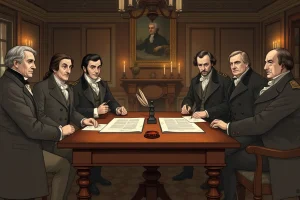
Negotiations began in Ghent, Belgium, in August 1814. The American commissioners—John Quincy Adams, Albert Gallatin, Henry Clay, Jonathan Russell, and James A. Bayard—initially demanded an end to impressment and recognition of neutral rights, but these had already been dropped as impractical. The British delegation, led by Admiral James Gambier, Henry Goulburn, and William Adams, began with ambitious demands, including the creation of an independent Indigenous buffer state in the Old Northwest and territorial concessions in Maine to secure a land corridor to Quebec. These demands were met with firm American resistance, and as the military balance shifted—notably the American victory at Lake Champlain and the British failure at Baltimore—London scaled back its objectives. On December 24, 1814, both sides signed the Treaty of Ghent. Article I stipulated that “all territory, places, and possessions whatsoever taken by either party from the other during the war” be restored without delay. Article IV established a commission to decide the ownership of islands in Passamaquoddy Bay, and Article V provided for a commission to resolve the Northeast boundary dispute. The treaty thus explicitly restored the pre-war borders and created mechanisms to settle older ambiguities, but it did not alter any recognized boundary.
Why It Matters
The absence of border changes in the Treaty of Ghent is a central fact in understanding the war’s outcome. For the United States, the war had been partly motivated by the desire to annex Canada, but that ambition was unfulfilled. For Britain, the defence of Canada was achieved, and the status quo preserved British maritime supremacy and the integrity of its colonies. The treaty’s silence on impressment and neutral trade meant that America’s declared war aims were unmet. The war’s only immediate territorial effect was the temporary occupation of American territory in Maine, which was returned after ratification. In the long run, however, the peace settlement led to the Rush-Bagot Agreement of 1817, which demilitarized the Great Lakes, and to later boundary arbitration that eventually clarified disputes. The war thus reinforced the existing border rather than altering it, and it set a precedent for peaceful resolution of boundary issues.
Definition
A border change refers to an alteration in the line of sovereignty between two countries, whether through cession, annexation, or treaty adjustment. In the context of the War of 1812, the relevant question is whether the peace treaty transferred territory between the United States and Great Britain. The answer is no: no territory changed hands permanently. The status quo ante bellum principle meant that all occupied lands were returned to their original owners, and no new boundaries were drawn.
Background
The U.S.–British boundary had been defined by the 1783 Treaty of Paris, but the line was often vaguely described. For example, the border through the Great Lakes and the St. Lawrence River was based on the “middle of the water,” but islands and channels were contested. The northeast boundary along the St. Croix River and highlands was also disputed. These ambiguities were inherited from the colonial era and continued into the early 19th century. The war itself was fought along these frontier lines, but the peace negotiations deliberately avoided redrawing them. Instead, the treaty set up joint commissions to resolve specific disputes, which eventually delivered final determinations.
How It Worked
The Treaty of Ghent operated through a series of articles. Article I ordered the restoration of all captured territory and property. Article II required the cessation of hostilities upon ratification. Article IV established a commission to decide the ownership of islands in Passamaquoddy Bay, and Article V created a commission to settle the northeast boundary from the St. Croix River to the St. Lawrence. Article VI and VII did the same for the Great Lakes boundary. These commissions were to produce binding decisions, and they did so over the following years. The treaty’s restoration clause was absolute: all forts, territories, and possessions were to be returned without delay, and without destruction of public property. This was implemented in practice, though some American soldiers remained in the Thames River valley until July 1815, and the British returned Michilimackinac and other posts.
Competing Viewpoints
Historians largely agree that the war produced no immediate border changes, but they differ on the importance of this outcome. Some emphasize that the treaty’s silence on maritime issues meant a British victory in terms of war aims, while others view it as a draw because no territory was lost. A more nuanced interpretation holds that the war had indirect consequences for the border: the Rush-Bagot Agreement demilitarized the Great Lakes, and the boundary commissions eventually clarified lines that had been disputed, but these were not changes imposed by the war itself. Canadian historians often stress that the defence of the border and the preservation of British North America was a defining moment for what later became Canada. American historians sometimes frame the war as a “second war of independence,” but the border itself remained unchanged.
Role in the War of 1812
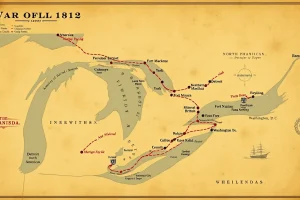
The border was a central theatre of the war. American invasions of Upper and Lower Canada in 1812, 1813, and 1814 were aimed at conquering territory, while British and Canadian forces defended their lines. Battles such as Queenston Heights, Lundy’s Lane, and the siege of Fort Erie occurred along the Niagara frontier. The war on the Great Lakes involved struggles for control of naval routes and supply lines. At the peace table, the British briefly sought territory in Maine and an Indigenous buffer state, but these demands were dropped after American resistance and military setbacks. The final treaty reverted to the pre-war boundary, reflecting a mutual exhaustion and a shared interest in stability. The war also highlighted the importance of the border as a symbol of sovereignty and identity for both sides.
Consequences and Historical Interpretation
The immediate consequence was a return to the status quo, with no territorial gains for either side. The treaty’s boundary commissions, however, led to a series of decisions that eventually defined the border with greater precision: the Passamaquoddy Bay islands were assigned in 1817, the northeast boundary was settled in 1842 by the Webster–Ashburton Treaty, and the Great Lakes boundary was clarified in 1822. The Rush-Bagot Agreement of 1817, which limited naval arms on the Great Lakes, and the later demilitarization of the entire U.S.–Canada border in the 1870s, contributed to a lasting peace. Historians interpret this outcome as evidence that the war, despite its violence, did not resolve the underlying issues that caused it, but it did establish a pattern of diplomatic resolution. The border that exists today between the United States and Canada is not a product of the war, but rather a continuation of pre-war arrangements that the war affirmed rather than altered.
Primary Sources
The most important primary source is the treaty itself: the “Treaty of Peace and Amity between His Britannic Majesty and the United States of America,” signed at Ghent on December 24, 1814. The treaty text is available in the U.S. National Archives and in various online repositories. It clearly states the restoration of territory and the creation of boundary commissions. Other sources include the official correspondence of the American negotiators, particularly John Quincy Adams’s diary and letters, which reveal the deliberations and the decision to abandon territorial claims from Britain. Admiral Lord Exmouth’s reports and the British Admiralty records also reflect the military context. The published writings of Albert Gallatin and Henry Clay, included in the American State Papers, provide further insight into the negotiations. One limitation is that these sources are predominantly from the American side; the British commissioner records are less accessible, but the treaty itself is the definitive legal text.
Further Reading
- Hickey, Donald R. The War of 1812: A Forgotten Conflict. University of Illinois Press, 1989.
- Stagg, J.C.A. The War of 1812: Conflict for a Continent. Cambridge University Press, 2012.
- Benn, Carl. The War of 1812. Osprey Publishing, 2002.
- American Battlefield Trust. “The Treaty of Ghent: Ending the War of 1812.” Accessed 2024.
- JSTOR Daily. “The Treaty of Ghent: Annotated.” Accessed 2024.
- The Historica-Dominion Institute. “1812 Borders Guide.” Government of Canada.
References
- American Battlefield Trust. “The Treaty of Ghent: Ending the War of 1812.” https://www.battlefields.org/learn/articles/treaty-ghent-ending-war-1812
- JSTOR Daily. “The Treaty of Ghent: Annotated.” https://daily.jstor.org/the-treaty-of-ghent-annotated/
- The Historica-Dominion Institute. “1812 Borders Guide.” http://education.historicacanada.ca/files/11/1812_borders_guide_EN.pdf
- Wikipedia. “Results of the War of 1812.” https://en.wikipedia.org/wiki/Results_of_the_War_of_1812
FAQ
Did the United States gain any territory from the War of 1812?
No. The Treaty of Ghent restored all territory to its pre-war status, so the United States did not acquire any new territory from Britain.
What did the Treaty of Ghent say about borders?
Article I ordered the restoration of all captured territory. Subsequent articles established commissions to resolve pre-existing boundary disputes, but no new boundaries were created.
Did the war lead to any permanent border changes?
No immediate changes, but the boundary commissions later clarified disputed lines, such as the northeast boundary, eventually settled by the Webster-Ashburton Treaty in 1842. The war also led to the Rush-Bagot Agreement, which demilitarized the Great Lakes.


Leave a Reply