
Short Answer
The question of why the United States did not conquer Canada during the War of 1812 (1812–1815) lies at the heart of that conflict’s historiography. American leaders and War Hawks expected a swift annexation of British North America, yet successive campaigns across the Detroit, Niagara, and Lake Champlain frontiers ended in failure or stalemate. This failure shaped the modern border, Canadian national identity, and the strategic relationship between Britain and the United States.
Historical Context
The War of 1812 began on June 18, 1812, when the United States declared war on Great Britain over impressment, trade restrictions, and British support for Indigenous nations resisting American expansion. Many Republicans, particularly the War Hawks in Congress, saw Canada—then a collection of British colonies including Upper and Lower Canada—as a vulnerable target. The United States enjoyed a population advantage of nearly 7.7 million to about 500,000 in Canada, making conquest seem plausible. American leaders like Thomas Jefferson called the acquisition of Quebec a “mere matter of marching,” while Speaker Henry Clay claimed Kentucky militia alone could seize Upper Canada. But the American army was small, poorly trained, and led by aging or incompetent officers. The militia system, which relied on state-controlled troops, proved unreliable for offensive action outside U.S. borders. In addition, the British military, though distracted by the Napoleonic Wars, maintained experienced regular forces in Canada, supported by Canadian militia and numerous Indigenous allies who viewed American expansion as a grave threat.
What Happened
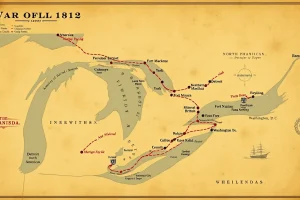
The United States launched its first invasion of Canada in July 1812, when Brigadier General William Hull crossed from Detroit into Upper Canada. After a brief siege of Fort Malden, Hull retreated to Detroit, where he surrendered his entire army to British Major General Isaac Brock on August 16 after a bombardment and a threat of an Indigenous assault. A simultaneous attack on Mackinac Island gave the British control over the upper Great Lakes. In October 1812, American General Stephen Van Rensselaer invaded across the Niagara River. His forces seized Queenston Heights but were pinned down and captured when New York militia refused to cross the river to reinforce them. A third thrust toward Montreal, led by General Henry Dearborn, stalled at Plattsburgh, New York, in November 1812, as militia again refused to leave U.S. territory. In 1813, American efforts improved in the West with Oliver Hazard Perry’s naval victory on Lake Erie and William Henry Harrison’s triumph at the Battle of the Thames, where Tecumseh was killed. However, the larger eastern campaigns failed. The Saint Lawrence campaign of 1813, aimed at Montreal, collapsed due to quarrels between Generals James Wilkinson and Wade Hampton, leading to defeat at Châteauguay. In 1814, the British launched counteroffensives, and although the war ended in a stalemate, no American invasion after 1812 succeeded in holding Canadian territory.
Why It Matters
The failure to conquer Canada had profound consequences. It prevented territorial expansion, forced the United States to settle for the status quo in the Treaty of Ghent (1814), and strengthened the British position in North America. Politically, it exposed the weakness of the American military system and prompted post-war reforms in infrastructure and military training. In Canada, the repulsion of invasions fostered a sense of distinct identity and cemented the legacy of defenders like Isaac Brock and Tecumseh. Historians continue to debate whether Canada was ever a primary war aim or merely a bargaining chip, and why a vastly more populous country failed so conspicuously.
Definition
“Conquering Canada” in the context of the War of 1812 refers to the American military objective of seizing and annexing the British colonies of Upper Canada (now Ontario) and Lower Canada (now Quebec). The goal was to end British influence on the continent and potentially incorporate the territory into the United States as states or territories.
Background
American desire to incorporate Canada predated the War of 1812. The Continental Congress had invited Quebec and Nova Scotia to join the Revolution, and the Articles of Confederation included a standing invitation for Canada to accede. After independence, expansionists looked north as a natural extension of republicanism. During the Napoleonic Wars, Britain’s maritime policies inflamed tensions, and War Hawks like Henry Clay saw Canada as a bargaining chip to compel Britain to respect American rights. The belief that Canadians—recently settled by American immigrants—would welcome liberation proved false; both French Canadians and Loyalist descendants sided with Britain.
How It Worked
The American war plan involved separate thrusts at strategically important points: the Detroit frontier, the Niagara Peninsula, and the Montreal–Lake Champlain corridor. Each campaign required moving men and supplies through wilderness and along waterways. The regular army numbered only about 12,000 troops at war’s outset, many untrained and led by inept officers. State militia, essential to fill out the numbers, often refused to serve outside U.S. borders. The British, by contrast, had a professional officer corps, control of Lake Ontario’s naval squadron, and mobile Indigenous allies who conducted raiding warfare. Canadian militia, though sometimes reluctant, fought to protect their homes. The American logistical system was poor: poor roads, lack of transport, and inadequate food and ammunition supplies crippled expeditions. The coordination between separate commands was abysmal, as seen in the 1813 Saint Lawrence campaign.
Competing Viewpoints
Historians differ on why the conquest failed. Traditional accounts emphasize American military incompetence and the heroic resistance of Canadians and Indigenous warriors. Others, like Donald Hickey, stress logistical and structural weakness: the United States was a young republic with a small standing army and anti-militaristic traditions. Alan Taylor and other historians note that the war was a complex borderlands conflict, with Indigenous politics and local rivalries equally important. A minority argue that American leaders never seriously intended to annex all of Canada—some sought it as a temporary bargaining chip to secure maritime concessions. The relative weight of these factors remains debated, but most agree that the United States’ inability to conquer Canada was due to a combination of operational failures, political constraints, and the strong defense mounted by British regulars, Canadian militia, and Indigenous nations.
Role in the War of 1812
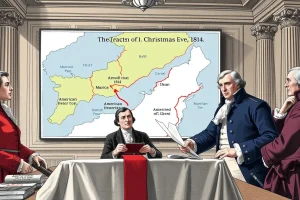
The failed conquest defined the land war. Had the Americans captured Montreal or Kingston, they could have isolated Upper Canada and possibly forced an early peace. Instead, the war slogged through raids and counter-raids. The United States achieved notable victories in the West and at sea, but these were not enough to secure Canada. In 1814, Britain, freed from Napoleon, sent more troops, and the focus shifted to defending the American frontier. The peace treaty of Ghent, signed in December 1814, restored all territory to its pre-war boundaries, leaving the project of conquering Canada permanently abandoned.
Consequences and Historical Interpretation
In the long run, the failed conquest solidified the 49th parallel and the Great Lakes as an international boundary, eventually demilitarized by the Rush-Bagot Agreement of 1817. In Canada, the War of 1812 became a founding moment, with battles like Queenston Heights celebrated as symbols of colonial loyalty and courage. In the United States, the war inspired nationalistic pride despite its ambiguous outcome, while politicians quietly dropped plans for northern annexation. Historians now view the failure as a result of the U.S.’s limited state power and the resilience of the British coalition. The question remains relevant today in debates about continental power and North American unity.
Primary Sources
Key primary sources include American and British military dispatches, such as General William Hull’s July 1812 proclamation to Canadian inhabitants urging them to accept American liberation, and his subsequent court-martial testimony. British commander Isaac Brock’s correspondence describes his strategies and his reliance on Indigenous allies. Also valuable are the diaries and letters of militia members, such as those from the New York militia who refused to cross into Canada. These sources are biased by national and personal perspective; American accounts often exaggerated obstacles, while British accounts celebrated victories. Nevertheless, they reveal the operational problems and attitudes of the time.
Further Reading
- Donald R. Hickey, The War of 1812: A Forgotten Conflict (University of Illinois Press, 1989)
- Alan Taylor, The Civil War of 1812: American Citizens, British Subjects, Irish Rebels, & Indian Allies (Knopf, 2010)
- J. Mackay Hitsman, The Incredible War of 1812: A Military History (University of Toronto Press, 1965)
- John R. Grodzinski, Defender of Canada: Sir George Prévost and the War of 1812 (University of Oklahoma Press, 2013)
- National Park Service, “A Mere Matter of Marching: Stalemate at the Canadian border” – NPS article
References
- Greenspan, Jesse. “How U.S. Forces Failed to Conquer Canada in War of 1812.” History.com, July 12, 2012. Link
- Hickey, Donald R. “A Mere Matter of Marching: Stalemate at the Canadian border.” National Park Service, March 10, 2015. Link
- Maass, Richard. “The 51st State That Never Was: Why the United States Didn’t Annex Canada.” War on the Rocks, February 14, 2025. Link
- Guttman, Jon. “The US Tried to Invade Montréal in the War of 1812. They Failed—and Saved Canada.” HistoryNet, May 3, 2022. Link
FAQ
Why did U.S. militia refuse to fight in Canada?
Many state militia members believed they were only obligated to defend their own states, not engage in offensive operations abroad. They also feared for the safety of their homes and lacked training for extended campaigns.
What role did Indigenous nations play in preventing U.S. conquest?
Indigenous nations such as the Shawnee, led by Tecumseh, and various Great Lakes tribes fought alongside the British to defend their lands against American expansion. Their raids, ambushes, and knowledge of the terrain significantly hampered American operations.
Did the United States ever seriously plan to conquer all of Canada?
Yes, many War Hawks and President James Madison endorsed invasion plans. However, some historians argue that the objective was often to use captured territory as a bargaining chip rather than permanent annexation.


Leave a Reply