Short Answer
The question of how news of peace reached the armies during the War of 1812 centers on the significant time lag between the signing of the Treaty of Ghent on December 24, 1814, and the moment when soldiers on both sides learned that the war was over. This delay had profound military consequences, most famously the Battle of New Orleans on January 8, 1815, which was fought more than two weeks after the peace treaty had been concluded but before the news arrived. Understanding this process reveals the limitations of early nineteenth-century communication and how they shaped the final military encounters of the war.
Historical Context
By late 1814, the War of 1812 had reached a stalemate. Both the United States and Great Britain, exhausted by over two years of conflict and eager to end the fighting, sent delegates to Ghent (in present-day Belgium) to negotiate a peace. The British had recently defeated Napoleon, freeing up veteran troops for North America, but also faced war-weariness at home. The Americans, despite some naval victories, had seen Washington burned and faced a tightening British blockade. Negotiations began in August 1814, and after months of wrangling over territorial boundaries, British impressment, and Indigenous rights, a compromise treaty was signed on December 24, 1814. However, the treaty contained no provisions for an immediate ceasefire; it merely stipulated that hostilities would cease once the ratifications were exchanged in Washington. This meant that the armies in the field remained under orders to fight until word of the treaty formally reached their commands.
What Happened
The Treaty of Ghent was signed on December 24, 1814. The American negotiators, including John Quincy Adams and Henry Clay, immediately dispatched copies of the treaty to the United States via the sloop-of-war HMS Favourite and the American ship HMS Brazen (though the British used their own couriers). The fastest crossing took roughly three to four weeks, but the Atlantic was stormy and ships often took longer. The primary copy intended for ratification by the U.S. Senate was carried by Henry Carroll, one of the American commissioners, who sailed on the Favourite. Meanwhile, fighting continued in several theaters. On January 8, 1815, British forces under Sir Edward Pakenham launched a major assault on American lines at New Orleans, defended by General Andrew Jackson. The attack resulted in a devastating British defeat, with over 2,000 British casualties to about 70 American losses. The battle occurred because neither commander had received word of the peace treaty. News finally reached Washington in mid-February 1815. The U.S. Senate ratified the treaty on February 16, and President James Madison proclaimed peace on February 17. Even after that, official dispatches were still traveling to remote outposts; some skirmishes occurred in the days and weeks following as news spread gradually across the frontier.
Why It Matters
The delay in transmitting peace news had immediate and long-lasting consequences. Immediately, it caused unnecessary bloodshed, most strikingly at New Orleans, a battle fought after the treaty had been signed. The American victory there, though strategically irrelevant to the peace settlement, became a powerful symbol of American military success and fueled a surge of national pride. The British, meanwhile, were forced to justify why they had launched an attack after the peace was concluded. For historians, the episode underscores the importance of communication in warfare and the difficulties of coordinating a global conflict. It also highlights the awkward situation in which both governments found themselves: having to explain why soldiers were still dying after a treaty had been signed. In the longer term, the Battle of New Orleans, despite being fought after the peace, helped shape American memory of the war as a victory, contributing to the “Second War of Independence” narrative. The delay also had practical implications for the treaty’s implementation, as both sides had to sort out territorial withdrawals and prisoner exchanges in a context where news was still reaching some areas weeks after ratification.
Definition
“News of peace” in the context of the War of 1812 refers to the formal communication that the Treaty of Ghent had been signed and ratified, and that all hostilities were to cease. In this era, there was no electronic communication; messages traveled by ship across the Atlantic and then by mounted couriers or postal service over land. The term “armies” includes all military forces—American, British, Canadian, and Indigenous allies—that were in active operations in North America at the time.
Background
During the early nineteenth century, communication across the Atlantic Ocean took between twenty and forty days depending on winds and weather. Official dispatches were often carried by naval vessels, but their speed was unpredictable. Once a ship reached port, the news still had to be transported overland to the capitals and then to the scattered military commands along the frontier. The War of 1812 was fought over a vast geographic area, from Canada to the Gulf of Mexico, and many posts were isolated by poor roads and wilderness. Thus, even after the treaty was signed, it could take weeks for official word to reach commanders in remote areas. Additionally, because the treaty did not take effect until ratifications were exchanged in Washington, commanders were still legally obliged to continue military operations until they received official notice that peace had been proclaimed.
How It Worked
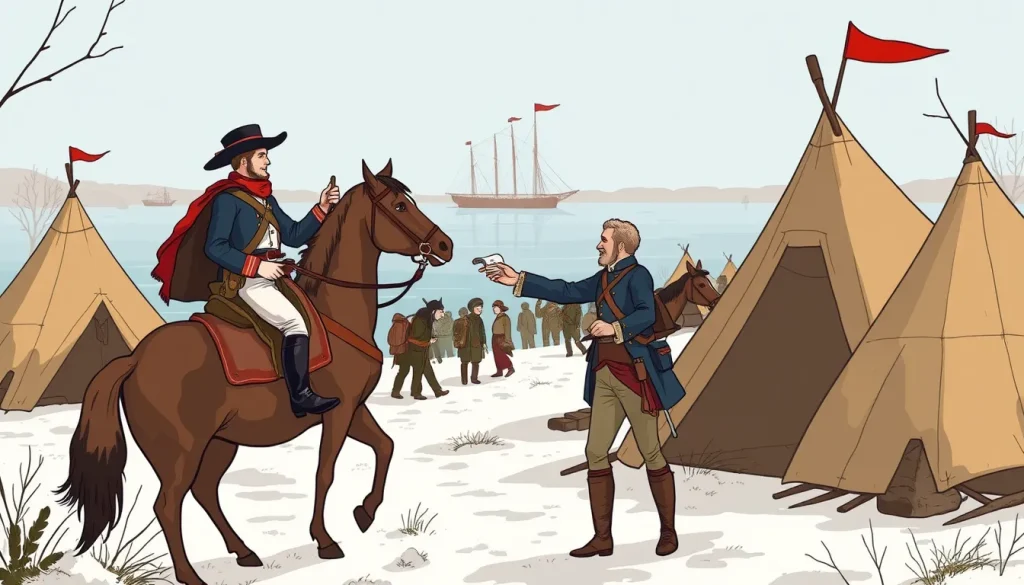
The process of transmitting peace news began with the signing of the treaty. Copies were sent to Washington and London immediately. The American ship HMS Favourite (though British, it was allowed to carry the American copy) sailed from Ghent with Henry Carroll and the American copy. Meanwhile, the British dispatched their own copy via HMS Brazen. The voyage across the Atlantic was often treacherous; storms and calms could delay arrival. When ships reached port—typically in the Chesapeake Bay or New York—they were met by couriers who rushed the documents to Washington and to the army commands. The U.S. government, upon receiving the treaty, called the Senate into session to ratify it. The official ratification copy was then carried to the military commands, but because of the distances, it took time. For example, Andrew Jackson at New Orleans did not receive official word until February 13, 1815, more than a month after the treaty was signed. In his case, the news arrived via courier from Washington. British commanders received their instructions via the Royal Navy; some orders were delayed by storms and misrouting. The actual cessation of fighting occurred when each commander received the explicit order to stop. As a result, there were several skirmishes in the weeks after the treaty, including a battle on February 11 at Fort Bowyer in Alabama, which occurred three days before Jackson’s formal notification. The system, though slow, was the only means available; it relied on the reliability of sailors, couriers, and the vagaries of weather.
Competing Viewpoints
Historians have debated whether the Battle of New Orleans was “unnecessary” in the sense that it was fought after the peace treaty. Some argue that the delay was unavoidable given the communication limits, and that both sides acted correctly under the rules of war. Others contend that the British attack was a reckless violation of the spirit of the peace, as they knew the treaty was signed but had not yet received official confirmation; in fact, the British fleet off the coast of Florida did receive news before the attack, but the commander decided to proceed anyway. This has led to different interpretations of the battle’s significance: some see it as a pointless tragedy, while others view it as a heroic American defense that saved the nation from a humiliating defeat despite the treaty. Another debate concerns the “peace news” itself: some scholars emphasize the role of unofficial rumors and private letters that circulated ahead of the official dispatches, while others focus on the official channels. The competing views illuminate how historians weigh strategy, communication, and timing in understanding the war’s end.
Role in the War of 1812
The delay in peace news directly affected the final military operations of the War of 1812. It allowed the Battle of New Orleans to take place, which became the most famous engagement of the war and shaped American perceptions of the conflict. It also affected operations in the Chesapeake, where British forces continued to raid until they received the news in February. The delay complicated logistics and prisoner exchanges, and it required both governments to communicate the peace to their far-flung commands. For Indigenous peoples, the delay meant that fighting continued in some regions, and the peace treaty’s provisions, which largely ignored their interests, were implemented without their input. In sum, the slow transmission of peace news was a defining feature of the war’s end, highlighting the challenges of managing a global war in an age of sail.
Consequences and Historical Interpretation
The most immediate consequence was the Battle of New Orleans, which occurred after the treaty was signed. The American victory there, though strategically inconclusive since the war was over, boosted American national morale and helped create the myth of a British defeat. For the British, it was an embarrassing coda to a war they considered peripheral. The delay also forced a reevaluation of military protocol: commanders had to decide when to obey a treaty that had not been ratified. In the aftermath, both governments recognized the need for faster communication, though it would take another generation for the telegraph to change that. Historians today interpret the episode as an example of the “friction of war”—the unpredictable delays and miscommunication that complicate even the clearest orders. The peace-news delay is also used to illustrate the difference between formal diplomacy and the lived experience of soldiers, many of whom did not know the war had ended until days or even weeks later.
Primary Sources
Several primary sources document the transmission of peace news. The Treaty of Ghent itself (signed December 24, 1814) is the foundational document; the National Archives of the United States holds the official U.S. copy. The letters and journals of Andrew Jackson, preserved in the Library of Congress, show his surprise upon receiving the peace news in mid-February 1815. British commander Sir Edward Pakenham’s official dispatch, written before his death at New Orleans, expressed confidence in the assault while unaware of the treaty. The correspondence of U.S. Secretary of State James Monroe and diplomat Henry Carroll provides insight into the efforts to get the ratified treaty to the field. Newspapers of the era, such as the National Intelligencer and the Times (London), reported the arrival of the news and the reaction of the public. One key limitation of these sources is that they were often written after the fact, influenced by the desire to portray events in a favorable light. For example, Jackson’s later accounts emphasize his decisive response to the news, while British accounts downplay the significance of the post-treaty battle.
Further Reading
- Hickey, Donald R. The War of 1812: A Forgotten Conflict. University of Illinois Press, 1989.
- Benn, Carl. The War of 1812. Osprey Publishing, 2002.
- Stagg, J.C.A. Mr. Madison’s War: Politics, Diplomacy, and Warfare in the Early American Republic, 1783–1830. Princeton University Press, 1983.
- Bickham, Troy O. The Weight of Vengeance: The United States, the British Empire, and the War of 1812. Oxford University Press, 2012.
- Library of Congress. “Treaty of Ghent”. Digital copy available at loc.gov.
References
- Hickey, Donald R. The War of 1812: A Forgotten Conflict. University of Illinois Press, 1989.
- Benn, Carl. The War of 1812. Osprey Publishing, 2002.
- Stagg, J.C.A. Mr. Madison’s War: Politics, Diplomacy, and Warfare in the Early American Republic, 1783–1830. Princeton University Press, 1983.
- “Treaty of Ghent.” National Archives, Washington, D.C.
- Jackson, Andrew. Papers. Library of Congress.
FAQ
How long did it take for news of the Treaty of Ghent to reach the armies?
It took between 30 and 50 days. The treaty was signed on December 24, 1814, and most commanders did not receive official word until mid-February 1815.
Did any fighting occur after the peace treaty was signed?
Yes, the Battle of New Orleans on January 8, 1815, and several smaller engagements happened after the treaty was signed but before news reached the commanders.
Why did the Battle of New Orleans happen if the war was already over?
Because the treaty did not take effect until ratified and exchange of ratification had occurred. News had not reached the battlefield, so both sides continued fighting under standing orders.


Leave a Reply