Short Answer
Western expansion of the United States into the trans-Appalachian West between the Revolution and the War of 1812 provoked sustained Native American resistance, culminating in military confrontations such as the Battle of Fallen Timbers and the Battle of Tippecanoe. This conflict over land and sovereignty became a principal cause of the War of 1812, as Indigenous nations forged alliances with British Canada to check American encroachment. Understanding this struggle is essential for interpreting the war’s origins and its consequences for North American peoples.
Historical Context
Following the Treaty of Paris in 1783, the United States claimed all territory east of the Mississippi, but the Northwest Territory remained firmly held by diverse Indigenous nations, including the Shawnee, Miami, Delaware, Wyandot, and Ottawa. The U.S. government, seeking to secure land for settlers and revenue, pressed for land cessions through treaties. However, many Native peoples saw these treaties as fraudulent. Britain, still maintaining posts in the region and trading with Native nations, encouraged resistance to limit U.S. expansion. The weak Confederation government was unable to enforce its claims, and violence erupted. The Northwest Ordinance of 1787 established territories and encouraged settlement, further intensifying pressure. These conditions set the stage for a series of wars and diplomatic conflicts.
What Happened
The Northwest Indian War (1785–1795) saw a multitribal confederacy, led by warriors such as Blue Jacket and Little Turtle, twice defeat American armies under Generals Josiah Harmar (1790) and Arthur St. Clair (1791). In 1794, General Anthony Wayne’s Legion of the United States defeated the confederacy at the Battle of Fallen Timbers, near present-day Toledo, Ohio. This led to the Treaty of Greenville in 1795, by which twelve Native nations ceded much of present-day Ohio and parts of Indiana and other states. American settlement then surged, and Native peoples lost further land through successive treaties. In the early 1800s, as pressure mounted, the Shawnee brothers Tecumseh and Tenskwatawa (the Prophet) revitalized resistance. They called for a pan-Indian confederacy and rejected land sales. In 1811, Indiana Governor William Henry Harrison marched against their settlement at Prophetstown and attacked at the Battle of Tippecanoe. Although the battle was indecisive, it destroyed the town and damaged the movement’s credibility. Many warriors then turned to the British for support. By 1812, the frontier was on the brink of war, with Native nations and the British aligning against American expansion.
Why It Matters
The pre-1812 expansion and resistance fundamentally altered the geopolitical landscape of eastern North America. The American victories in the 1790s opened the Old Northwest to settlement, but also fueled Native grievances and British involvement. Tecumseh’s confederacy and the Tippecanoe battle directly contributed to American calls for war against Britain, which they accused of instigating Indian attacks. The War of 1812 itself witnessed Native nations fighting alongside British forces, as at the Siege of Detroit and the Battle of the Thames. The eventual American victory and the death of Tecumseh shattered the pan-Indian movement, leading to further land cessions and the displacement of many Native peoples. Historians have interpreted this period as a struggle over power and sovereignty, with Native resistance representing both a defense of homelands and an assertion of political autonomy.
Definition
Western Expansion and Native Resistance before 1812 refers to the processes by which the United States extended sovereignty over the trans-Appalachian West and the organized opposition of Native American nations to that expansion, from the end of the Revolutionary War to the eve of the War of 1812.
Background
The background includes the French and Indian War, British control, American Revolution, and the establishment of the U.S. The Proclamation of 1763 had reserved the West for Indians, but after independence the U.S. disregarded that. The Treaty of Paris gave the U.S. land that Indians still occupied. The federal government pursued a policy of land acquisition and assimilation, while settlers moved across the Appalachians.
How It Worked
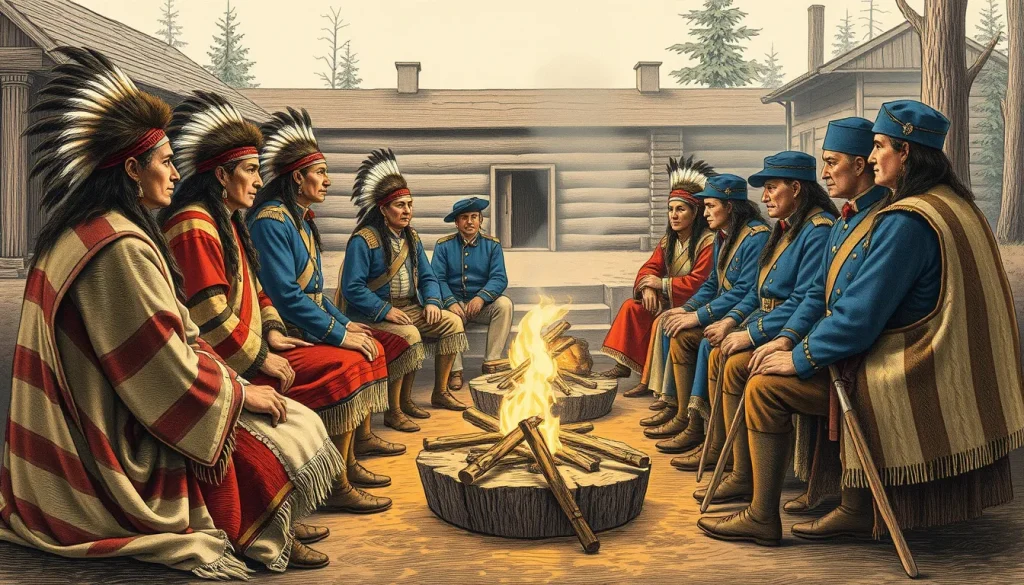
U.S. policy employed treaties, military expeditions, and the establishment of territorial governments. Treaties were often made with selected chiefs or factions, not full tribal councils, leading to disputes. Military efforts ranged from punitive campaigns to the regular army’s operations. The Indian factory system aimed to control trade and influence. Native resistance took forms from diplomacy and alliances to armed conflict, including the Northwest Indian War and Tecumseh’s confederacy.
Competing Viewpoints
Americans saw expansion as a natural right and a fulfillment of destiny, viewing Indians as obstacles to civilization. Many American officials, including Thomas Jefferson, believed that Indians should be assimilated or removed. Native peoples viewed the U.S. as an aggressor that broke promises and sought to destroy their cultures and take their lands. The British, interested in maintaining trade and security, supported Native resistance as a buffer against U.S. expansion. These rival perspectives created a cycle of violence and misunderstanding.
Role in the War of 1812
The tensions over Western expansion and Native resistance were among the primary causes of the war. American war hawks blamed British for inciting Indian attacks by supplying arms and occupying forts. The Battle of Tippecanoe was used as evidence of the “Indian menace.” When war was declared in June 1812, many Native nations allied with the British, expecting to reclaim their lands. The alliance affected early British victories and the course of the war in the Northwest. The American invasion of Canada was partially aimed at cutting off British support for the Indians. The end of the war left Native nations without the promised British protection.
Consequences and Historical Interpretation
The war’s conclusion, with the Treaty of Ghent, essentially returned the status quo of territories, but it was a disaster for Native peoples. The British abandoned their Indian allies, and the U.S. intensified its expansion. Tecumseh’s death and the destruction of the confederacy allowed for forced removal in the following decades, culminating in the Trail of Tears. Historians have debated the degree to which Native resistance shaped U.S. policy and the war’s outcome. Some view the period as the end of an era for Eastern Indians, others as a continuation of resistance. The war also solidified American control over the old Northwest and paved the way for further westward expansion.
Primary Sources
Important contemporary documents include the Treaty of Greenville (1795), which records the land cessions after Fallen Timbers. Tecumseh’s speeches to William Henry Harrison in 1810, though recorded by Harrison and possibly edited, express Native demands and unity. Harrison’s official report on the Battle of Tippecanoe (November 1811) provides the American military perspective but is one-sided. British military correspondence, such as letters from Sir Isaac Brock or Indian agent Matthew Elliott, reveals British support for Native nations. These sources are valuable but often reflect Euro-American viewpoints; direct Native voices are scarce and often mediated.
Further Reading
- Dowd, Gregory Evans. A Spirited Resistance: The North American Indian Struggle for Unity, 1745-1815. Johns Hopkins University Press, 1992.
- White, Richard. The Middle Ground: Indians, Empires, and Republics in the Great Lakes Region, 1650-1815. Cambridge University Press, 1991.
- Horsman, Reginald. Expansion and American Indian Policy, 1783-1812. University of Oklahoma Press, 1967.
- Sugden, John. Tecumseh: A Life. Henry Holt, 1998.
References
- National Park Service. “Native tribes view white encroachment with suspicion.” Accessed 2025. http://nps.gov/articles/native-tribes-view-white-encroachment-with-suspicion.htm
- Encyclopedia.com. “Claiming the Near West: Territorial Expansion to 1812.” Accessed 2025. https://www.encyclopedia.com/history/encyclopedias-almanacs-transcripts-and-maps/claiming-near-west-territorial-expansion-1812
- Encyclopedia.com. “American Indian Resistance to White Expansion.” Accessed 2025. https://www.encyclopedia.com/history/encyclopedias-almanacs-transcripts-and-maps/american-indian-resistance-white-expansion
- Bergmann, William H. “Commerce and Arms: The Federal Government, Native Americans, and the Economy of the Old Northwest, 1783–1807.” The Journal of Economic History (2006). DOI: 10.1017/S0022050706250204.
- Krieger, Brian Isaac. “Power Struggle in the Old Northwest: Why the United States Won and the Indians Lost the Indian War, 1786-1795.” M.A. thesis, North Carolina State University, 2008. http://lib.ncsu.edu/resolver/1840.16/2160
FAQ
What was the Northwest Indian War?
It was a series of conflicts from 1785 to 1795 between the United States and a multitribal confederacy of Native nations in the Ohio Valley. The war ended with the Battle of Fallen Timbers and the Treaty of Greenville, which opened much of Ohio to settlement.
Why did Tecumseh form a confederacy?
Tecumseh and his brother Tenskwatawa sought to unite Native nations to resist further land cessions and cultural assimilation. They argued that land belonged to all Native peoples and could not be sold by individual tribes, and they called for a return to traditional ways.
How did Native resistance lead to the War of 1812?
American grievances against British support for Native resistance, including supplying arms and encouraging attacks on settlers, were a major cause of the war. The Battle of Tippecanoe in 1811 heightened anti-British sentiment, and the belief that Britain was instigating Indian warfare helped push the United States to declare war in 1812.
Leave a Reply