
Short Answer
That answer changes when victory is measured by particular objectives. Britain and the Canadian colonies successfully resisted American invasion. Americans celebrated defensive victories and gained confidence in their country. Many Indigenous nations, however, suffered weakened alliances, lost territory, and greater exposure to American expansion.
The most useful assessment is therefore: an inconclusive Anglo-American war, a successful defense of British North America, and severe consequences for many Indigenous peoples. For some enslaved people who reached British protection, the conflict also opened a route to freedom. ^1
Results at a Glance
| Perspective | Main result | What it means for the question of victory |
|---|---|---|
| United States | No annexation of Canada; territory restored; renewed national confidence | Survival and morale supported victory claims, despite limited treaty gains |
| Britain | Canadian colonies retained; blockade damaged American commerce | Britain achieved its central defensive objective |
| Canadian colonies | American invasions failed to secure lasting conquest | Local defenders could regard the outcome as a victory |
| Indigenous nations in the northwest | Tecumseh’s coalition weakened; British backing became less effective | Major political and strategic losses |
| Muscogee/Creek communities | Devastating defeat and extensive land cession | Connected warfare brought lasting dispossession |
| Some freedom seekers | Escape and resettlement under British protection | Individual and family freedom, rather than national victory |
| Civilians and military families | Death, injury, disrupted livelihoods, and destruction | National celebration did not erase personal losses |
These outcomes explain why a single winner label is inadequate. A settlement that preserved the territory of two governments could still transform the security and future of other participants. ^42^5
How Should Victory Be Measured?
The question has several possible meanings:
- Military victory: Did one side decisively defeat the other’s armed forces?
- Diplomatic victory: Did the peace agreement secure the objectives that motivated the war?
- Defensive success: Did a government or community preserve what it intended to protect?
- Long-term advantage: Did the war improve a participant’s position afterward?
- Victory in public memory: Did later generations remember the conflict as a triumph?
These measures can point in different directions.
An army can lose battles while successfully defending its territory. A government can accept modest treaty terms while its citizens celebrate a famous victory. A military ally can help defend another country and still lose its own struggle for land and autonomy.
The analysis below separates those questions. This avoids treating a celebrated battle, the formal peace agreement, and the consequences decades later as interchangeable evidence.
What the Treaty of Ghent Actually Achieved
Restoration Rather Than Conquest
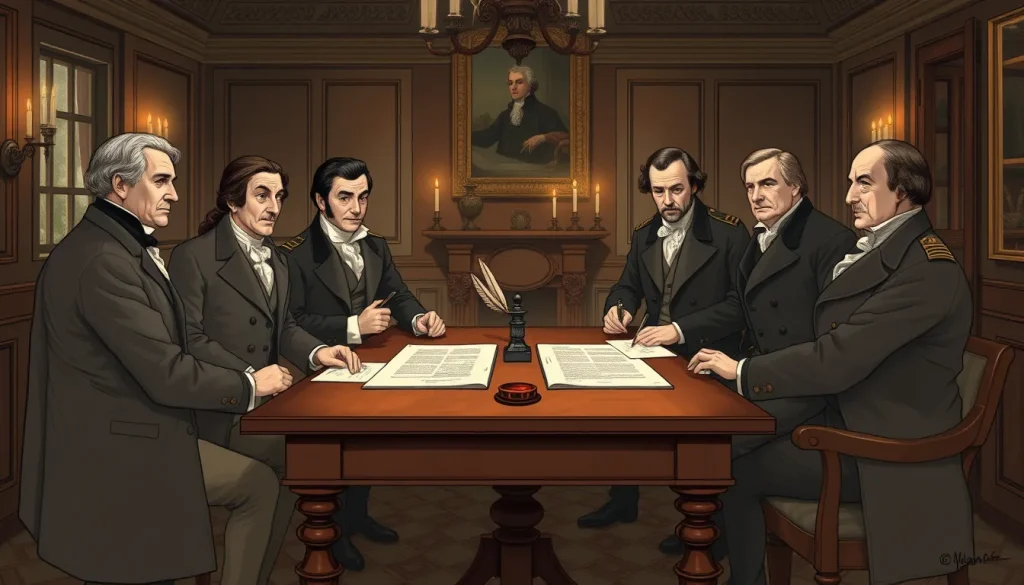
American and British negotiators signed the Treaty of Ghent on December 24, 1814, in present-day Belgium.
Its central territorial principle was restoration of places taken by one party from the other. Historians describe this as status quo ante bellum, meaning the situation before the war.
The agreement did not annex Canada to the United States or award Britain a permanent conquest of American territory. It also established procedures for addressing disputed boundaries.
Restoration did not mean that the war had changed nothing. It described the settlement between the two principal states; the experiences of Indigenous nations and displaced civilians require separate examination. ^3
Key Provisions and Omissions
| Issue | Result at Ghent |
|---|---|
| Captured territory | General restoration, with specified disputed islands handled separately |
| Prisoners of war | Return provided for by the treaty |
| Boundary disputes | Commissions established to investigate and resolve disagreements |
| Impressment | No treaty commitment ending the practice |
| Indigenous nations | Article IX provided for ending hostilities and restoring specified rights and possessions |
| Slave trade | Article X pledged efforts toward abolition of the trade; it did not abolish slavery |
The omissions matter as much as the provisions. American negotiators did not obtain a written British concession on impressment, one of the grievances used to justify the war. ^7
When Did the War End?
The treaty’s signature and its entry into force were different events.
The main British assault at New Orleans occurred on January 8, 1815. The U.S. Senate approved the treaty on February 16, and ratifications were exchanged on February 17, 1815, formally ending the Anglo-American war.
Fighting could continue where news arrived slowly. The conflict did not stop everywhere at the moment diplomats signed the document in Europe.
This chronology is essential when evaluating New Orleans: the battle came after the terms had been negotiated, but before the treaty took effect. ^9
Did the United States Win?
The Case for an American Victory
Americans could point to real accomplishments. The United States resisted British invasions, retained its territory under the peace settlement, and achieved memorable victories on land and water.
Successful defenses at Baltimore and Plattsburgh, followed by New Orleans, provided a powerful ending to a war marked by earlier humiliations.
The conflict also reinforced public confidence in American sovereignty and military ability. Celebrated ships, commanders, flags, and battle stories supplied material for a stronger national identity.
These were meaningful gains, but they were not the same as securing every original war objective. The distinction explains how Americans could remember victory while the treaty itself offered limited concessions. ^10
The Case Against Calling It a Decisive American Victory
The United States failed to conquer British North America. Early invasions suffered serious reverses, and later gains did not produce permanent annexation.
The peace agreement also omitted a British renunciation of impressment. A return to the prewar territorial position was far more modest than the ambitions expressed by some American supporters of war.
British naval power constrained American commerce and military operations throughout much of the conflict.
Judged against ambitious offensive aims and demands for maritime concessions, the American result was limited. Describing it as an unqualified victory would ignore the gap between what supporters hoped to achieve and what the settlement delivered. ^11
Was It a Second War of Independence?
The phrase second war of independence captures a powerful American interpretation: the young republic had defended its sovereignty against British pressure.
It should not be read as a claim that the United States first became legally independent in 1815. Britain had already recognized American independence in the Treaty of Paris of 1783.
The War of 1812 concerned the treatment, security, and rights of an existing sovereign country. Its later description as another independence struggle expressed national pride and the desire for respect, rather than a new legal creation of the United States.
Keeping those meanings separate preserves the significance of the phrase without confusing the two wars. ^12
Did Britain Win?
Britain Preserved Its North American Colonies
Britain’s strongest claim rests on successful defense.
In 1812, British leaders sought to protect their North American possessions while continuing the struggle against Napoleon. American armies did not achieve a lasting conquest of the Canadian colonies.
By that measure, Britain obtained a central objective. Defense can count as success even without major territorial expansion.
It would therefore be misleading to describe the war as an American victory over Britain simply because Americans won prominent battles late in the conflict. British North America remained outside American control. ^14
The Blockade Was a Major British Achievement
The Royal Navy’s blockade damaged American commerce and placed sustained pressure on coastal regions.
American frigates won celebrated individual encounters, but those victories did not remove Britain’s overall naval superiority or break the blockade.
This distinction is important. Winning a ship duel demonstrates tactical success; maintaining a blockade affects trade, revenue, access to ports, and an opponent’s ability to use its navy.
British maritime pressure thus forms part of any serious assessment of the outcome. An account centered only on American naval heroes would leave out one of Britain’s most effective instruments of war. ^15
Why Not Call It a Complete British Victory?
Britain did not decisively compel the United States to accept all the demands advanced during negotiations.
British offensives suffered setbacks, and the final settlement did not create the proposed Indigenous buffer territory between American settlements and British North America.
The peace also reflected a desire to end an expensive and distracting conflict. British success in defending Canada did not automatically mean that continued fighting would yield worthwhile additional gains.
Britain can reasonably claim defensive and maritime success. Calling the entire war a complete victory goes further than the negotiated result supports. ^17
Did Canada Win?
A Successful Defense of the Colonies
People in the Canadian colonies had a clear reason to regard the outcome as a victory: American invasion had not brought their communities under American rule.
British regulars, colonial forces, militia, and Indigenous allies contributed to that defense. Their resistance preserved British North America’s separate development.
This is a stronger claim than suggesting that Canadian forces conquered the United States. The principal achievement was preventing conquest of their own territory.
The defense became part of later Canadian historical memory. ^18
Canada Was Not Yet the Modern Confederation
In 1812, Upper Canada and Lower Canada were British colonies. Confederation came in 1867.
Saying “Canada won” is therefore shorthand for the successful defense of territories and communities that later became part of modern Canada.
It should not imply that an independent Canadian national government directed the war. Nor should it erase the roles of British forces and Indigenous nations.
The outcome helped preserve the conditions for Canada’s later development, but the war did not immediately establish the modern country. ^19
A Shared Defense Did Not Produce Equal Outcomes
Indigenous allies helped defend the colonies, yet their longer-term interests did not always align with those of colonial governments.
As the American threat diminished, pressure on Indigenous land could increase within British North America as well.
A Canadian victory narrative therefore needs qualification. Preserving the colonies was a real achievement, but it did not guarantee the land security or autonomy Indigenous participants sought.
Military cooperation did not permanently settle the interests of all participants. ^18
Why Indigenous Nations Suffered the Greatest Strategic Losses
Their War Aims Were Different
Many Indigenous participants sought protection of homelands and political autonomy against American expansion. Cooperation with Britain was a means of pursuing those interests.
Their objectives were not satisfied simply because Britain retained Canada. Nor did restoration of Anglo-American territory restore their own political strength.
The peace between Britain and the United States weakened the possibility of using British military support to resist American expansion.
The war’s consequences must therefore be assessed from Indigenous objectives, rather than assuming that a British ally necessarily shared Britain’s result. ^4
Tecumseh’s Death and the Northwest
Tecumseh worked to build an alliance capable of resisting American territorial encroachment.
American victory on Lake Erie in September 1813 undermined the British position around Detroit. The subsequent retreat led to the Battle of the Thames, where Tecumseh was killed on October 5.
His death and the defeat severely weakened the coalition’s prospects. The American recovery in the northwest also reduced the leverage available to Indigenous resistance.
This did not end every Indigenous struggle. It was, however, a major setback to an effort to create a durable collective barrier to American expansion. ^20
Horseshoe Bend and the Treaty of Fort Jackson
In the connected Creek War, Andrew Jackson’s forces defeated Red Stick fighters at Horseshoe Bend on March 27, 1814.
The Treaty of Fort Jackson of August 9, 1814, imposed an enormous land cession on the Creek Nation—nearly 22 million acres according to the National Park Service’s treaty account.
Creek communities that had cooperated with the Americans also faced the consequences of the cession. Alliance with Jackson did not protect them from his territorial demands.
These gains came through warfare and agreements involving Indigenous peoples, rather than a British cession of Canada. They help explain why the United States could emerge with advantages for expansion even while Ghent restored territory between the principal states. ^5
What About Article IX of the Treaty of Ghent?
Article IX required Britain and the United States to end hostilities with Indigenous nations at war with them and restore specified possessions, rights, and privileges associated with 1811, subject to reciprocal cessation of hostilities.
It would therefore be inaccurate to say that the treaty contained no provision concerning Indigenous peoples.
The problem was the difference between written protection and effective protection. The settlement did not establish the proposed buffer territory or secure a lasting defense against further dispossession. ^7
Long-Term Consequences
After the war, American expansion and land cessions continued. Indigenous communities faced a changing balance of power in which a major external source of military support had become less available.
These developments contributed to the circumstances in which later removal policies operated. The war was not the sole cause of removal, and the consequences unfolded over time.
Indigenous peoples continued to negotiate, resist, adapt, and preserve communities and cultures. Recognizing the severity of the losses does not mean treating 1815 as the end of Indigenous political agency. ^24
What Did New Orleans Change?
A Decisive Battle, Not a Decisive Peace Settlement
The British main assault at New Orleans on January 8, 1815, ended in a decisive American defensive victory.
Jackson’s success protected the city during the campaign and supplied a dramatic military achievement. It did not rewrite the Treaty of Ghent, whose terms had already been agreed in December.
This is the central distinction: New Orleans was a major American victory within the war, but it did not by itself decide the negotiated outcome of the entire conflict. ^26
Why the Battle Shaped American Memory
News of New Orleans and news of peace reached Americans close together. The combination encouraged celebrations that associated the end of the war with military triumph. ^9
Jackson became a national hero. The battle’s place at the end of the familiar story helped overshadow earlier failures.
That does not make the victory imaginary. It explains why a genuine battlefield success acquired a broader meaning than the peace terms alone would suggest.
The treaty and the battle played different roles: one ended the conflict, while the other helped shape how Americans interpreted its ending. ^27
Was the Battle Meaningless Because the Treaty Was Signed?
No. The treaty was not yet in force, and the forces near New Orleans had not received timely news of the agreement.
Soldiers and defenders still faced an active military threat. The battle had immediate consequences for lives, positions, and public confidence.
What cannot be established as fact is a hypothetical claim about exactly what Britain would have done had it captured the city. Such scenarios require assumptions about decisions that were never made.
The documented result is sufficient: the assault failed, the existing peace terms remained in place, and the victory transformed Jackson’s reputation. ^26
Why the Military Results Do Not Produce One Simple Winner
The fighting took place across different theaters. Success in one region could coincide with failure elsewhere.
| Campaign or engagement | Result relevant to the wider war |
|---|---|
| Detroit, 1812 | American surrender undermined the initial northwestern offensive |
| Canadian invasion routes, 1812–1813 | Defenders prevented a lasting American conquest |
| Lake Erie and the Thames, 1813 | American recovery in the northwest; major setback for Tecumseh’s movement |
| Washington, 1814 | British victory at Bladensburg enabled destruction of public buildings |
| Plattsburgh and Baltimore, 1814 | American defenses checked British offensives |
| New Orleans, 1815 | Main British assault decisively repulsed |
Counting victories without examining their effects produces a weak assessment. Capturing a town, preserving a supply route, stopping an invasion, and destroying a coalition were different achievements. ^19^28
At Plattsburgh, the naval defeat prompted British withdrawal. Historians differ over how decisively that result influenced negotiations at Ghent. It is safest to distinguish the demonstrated campaign effect from stronger claims that one battle alone dictated the peace. ^29
Political and Cultural Consequences in the United States
Nationalism and Public Symbols
The war encouraged a stronger sense of American national identity.
The defense of Fort McHenry, the reputation of USS Constitution, and celebrated commanders became prominent symbols. Public memory often joined the War of 1812 to the story of the American Revolution.
This patriotic interpretation helped Americans remember the conflict as confirmation of national strength.
National feeling was a consequence of the war, but it is not proof that the United States won every military or diplomatic contest. A society’s confidence and the exact terms of a peace treaty answer different questions. ^30
The Federalists and the Hartford Convention
Federalist opposition to the war reflected serious political and economic disagreements.
The Hartford Convention of 1814–1815 gave New England critics a forum for grievances and proposed changes. News of peace and American victory made that opposition appear badly timed.
The convention became associated with accusations of disloyalty and contributed to the party’s loss of national influence.
It should not be simplified into the claim that every participant was plotting treason. Nor did the party disappear instantly because of a single meeting. The war intensified a political decline within a broader changing party system. ^32
Military Heroes and Political Careers
The conflict elevated commanders whose reputations extended into national politics.
Jackson’s victory at New Orleans was particularly influential. His image as a successful military leader became an enduring political asset.
Such careers show how battlefield reputation could matter long after peace. They also demonstrate why later political success should be treated as a consequence of wartime prominence, rather than as evidence that the entire war had been decisively won. ^27
Economic Costs and Institutional Changes
Commerce and Regional Damage
The war disrupted trade and exposed coastal communities to blockade and raids.
Merchants, farmers, shipowners, and workers could lose markets, property, or income. Recovery varied by region and occupation.
Restrictions on imported goods also encouraged some domestic manufacturing. That uneven effect should not be mistaken for a net benefit shared by everyone.
An industry might gain orders while nearby farms or commercial enterprises suffered destruction. The experience of particular sectors is therefore more informative than a sweeping statement that the war either ruined or strengthened the entire economy. ^34
Banking and Government Finance
The conflict exposed weaknesses in federal finance.
The First Bank of the United States had lost its charter before the war. Difficulties financing military operations helped strengthen the case for another national bank.
Madison signed the charter for the Second Bank of the United States in April 1816, and it opened in 1817.
This development was part of the institutional response to wartime problems. It illustrates how a costly and inconclusive conflict could still lead policymakers to reconsider earlier positions about national capacity. ^35
Coastal Defense
British raids and the vulnerability of American ports encouraged changes in defense planning.
The postwar Third System of Coastal Fortifications developed from a broader strategy initiated in 1816. New forts and improvements to older positions sought to reduce the risks exposed during the war.
These investments were lessons drawn from vulnerability. They should not be presented simply as rewards for victory.
A government can emerge from a war with greater confidence while also recognizing that its earlier preparations were inadequate. ^36
Freedom, Slavery, and Unequal Outcomes
Freedom Through British Protection
Some enslaved African Americans escaped to British ships and camps. Men who joined the Colonial Marines served in British operations, while family members also sought refuge.
After the war, freedom seekers were resettled in places including Nova Scotia and Trinidad. Descendants of Colonial Marines in Trinidad became known as the Merikins.
For those families, the most important result could be freedom from slavery. Their success does not fit neatly into an American or British national victory label. ^6
Service Did Not Bring General Equality
Black men also served with American forces, but military contribution did not produce general emancipation or racial equality.
The experience varied by legal status, location, and individual circumstances. Celebrations of national freedom could coexist with continued slavery and exclusion.
Britain’s assistance to freedom seekers likewise should not be confused with abolition of slavery across its empire at that time.
The war could create an opportunity for one family while leaving the broader structures of oppression intact. Those different scales of outcome need to be kept separate. ^38
The Human Cost
National achievements did not erase death, disability, grief, or destruction.
Military personnel faced disease as well as enemy fire. Treatment was limited, and surviving a wound could leave lasting consequences.
Civilians experienced disrupted livelihoods, displacement, and the loss of homes or relatives.
The absence of major territorial changes between Britain and the United States therefore does not make the war insignificant. For people who bore its costs, the return of peace mattered regardless of which country later claimed victory. ^39
Did the War Create a Peaceful Border?
The peace of 1815 opened the way to further agreements, but it did not immediately settle every boundary dispute or eliminate tension.
The Rush-Bagot agreement of 1817 limited naval armament on the Great Lakes. The Convention of 1818 addressed additional issues and established the forty-ninth parallel as the boundary across a western section of British North America and U.S. territory.
These arrangements helped reduce the risk of renewed conflict.
The later peaceful relationship was built through subsequent diplomacy. It was not a single provision of Ghent, and the entire modern border was not drawn in 1814.
This is an important long-term consequence: a war without decisive conquest could be followed by agreements that made another war less attractive. ^41
Common Misconceptions
The United States Won Because It Won New Orleans
New Orleans was a decisive American battle victory. The peace terms had already been negotiated, so it cannot alone establish victory in the entire war.
Britain Won Because It Burned Washington
The destruction was a major American humiliation, but it did not end the war or force American surrender.
A Draw Means Nobody Lost Anything
The restoration of Anglo-American territory did not restore lives, property, or the security of Indigenous nations.
Ghent Ended Impressment by Treaty
The treaty did not contain that concession. Changed European circumstances reduced the practical urgency of the dispute.
The Treaty Abolished Slavery
Article X concerned efforts against the slave trade. It did not abolish slavery. ^7^26
References and Further Reading
FAQ
Did the United States win the War of 1812?
Not in a formal sense. The Treaty of Ghent restored prewar boundaries and resolved none of the maritime issues in dispute. Many historians argue the United States nonetheless gained in practice, because Britain abandoned impressment and trade restrictions once the Napoleonic Wars ended.
Why is the Battle of New Orleans important to the question of who won?
Fought on January 8, 1815, before news of the treaty reached America, it did not affect the peace terms. Its decisive American victory, however, shaped later memory of the war as a triumph and colored interpretations of the overall result.
Which participant lost the most from the war?
Historians broadly agree that Indigenous nations lost the most. Tecumseh's confederacy collapsed after his death at the Battle of the Thames in 1813, the Treaty of Ghent's promise to restore Indigenous rights was never enforced, and United States expansion accelerated afterward.


Leave a Reply