
Short Answer
During the War of 1812, thousands of American, British, and Canadian military personnel and sailors became prisoners of war. They were held in detention depots, prison hulks, and purpose-built prisons in Canada, Great Britain, and the United States. The management of these captives—through exchange cartels, paroles, and confinement—became a central humanitarian and diplomatic issue that affected the conduct and conclusion of the war.
Historical Context
The War of 1812 grew out of long-standing tensions between the United States and Great Britain over maritime impressment, trade restrictions, and British support for Indigenous peoples resisting American expansion. Both combatants entered the war with existing practices for handling prisoners drawn from European conflicts, but without a formal bilateral agreement. The United States had no standing administrative system for enemy prisoners, while Britain relied on its extensive wartime infrastructure built to hold Napoleonic-era captives. The war was fought along the Canadian border, on the high seas, and in the American interior, so prisoners were taken on land and sea and transported to widely scattered locations.
What Happened
Prisoners were captured in a variety of circumstances. On land, American soldiers were taken at the surrenders of Detroit (1812), Frenchtown (1813), and other engagements on the Canadian frontier. Many of these were marched to detention centres in Quebec, Nova Scotia, or other parts of British North America. British and Canadian prisoners—including militia and Indigenous allies—occasionally fell into American hands during campaigns such as York, Fort George, and the Thames. At sea, captured crews from warships and privateers were often taken to Halifax, Nova Scotia, the Royal Navy’s principal North American base, before being forwarded to Britain. American naval prisoners destined for England were frequently held in prison hulks at Chatham and later transferred to Dartmoor Prison in Devon. British prisoners in American custody were dispersed in coastal and inland depots, including Boston, Salem, and New York. Exchanges occurred through local arrangements and, by 1813, through more formal cartels based on rank-for-rank principles. Parole agreements allowed many officers to return home while promising not to fight again until exchanged. The documentary record of prisoner numbers is partial, but the General Entry Books in the British Admiralty’s ADM 103 series, for example, list over six thousand American prisoners received at Halifax between 1812 and 1814.
Why It Matters
Prisoner treatment became a prominent propaganda subject in both countries. American newspapers and politicians publicised accounts of overcrowding, inadequate food, and disease, while British authorities pointed to similar charges made against American conditions. The longest-lasting controversy arose from the April 1815 incident at Dartmoor Prison, when British guards opened fire on American prisoners during a protest, killing six and wounding dozens. This event was investigated and condemned on both sides. The Treaty of Ghent, signed in December 1814 and ratified the following February, required the immediate release of all prisoners and the return of their property, though the logistical process of repatriation took months. Prisoner issues shaped wartime diplomacy and public sentiment, and the records produced by cartels, parole lists, and entry books now form a key primary-source layer for historians studying the everyday experience of the war.
Definition
A prisoner of war (POW) is a combatant captured by an enemy during an armed conflict. During the War of 1812, this status applied to uniformed soldiers, sailors, and privateers, but also to some non-combatants such as civilian government officials and traders captured at sea. The legal framework for prisoners’ rights was not yet codified, but customs derived from European warfare treated them as wards of the capturing state, with obligations to provide humane care and the right to be exchanged unless charged with a crime.
Background
Prisoner exchange had long been a feature of eighteenth-century warfare, conducted through cartels or formal bilateral agreements that assigned values to ranks. During the Napoleonic Wars, Britain constructed an extensive system of prison depots, hulks, and medical facilities to house captured French and Allied personnel. When Anglo-American fighting began in June 1812, Britain adapted this infrastructure for American captives, initially treating them as rebellious or former subjects, which complicated exchange negotiations. The United States had no comparable centralised system, relying on local jails, army posts, and improvised barracks.
How It Worked
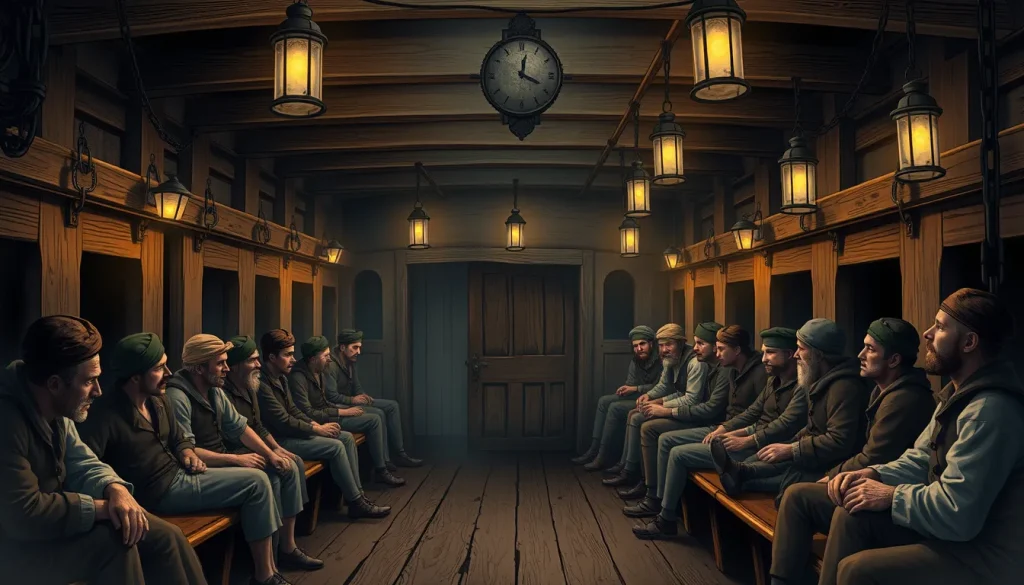
After capture, prisoners were typically registered by a naval or army agent, noting their name, rank, unit or ship, and place of capture. They were then assigned to a depot or prison ship. Conditions varied widely: officers often received parole privileges, while enlisted men were confined to crowded hulks such as HMS Jersey at Halifax, HMS Nassau at Chatham, or the stone prison at Dartmoor. Food and clothing were provided according to a scale, but shortages and mismanagement were common. Exchange negotiations followed a rank-for-rank formula, with a captain exchanged for a captain, a private for a private, and so on. Parole allowed officers and sometimes sailors to return home on their own recognizance, usually with the condition that they not take up arms until formally exchanged. Records such as the ADM 103 General Entry Books preserve the names, numbers, and often the fates of these men.
Competing Viewpoints
Contemporaries disagreed sharply about the treatment of POWs. American accounts—such as letters printed in newspapers and later congressional investigations—alleged that British prison hulks were deathtraps, with insufficient rations and medical care. British officials countered that the conditions were comparable to those in the Royal Navy and that American prisoners were given the same allowances as British soldiers. British captives in the United States also complained of neglect, and some British officers charged that American jailers withheld food and medicines. Modern historians, such as those studying the surviving ADM 103 records and American depot returns, argue that both systems were inadequate but that deliberate cruelty was less common than propaganda suggested. The Dartmoor incident of April 1815 became the most debated episode, with the British commission ascribing the tragedy to a misunderstanding, while many Americans saw it as murder.
Role in the War of 1812
Prisoners of war were a strategic resource and a diplomatic burden. Captured men represented potential bargaining chips in exchange negotiations, but they also consumed scarce resources. The fear of capture and the hope of exchange influenced morale among soldiers and sailors. The presence of American prisoners in British hands was a recurring grievance in patriotic rhetoric, sustaining public support for the war. Conversely, the cost of housing British prisoners in the United States and disputes over their care undermined peace efforts. The issue peaked during the summer of 1814, when the collapse of negotiations over impressment and the burning of Washington complicated exchange talks. Ultimately, the peace treaty’s prisoner-release clause was seen as a necessary closing of the conflict’s humanitarian chapter.
Consequences and Historical Interpretation
The immediate consequence of the war’s end was a large and difficult repatriation. Many American prisoners held in Halifax, Quebec, and England were not released until the summer and autumn of 1815. The Dartmouth incident left a lasting stain on Anglo-American relations. In historical interpretation, the POW experience has been used to assess the general conduct of the war: critics of Britain point to the harsh conditions of Dartmoor and the hulks, while defenders argue that the death rates were comparable to ordinary military service. The surviving records have enabled demographic studies of the prisoners—their ages, hometowns, and former occupations—revealing that many were recent immigrants, including Irish and German-born seamen. Modern historians emphasise that both sides failed to meet contemporary standards of humane treatment, but that the practice of exchange and parole kept the conflict from becoming as destructive as the Napoleonic European wars.
Primary Sources
Primary sources for the study of prisoners during the War of 1812 include:
- Index to Records Relating to War of 1812 Prisoners of War (M1747) and Records Relating to War of 1812 Prisoners of War (M2019) at the U.S. National Archives and Records Administration (NARA). These contain lists of American prisoners, clothing accounts, death records, and exchange lists.
- British Admiralty records in the ADM 103 series, digitised by British Online Archives, notably General Entry Books for Halifax, Nova Scotia (1812–1815) and Chatham, England (1812–1814). These include names, serial numbers, ships, and disposition of thousands of American prisoners.
- Matthew Brenckle’s study, British and American Naval Prisoners of War During the War of 1812 (USS Constitution Museum, 2005), which draws on memoirs, court-martial accounts, and official correspondence.
- Published index, List of American Prisoners of War 1812–1815, compiled from the Canadian General Entry Book and issued by the National Society United States Daughters of 1812, providing personal names and states.
Each source reflects the administrative viewpoint of its creators. NARA records were collected by the U.S. Adjutant General’s office for exchange and accounting purposes; ADM 103 books were kept by British prison agents. Both lack comprehensive coverage and may omit soldiers held in militia camps. Contemporary memoirs and newspaper accounts add testimony but must be read with awareness of wartime bias.
Further Reading
- Hickey, Donald R. The War of 1812: A Forgotten Conflict. University of Illinois Press, 1989. Standard scholarly overview.
- Latimer, Jon. 1812: War with America. Cambridge, MA: Harvard University Press, 2007. Provides a British perspective.
- Malcomson, Robert. Historical Dictionary of the War of 1812. Lanham, MD: Scarecrow Press, 2006. Entries on prisons and exchanges.
- USS Constitution Museum. “British and American Naval Prisoners of War During the War of 1812.” Boston, 2005.
- British Online Archives. “Prison Ship Records from the War of 1812,” including volumes for Halifax and Chatham.
References
- National Archives and Records Administration. “American Prisoners during the War of 1812.” Reference Report. Accessed via https://www.archives.gov/files/research/military/war-of-1812/american-pows.pdf.
- British Online Archives. “Prison Ships and Depots in Overseas Locations – Halifax, Nova Scotia, 1812-1815.” https://britishonlinearchives.com/collections/58/volumes/343/prison-ships-and-depots-in-overseas-locations-halifax-nova-scotia-1812-1815.
- British Online Archives. “Prison Ships and Depots in England – Chatham, 1812-1814.” https://britishonlinearchives.com/collections/58/volumes/337/prison-ships-and-depots-in-england-chatham-1812-1814.
- Brenckle, Matthew. British and American Naval Prisoners of War During the War of 1812. USS Constitution Museum, 2005. https://ussconstitutionmuseum.org/wp-content/uploads/2020/05/British-and-American-Naval-Prisoners-of-War-During-the-War-of-1812.pdf.
- National Society United States Daughters of 1812. List of American Prisoners of War 1812-1815, as indexed and published. https://www.americanwars.org/1812-pow/american-prisoners-of-war.htm.
FAQ
How many American prisoners were held during the War of 1812?
Exact numbers are unknown. Surviving records, such as the Halifax General Entry Books, list over six thousand prisoners received at that one location, while NARA indexes thousands of names from various depots.
Where were prisoners of war held?
American prisoners were held in British depots in Canada (Quebec, Halifax), aboard prison hulks in England (Chatham), and at Dartmoor Prison. British prisoners in American custody were kept in coastal and inland jails and barracks, such as in Boston or Salem.
What was the Dartmoor incident?
On April 9, 1815, British guards fired on American prisoners at Dartmoor Prison during a protest, killing six and wounding dozens. A British investigation attributed it to a misunderstanding, but many Americans considered it a deliberate act.
How did prisoner exchanges work?
Exchanges were conducted through cartels based on rank-for-rank formulas, where an officer of one rank was traded for an equivalent enemy officer. Parole agreements allowed officers to return home while promising not to fight until exchanged.




Leave a Reply