
Short Answer
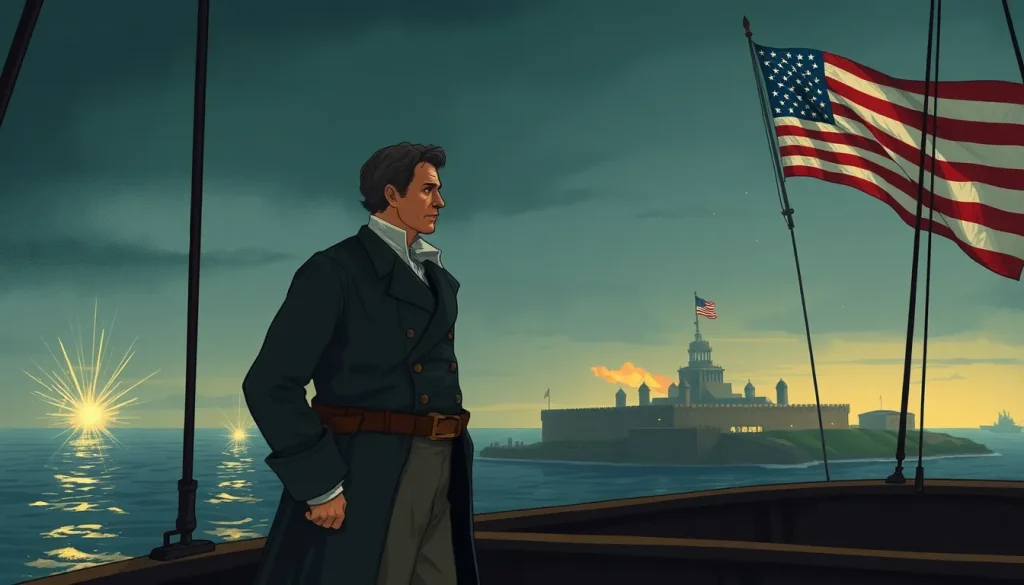
Francis Scott Key (August 1, 1779 – January 11, 1843) was an American lawyer, poet, and amateur verse writer from Maryland. He is best known for writing the poem “Defence of Fort M’Henry” after observing the British naval bombardment of Fort McHenry during the Battle of Baltimore in September 1814. That poem, set to the tune of a British drinking song, became the lyrics of the United States’ national anthem, “The Star-Spangled Banner.” Key’s personal experience aboard a truce ship during the bombardment ties him directly to a critical episode of the War of 1812 and shaped the anthem’s enduring symbolism.
Historical Context
The War of 1812 (1812–1815) pitted the United States against Great Britain over maritime rights, impressment, and territorial ambitions. By mid-1814, British forces had shifted to a more aggressive strategy along the American coast. In August 1814, a British expeditionary force entered the Chesapeake Bay, defeated American troops at the Battle of Bladensburg, and burned public buildings in Washington, D.C. The British next targeted Baltimore, a major port and shipbuilding center. The city’s harbor was defended by Fort McHenry, whose garrison guarded the water approach. The impending attack, known as the Battle of Baltimore, occurred on September 12–14, 1814. During this period, prisoner exchanges and diplomatic negotiations occurred under flags of truce, which is how Key became involved.
What Happened
In late August 1814, British forces seized Dr. William Beanes, a respected physician from Upper Marlboro, Maryland, accusing him of imprisoning British stragglers after the fall of Washington. Beanes was held aboard a British warship. Francis Scott Key, a lawyer with personal ties to Beanes, was asked by the U.S. government to help secure his release. Key and Colonel John Stuart Skinner, a prisoner-exchange agent, sailed out of Baltimore on September 5 aboard a small vessel flying a flag of truce. They boarded the British flagship HMS Tonnant and negotiated Beanes’s release. However, because Key and Skinner had become familiar with British plans and positions, they were detained until after the attack on Baltimore. On September 13, the British fleet began a 25-hour bombardment of Fort McHenry. From a stationary truce ship, Key watched the bombardment through the night. At dawn on September 14, he saw that a large American flag still flew over the fort, signaling that the British had not taken it. Overjoyed, Key began writing a poem on the back of a letter he had in his pocket. Upon release, he completed the poem in Baltimore and had it printed as a broadside titled “Defence of Fort M’Henry,” with a note that it could be sung to the tune of “To Anacreon in Heaven.”
Why It Matters
Key’s poem captured a moment of national defiance and quickly spread through newspapers. It was renamed “The Star-Spangled Banner” and became a popular patriotic song, though not the official anthem until 1931. The poem’s survival as the national anthem has made Francis Scott Key a central figure in American memory of the War of 1812. For historians, the poem also serves as a primary source for understanding contemporary perceptions of the battle and the symbolic importance of the flag. However, Key’s legacy is complicated by his slaveholding and opposition to abolition, which has prompted modern reappraisals of his life and words.
Early Life
Francis Scott Key was born on August 1, 1779, at Terra Rubra, a family estate in Frederick County, Maryland (now in Carroll County). He was the son of John Ross Key, a lawyer and Continental Army officer, and Ann Phoebe Dagworthy Charlton. Key grew up in a wealthy slave-owning household. He attended St. John’s College in Annapolis, graduating in 1796, and then studied law under his uncle Philip Barton Key. He married Mary Tayloe Lloyd in 1802; they eventually had eleven children. Key established a legal practice in Georgetown, in the District of Columbia, and became a prominent attorney.
Role Before the War
Before the War of 1812, Key was a successful lawyer in the Washington, D.C., area. He gained note in 1807 when he helped defend Justus Eric Bollman and Samuel Swartwout, who were accused of treason in connection with Aaron Burr’s conspiracy. Key also served as a quartermaster in the Georgetown Light Field Artillery, a local militia unit. Despite his military service, Key opposed the declaration of war in 1812, reflecting his deep religious convictions, but he remained loyal to his country and continued his militia duties.
Role During the War
Key served as a volunteer aide to General Walter Smith at the Battle of Bladensburg in August 1814, which ended in a American defeat. His most significant contribution came after the battle when he was asked to help free Dr. William Beanes. Key’s mission to negotiate Beanes’s release placed him in the center of the Battle of Baltimore, and his subsequent writing of “Defence of Fort M’Henry” became his enduring wartime legacy.
Major Actions
Key’s primary military-related action during the war was his participation in the prisoner-exchange delegation that went aboard HMS Tonnant on September 7, 1814. The British officers, including Vice-Admiral Alexander Cochrane, Rear-Admiral George Cockburn, and Major-General Robert Ross, agreed to release Beanes but prevented Key and Skinner from leaving until the attack on Baltimore was complete. During the bombardment, Key remained on his truce ship, observing the attack and the flag’s survival. His poem, composed in the aftermath, became a major cultural artifact of the war.
Contemporary Accounts
Key himself did not leave a detailed account of the events; his poem is the primary first-person testimony. Contemporary reports in Baltimore newspapers reproduced the poem, and John Skinner later recalled the incident. The poem’s handbill and newspaper versions were published widely. Historians rely on these sources, along with naval records, to reconstruct the timeline. No complete contemporary narrative from Key exists, so the precise details of his detention and observations are inferred from the poem and later accounts.
Later Life
After the war, Key returned to his law career. He became the United States District Attorney for the District of Columbia (1833–1841) under Presidents Andrew Jackson and Martin Van Buren. He argued several cases before the Supreme Court and was involved in the suppression of abolitionist literature, a role that has attracted criticism. Key was also a founding member of the American Colonization Society, which promoted the resettlement of free Black Americans in Africa. He continued to write poetry, publishing little until after his death. Key died on January 11, 1843, in Baltimore and was initially buried there; his remains were later moved to Mount Olivet Cemetery in Frederick, Maryland.
Historical Legacy
Francis Scott Key is almost exclusively remembered for authoring “The Star-Spangled Banner.” The poem’s emotional power and its association with the flag have made Key a national symbol. However, modern historians and the public have increasingly scrutinized his slaveholding and anti-abolitionist stance, leading to debates about how to honor his legacy. The poem itself remains a vital cultural artifact, and its creation is a key moment in the War of 1812’s history.
Primary Sources
The most important primary source is the poem “Defence of Fort M’Henry” itself, first printed as a broadside on September 17, 1814. The original broadside survives in the collections of the Maryland Historical Society. Key’s later correspondence and legal papers, held in various archives, provide insight into his personal and professional life. The official reports of British and American officers related to the Battle of Baltimore, such as those from Fort McHenry’s commander, Major George Armistead, offer military context. Skinner’s recollections, recorded later, also contribute. Researchers should note that Key’s poem is a literary text, not a precise diary, so it should be read as a patriotic composition rather than an objective report.
Further Reading
- National Park Service biography: Francis Scott Key (NPS People page, updated 2026).
- Fort McHenry National Monument and Historic Shrine: Francis Scott Key page.
- Smithsonian National Museum of American History: Star-Spangled Banner exhibit materials.
- George J. Svejda, Fort McHenry and the Star-Spangled Banner (National Park Service, 1969).
- Walter Lord, The Dawn’s Early Light (W.W. Norton, 1972).
References
- National Park Service. “Francis Scott Key.” Accessed 2026. https://www.nps.gov/people/francis-scott-key.htm.
- National Park Service. “Francis Scott Key.” Fort McHenry National Monument and Historic Shrine. Accessed 2026. https://www.nps.gov/fomc/learn/historyculture/francis-scott-key.htm.
- Smithsonian National Museum of American History. “Francis Scott Key.” Accessed 2026. https://amhistory.si.edu/starspangledbanner/francis-scott-key.aspx.
- The Poetry Foundation. “Francis Scott Key.” Accessed 2026. https://www.poetryfoundation.org/poets/francis-scott-key.
- Wikipedia. “Francis Scott Key.” Accessed 2026. https://en.wikipedia.org/wiki/Francis_Scott_Key.
FAQ
Why was Francis Scott Key on a British ship during the Battle of Baltimore?
He was sent to negotiate the release of Dr. William Beanes, an American prisoner, under a flag of truce. The British detained him until after the bombardment because he had gained knowledge of their plans.
When was 'The Star-Spangled Banner' officially made the national anthem?
The U.S. Congress designated it as the national anthem in 1931.
Did Francis Scott Key own enslaved people?
Yes, Key owned enslaved individuals throughout his life, although he also took some legal actions on behalf of enslaved people seeking freedom and supported colonization efforts. This aspect of his life has been the subject of modern historical debate.
Leave a Reply