
Short Answer
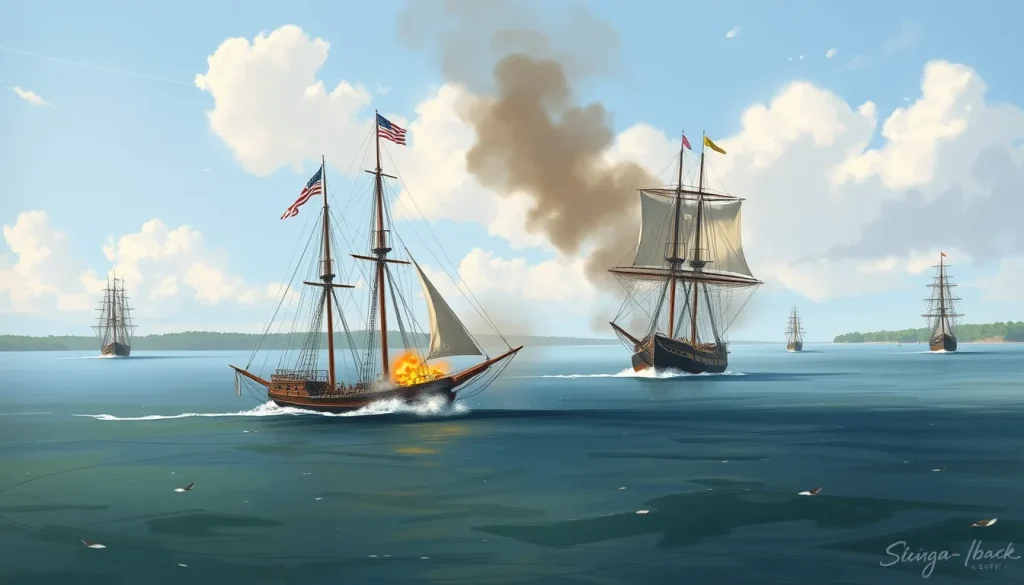
The Battle of Lake Erie, also known as the Battle of Put-in-Bay, was fought on 10 September 1813 on the western basin of Lake Erie, near Put-in-Bay, Ohio. The United States Navy, commanded by Master Commandant Oliver Hazard Perry, defeated and captured a British Royal Navy squadron led by Commander Robert Heriot Barclay. This American victory secured control of the lake for the remainder of the war, enabling the recovery of Detroit and setting the stage for the Battle of the Thames.
Historical Context
During the War of 1812, control of the Great Lakes was vital to both belligerents. For the British, Lake Erie served as a supply line connecting Amherstburg (Fort Malden) and Detroit with the rest of Upper Canada and, ultimately, the Atlantic. American forces needed the lake to support their own operations and to cut British communication with their Indigenous allies. At the outbreak of the war, the British possessed a naval force on Lake Erie—a few armed vessels of the Provincial Marine—while the Americans had almost none. The Americans captured the British brigs Detroit and Caledonia in October 1812, but a naval race quickly ensued. By 1813, both sides were building warships at opposite ends of the lake: the Americans at Presque Isle (present-day Erie, Pennsylvania) and the British at Amherstburg.
What Happened
In the summer of 1813, Perry’s squadron of nine vessels broke out of Presque Isle and established a base at Put-in-Bay. The British, facing severe supply shortages at Fort Malden, decided they had to engage the Americans. At dawn on 10 September, lookouts spotted the British squadron. Perry raised his battle flag bearing the words “DONT GIVE UP THE SHIP” and prepared his fleet. The wind initially favored the British, whose long guns outranged the Americans’ carronades. However, by mid-morning the wind shifted, allowing Perry to close. The battle began around 11:45 a.m. Perry’s flagship, the brig Lawrence, bore the brunt of the British fire and was severely damaged. Perry transferred his flag to the undamaged brig Niagara, broke the British line, and forced the surrender of all six British vessels by 2:30 p.m. The British losses were 41 killed and 94 wounded; the Americans lost 27 killed and 96 wounded.
Why It Matters
The American victory gave the United States uncontested control of Lake Erie. This made the British position at Amherstburg and Detroit untenable. Major General Henry Procter abandoned Detroit and Fort Malden, retreating up the Thames River, with Tecumseh’s Indigenous confederacy following. American forces under William Henry Harrison pursued and defeated them at the Battle of the Thames on 5 October 1813, where Tecumseh was killed. The victory at Lake Erie thus proved strategically decisive in the Old Northwest, breaking British power in the region and undermining the Indigenous alliance that had threatened American settlements. The battle also became a lasting symbol of American naval courage, immortalized by Perry’s famous dispatch: “We have met the enemy and they are ours.”
Prelude
The naval race on Lake Erie intensified through the spring and summer of 1813. The Americans built their squadron at Presque Isle, using green timber and skilled shipwrights such as Noah Brown. By August, Perry had nine vessels ready and moved them to Put-in-Bay, establishing a blockade of British supply routes. The British at Amherstburg, commanded by Barclay, struggled to obtain guns and crew. They resorted to arming the flagship Detroit with guns taken from Fort Malden and filling out crews with soldiers and Canadian volunteers. Barclay, facing starvation at the fort, chose to fight rather than retreat.
Forces and Commanders
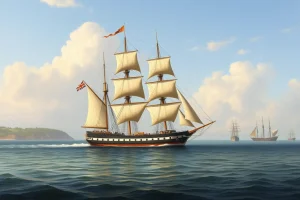
The American squadron, under Master Commandant Oliver Hazard Perry, consisted of nine vessels: the brigs Lawrence (Perry’s flagship) and Niagara (commanded by Jesse Elliott), the brig Caledonia, five schooners (Scorpion, Ariel, Somers, Porcupine, Tigress), and the sloop Trippe. They carried 54 guns total, with Lawrence and Niagara each mounting 20 carronades (32-pounders). The British squadron, under Commander Robert Heriot Barclay, had six vessels: the ship Detroit (19 guns), the ship Queen Charlotte (17 guns), the brig General Hunter, and the schooners Lady Prevost and Chippewa, plus the sloop Little Belt, totalling 63 guns. Barclay had fought at Trafalgar and lost an arm, but his squadron was hastily assembled with inexperienced crews.
Battlefield and Map Context
The battle took place in western Lake Erie, approximately 12 miles northwest of Put-in-Bay in the Bass Islands of Ohio. The American fleet was anchored in Put-in-Bay when Barclay’s squadron was spotted to the northwest. The lake’s open waters provided a relatively unobstructed battlefield, though the wind and island geography influenced maneuver. The shoreline of Ohio was to the south, with Upper Canada to the north.
Battle Chronology
At dawn (about 7 a.m.), Perry ordered his fleet out of Put-in-Bay. For hours, the American vessels tried to gain advantage against a west-southwest wind. At about 10 a.m., the wind shifted to the southeast, giving Perry the weather gauge. Barclay deployed his line and opened fire at about 11:45 a.m. The Lawrence closed with the British flagship and took heavy punishment for over two hours. Around 2:00 p.m., Perry transferred to the Niagara, whose crew had been relatively unengaged. Breaking through the British line, the Niagara raked the Detroit and Queen Charlotte, which had become entangled. The British struck their colors about 2:30 p.m., ending the battle.
Casualties and Losses
British casualties were 41 killed and 94 wounded (some sources say 40 killed and 93 wounded), while the Americans lost 27 killed and 96 wounded. All six British ships were captured, including Detroit and Queen Charlotte. The Lawrence was so badly damaged that she never saw service again. The British squadron’s loss was total, while the American fleet remained operational.
Result
The Battle of Lake Erie was a decisive American victory. The entire British squadron was captured, and the Americans gained control of the lake. Commander Barclay was wounded and taken prisoner, but later exonerated at a court martial that placed the blame on a shortage of resources and personnel.
Strategic Consequences
American control of Lake Erie forced the British to evacuate Detroit and Fort Malden. Major General Procter retreated up the Thames River, followed by Harrison’s army. The Battle of the Thames on 5 October 1813 resulted in a U.S. victory and Tecumseh’s death, breaking the Indigenous alliance and securing the American position in the northwest. The victory also allowed the Americans to resupply their forces and eventually to launch operations toward Lake Huron and Mackinac.
Primary Accounts
The most famous primary account is Perry’s dispatch to General Harrison, written on an envelope after the battle: “We have met the enemy and they are ours: two ships, two brigs, one schooner and one sloop.” Barclay’s official report to Admiral Sir John Borlase Warren describes the battle from the British perspective and highlights the shortage of experienced men and the quality of American ship construction. Another account is the diary of Samuel Hambleton, Perry’s purser, which records the preparations and the mood aboard ship. These documents are preserved in various archives and published in collections such as the Naval Documents of the War of 1812.
Battlefield Today
The battlefield is preserved by Perry’s Victory and International Peace Memorial, located on South Bass Island in Put-in-Bay, Ohio, operated by the National Park Service. The memorial, which includes a 352-foot column, commemorates the battle and celebrates the lasting peace between the United States, Canada, and Britain. The original Niagara was raised and restored and is now on display at the Erie Maritime Museum in Erie, Pennsylvania.
Primary Sources
Key primary sources include: (1) Oliver Hazard Perry’s letter to William Henry Harrison, 10 September 1813, which contains the famous “We have met the enemy” phrase. (2) Robert Heriot Barclay’s official dispatch to Admiral Warren, dated 12 September 1813, detailing the battle and its causes. (3) Samuel Hambleton’s diary, which provides a personal account of the preparations and the flag-raising ceremony. (4) The transcript of Barclay’s court-martial (1814), which examines the reasons for the defeat. (5) Isaac Chauncey’s correspondence regarding the building of the American squadron. These documents are available in the U.S. National Archives, Library and Archives Canada, and published collections like The Naval War of 1812: A Documentary History edited by William S. Dudley.
Further Reading
- Altoff, Gerard T. Deep Water: The Epic Battle of Lake Erie. Put-in-Bay, OH: Perry’s Victory and International Peace Memorial, 1998.
- Hickey, Donald R. The War of 1812: A Forgotten Conflict. Urbana: University of Illinois Press, 1989.
- Lambert, Andrew. The Challenge: Britain Against America in the Naval War of 1812. London: Faber and Faber, 2012.
- Latimer, Jon. 1812: War with America. Cambridge, MA: Harvard University Press, 2007.
- Skaggs, David Curtis, and Gerard T. Altoff. A Signal Victory: The Lake Erie Campaign, 1812-1813. Annapolis: Naval Institute Press, 1997.
References
- National Park Service, “The Battle of Lake Erie,” Perry’s Victory & International Peace Memorial, https://nps.gov/pevi/learn/historyculture/battle_erie_detail.htm.
- Barry M. Gough, “Battle of Lake Erie (Battle of Put-in-Bay),” The Canadian Encyclopedia, October 23, 2011, https://thecanadianencyclopedia.ca/en/article/battle-of-lake-erie-battle-of-put-in-bay.
- “Battle of Lake Erie,” Wikipedia, accessed 2023, https://en.wikipedia.org/wiki/Battle_of_Lake_Erie.
- “Battle of Lake Erie,” The War of 1812, https://thewarof1812.org/battles/battle-of-lake-erie/.
- Christopher Klein, “What Was the Battle of Lake Erie?” HISTORY, September 10, 2013, https://www.history.com/articles/the-battle-of-lake-erie-200-years-ago.
FAQ
Who commanded the American fleet at the Battle of Lake Erie?
Master Commandant Oliver Hazard Perry commanded the American squadron of nine vessels. His subordinate Jesse Elliott commanded the brig Niagara.
Why was the Battle of Lake Erie important?
The American victory gave the United States control of Lake Erie, forcing the British to abandon Detroit and Fort Malden. It led to the American victory at the Battle of the Thames and the death of Tecumseh, securing the Old Northwest.
What was Perry's famous quote after the battle?
Perry reported to William Henry Harrison: 'We have met the enemy and they are ours: two ships, two brigs, one schooner and one sloop.'
Leave a Reply