
Short Answer
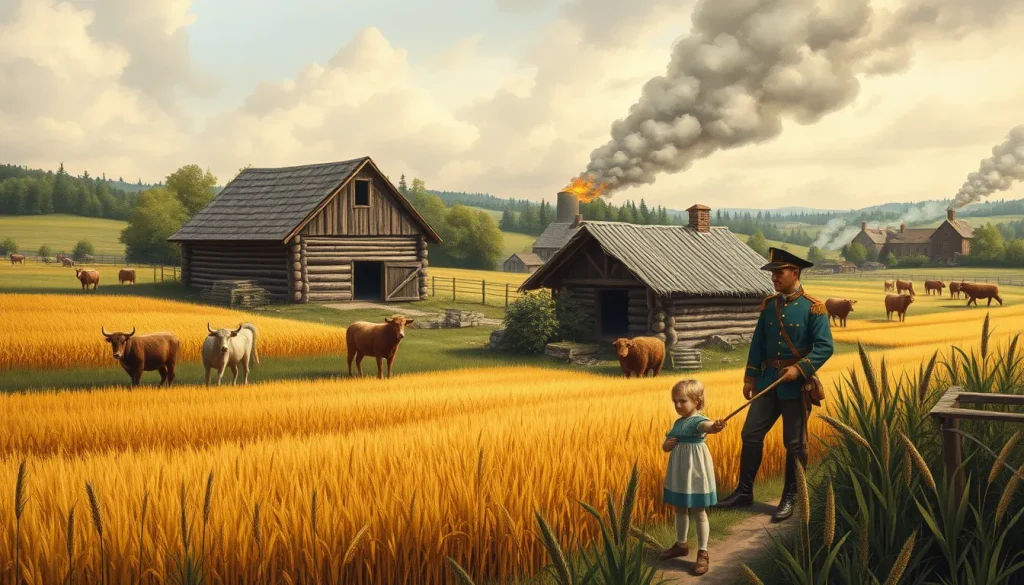
Farming during the War of 1812 encompasses the agricultural activities, disruptions, and military interactions that defined rural life along the Great Lakes and St. Lawrence frontier from 1812 to 1815. Both American and British/Canadian forces relied heavily on local produce, making farms both vital supply sources and vulnerable targets. The war turned fields into battlefields, drained farm labor through militia calls, and forced women and children to take on unprecedented agricultural responsibilities. This article examines the role of farming in the conflict, its destruction, and its lasting impact on rural communities.
Historical Context
Before the war, agriculture in Upper Canada, Lower Canada, and the American border states was largely self-sufficient or oriented toward local markets. Small farms produced wheat, corn, potatoes, peas, and oats, while livestock–pigs, cattle, sheep–provided meat, dairy, and labor. Many frontier settlements were barely above subsistence, especially in Upper Canada, where land clearance was still in progress. The British army, stationed at garrisons from Quebec to Michilimackinac, had traditionally purchased flour, beef, and pork from local farmers, creating a modest but reliable market. In the United States, particularly along the Niagara and Detroit frontiers, similar agricultural conditions prevailed, with farmers selling surplus to military posts and Indian agencies.
The outbreak of war in June 1812 introduced unprecedented demands. American plans to invade Canada presumed that local farms could supply their armies, while British commanders counted on Canadian agriculture to sustain their regulars, militia, and Indigenous allies. However, the scale of mobilization quickly exceeded regional production capacity. A dissertation by Glenn Steppler notes that “Canadian resources, even in Lower Canada, were not sufficient to support the forces employed by Britain during the war.” Moreover, the call-up of militiamen (often farmers themselves) removed crucial labor at planting and harvest times, compounding shortages.
What Happened
The war brought direct destruction to agricultural areas. Battles and skirmishes occurred on farmland, especially at Queenston Heights, Lundy’s Lane, and near Fort Detroit. Armies requisitioned food, forage, and livestock, sometimes paying with promissory notes that were rarely redeemed, and sometimes simply seizing goods. Burned farms, destroyed barns, and looted grain fields were common. For example, during the American occupation of the Niagara Peninsula in 1813, soldiers burned houses and crops, including the farm of Ann Butler, a widow who had managed her property after her husband’s death. Similarly, Elizabeth Skinner’s farm was damaged during the Battle of Lundy’s Lane, with soldiers destroying her wheat, corn, and potatoes.
Farmers responded by prioritizing their own survival. Desertion from militia units was widespread, often driven by the need to plant or harvest crops. As one source notes, “come harvest, more would abandon their posts” and “even the most loyal settlers would eventually resort to desertion in order to plant their crops.” Women, left alone when men served or died, took over farm management. The Fortitude and Resolution module documents how women like Sophia Hainer and Ann Butler handled livestock, field work, and even claims for damages. The destruction of mills—central to grinding grain into flour—was particularly devastating, as they represented major capital investments and were essential for local survival.
Why It Matters
Farming during the war was not a side issue; it was central to military operations and civilian survival. The British army’s supply problems, as described by Steppler, shaped strategy and often limited offensives. For the United States, the failure to capture and hold Canadian territory was partly due to logistical failures, including insufficient food. For the inhabitants, the loss of crops and livestock led to immediate hardship, with the winter after invasions leaving many without food or shelter. In the longer term, the war accelerated economic changes. As Adam Shortt observed, the war inflated food prices but also increased the cost of merchant goods, making farming less profitable in real terms. After the war, a building boom drew workers away from fields, and many former farmers turned to other occupations. The role of women in agriculture expanded and, for some, persisted after the war, altering the social fabric of rural communities.
Definition
Farming during the War of 1812 refers to the agricultural production, labor, and land use practiced by civilian farmers in the borderlands of Upper Canada, Lower Canada, and the United States between 1812 and 1815. It includes both the continuation of normal farming activities under wartime conditions and the direct military impacts such as requisitioning, destruction, and occupation.
Background
Prior to 1812, agriculture in the Great Lakes basin was characterized by small family farms producing a limited variety of crops suited to the short growing season. Wheat and corn were staples, but peas, oats, and potatoes were also common. Livestock—pigs, cattle, and poultry—were raised for subsistence and local sale. Farms were typically located along waterways or military roads, facilitating transport. The British armed forces had long purchased flour and meat from Canadian farmers, and American forts similarly bought from local producers. The war disrupted these patterns by increasing demand and introducing threats of violence.
How It Worked
During the conflict, armies routinely requisitioned supplies from farms. In Upper Canada, the Commissariat often issued receipts that were later submitted as claims for compensation—though compensation was slow and partial. Farmers also served in militia units, which meant that when they were on duty, their fields went untended. Officers sometimes granted leave to those “whose presence on the farms are most required to bring in their harvest.” Women and children took over planting, weeding, harvesting, and animal care. In occupied areas, farmers may have cooperated with the enemy to avoid destruction, a decision that sometimes led to charges of collaboration. Destruction was not always accidental; armies deliberately burned crops and barns to deny supplies to the enemy, as seen in the American raids on the Niagara district.
Competing Viewpoints
Contemporary viewpoints differed sharply. Military commanders saw farmers as suppliers or obstacles; they prioritized their army’s needs over civilian welfare. Some British officers, like Lieutenant-General Drummond, expressed anxiety about the Commissariat’s ability to feed troops, indicating a recognition of the limits of local agriculture. American officers, especially those on the Niagara frontier, believed that destroying farms would demoralize the Canadian population and force surrender. For farmers, the war represented an intrusion that threatened their livelihoods and families. They often resisted service when it conflicted with farm work, and many abandoned their posts. Indigenous warriors, who relied on hunting and agriculture, also affected the landscape, sometimes taking food from colonist farms. These competing perspectives highlight the tension between military necessity and civilian survival.
Role in the War of 1812
Farming was the backbone of the war effort on all sides. The British army in Canada depended on local flour, beef, and pork to feed regulars and militia. American forces also hoped to live off the land in Canada, but they underestimated the scarcity of supplies. The destruction of farms and mills was a deliberate military tactic intended to undermine enemy morale and capability. Moreover, the labor of farmers as militiamen was essential, yet also unreliable, because they frequently returned home for planting and harvest. The war could not have been fought without the agricultural resources of the region, but those same resources became targets and objects of conflict.
Consequences and Historical Interpretation
The immediate consequences included food shortages, homelessness, and destruction of capital improvements like barns and mills. Many families never fully recovered. Post-war compensation was slow; some claims were not paid until the 1820s. Over time, the war stimulated economic growth as rebuilding created employment and demand. However, short-term inflation meant that farmers’ profits were offset by high prices for goods. Historians interpret the war as a catalyst for Upper Canada’s development, but also as a demonstration of the fragility of frontier agriculture. The role of women in farming during the conflict has received increased scholarly attention, revealing that they managed farms and made crucial claims for damages. The war also transformed agricultural practices, leading to more diversified and commercial farming in the following decades.
Primary Sources
Primary sources for farming during the War of 1812 include claims for damages, such as those submitted by Ann Butler, Sophia Hainer, and Elizabeth Skinner, which list crops, livestock, and buildings lost to the war. These claims, held in Canadian archives, provide detailed insights into the scale of destruction. Official correspondence from British military leaders, such as Lieutenant-General Drummond, illustrates logistical challenges and the need for local food. Adam Shortt’s 1912 article “The Economic Effect of the War of 1812 on Upper Canada” uses contemporary letters and ledgers of merchants like Cartwright and Hamilton to trace price changes and agricultural output. Glenn Steppler’s dissertation examines Commissariat records to show how the British army procured food. While these sources are valuable, they often reflect the interests of the document creators—military officers, merchant elites, or claimants—so they must be read critically.
Further Reading
- Sheppard, George. Plunder, Profit, and Paroles: A Social History of the War of 1812 in Upper Canada. McGill-Queen’s University Press, 1994.
- Shortt, Adam. “The Economic Effect of the War of 1812 on Upper Canada.” 1912. Reprinted in Ontario History 104, no. 1 (2012).
- Steppler, Glenn A. “A Duty Troublesome Beyond Measure: Logistical Considerations in the Canadian War of 1812.” Master’s thesis, McGill University, 1974.
- Fortitude and Resistance: A Digital Exhibition on the War of 1812, University of Toronto Scarborough.
References
- “The Big Picture: Farming and the War of 1812.” Ontario Grain Farmer, September 2012. https://ontariograinfarmer.ca/2012/09/01/the-big-picture-farming-and-the-war-of-1812/.
- “Working and Leading,” Module 3: Coping with War, Fortitude and Resilience exhibition. https://swroberts.ca/far/exhibits/show/module3-coping-with-war/working-leading.
- Steppler, Glenn A. “A duty troublesome beyond measure: logistical considerations in the Canadian War of 1812.” PhD diss., McGill University, 1974. https://doi.org/10.82308/21260.
- Shortt, Adam. “The Economic Effect of the War of 1812 on Upper Canada.” Ontario History 104, no. 1 (2012). https://doi.org/10.7202/1065387ar.
- Dougherty, M. W. ““The Bread Which Perisheth”: Farming, Religion, and the Good Life in Rural Ontario, 1812–1867.” Agricultural History 99, no. 4 (2025): 564–585. https://doi.org/10.1215/00021482-11924358.
FAQ
How did the War of 1812 affect farmers in Upper Canada?
Farmers experienced destruction of crops, livestock, and buildings, as well as labor shortages due to militia service. Many had to abandon farms temporarily, and women took over agricultural work.
Why were mills particularly vulnerable during the war?
Mills were crucial for grinding grain into flour and were large investments. Destroying them crippled local food production and was a deliberate military tactic.
What role did women play in farming during the War of 1812?
Women managed farms when men were absent or killed, performing planting, harvesting, and animal care, and also submitted claims for wartime losses.

Leave a Reply