
Short Answer
The Battle of Chippawa, fought on July 5, 1814, near the Niagara River in Upper Canada (present-day Ontario), was a significant American victory in the War of 1812. It marked the first time American regular troops had decisively defeated an equal British force in an open-field engagement, demonstrating the value of rigorous training and professional leadership. The battle was part of the Niagara campaign of 1814, the largest American offensive of the war’s final year.
Historical Context
By 1814, the War of 1812 had ground through two years of mixed results for the United States. American invasions of Canada had failed, and the British had captured Fort Niagara and burned Buffalo. With Napoleon’s defeat in early 1814, Britain prepared to send veteran reinforcements to North America, threatening to tip the balance further. The American government, under Secretary of War John Armstrong Jr., sought a decisive blow before those veterans arrived. On the Niagara frontier, Major General Jacob Brown commanded the Left Division of the US Army, composed of newly trained regulars. During the winter and spring of 1814, Brigadier General Winfield Scott had drilled his brigade relentlessly at a camp near Buffalo, using French tactical manuals and emphasizing discipline and maneuver. These troops were dressed in gray uniforms due to supply shortages, not the standard blue, a detail that would have unintended consequences. On July 3, 1814, Brown’s division crossed the Niagara River and captured Fort Erie, opening the 1814 Niagara campaign.
What Happened
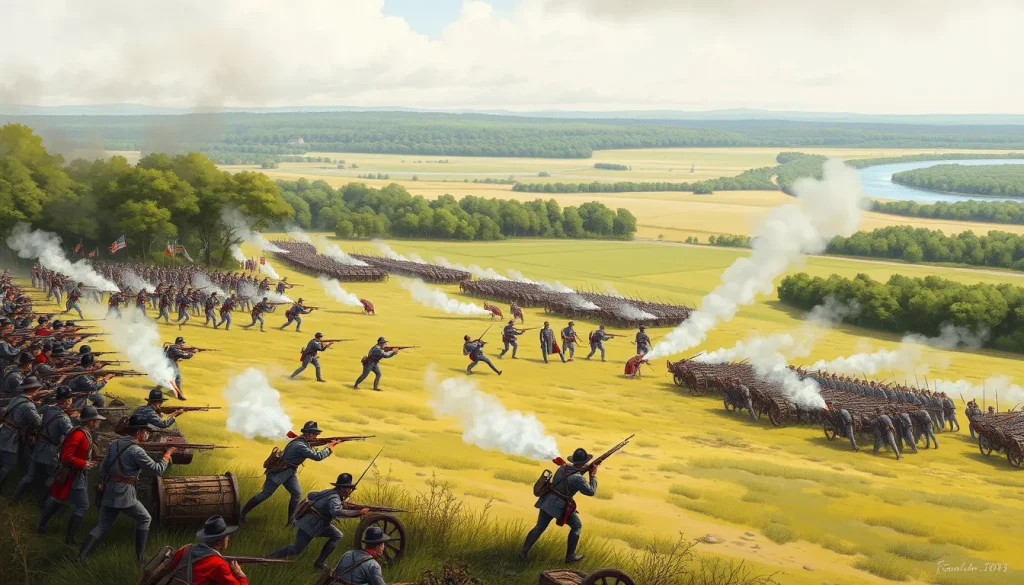
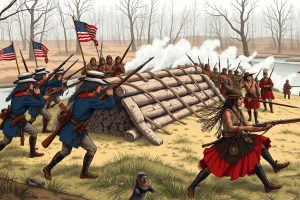
After taking Fort Erie, Brown sent Scott’s brigade northward along the Niagara River road on July 4. British Major General Phineas Riall, commanding the Right Division, deployed light infantry and artillery under Lieutenant Colonel Thomas Pearson to delay the American advance. By dusk, Scott’s men reached the Chippawa Creek (now the Welland River), where the British had destroyed the bridge and established a defensive line. The two armies faced each other across a broad, open plain. On the morning of July 5, Riall, mistakenly believing his opponents were militia due to their gray coats and their steady conduct under fire, ordered a full attack. As the British regulars advanced, Scott deployed his brigade in line. The Americans held their fire until the British came within close range, then delivered volleys that stopped the advance. The exchange of musketry lasted about thirty minutes. Scott exploited the terrain to extend his line, and additional American artillery helped break the British resolve. Riall ordered a withdrawal, and the British retreated back across the creek, destroying the bridge. The battle was over by about 6:30 p.m.
Why It Matters
The Battle of Chippawa was a morale-boosting victory for the United States. It proved that American regulars—when properly trained—could stand up to British veterans, a perception that had been badly dented in earlier defeats. The engagement also elevated Winfield Scott’s reputation and served as a foundation for the future US Army officer corps. However, the victory had limited strategic consequences: the Americans lacked the strength to push on to Fort George and the campaign stalled, culminating in the bloody stalemate at Lundy’s Lane three weeks later. Historically, Chippawa is remembered as a turning point in American military professionalism, with the phrase “Regulars, by God” allegedly exclaimed by Riall, though the exact wording is uncertain. The battle’s significance was recognized by contemporaries and later historians as a milestone in the maturation of the US Army.
Prelude
The American plan for 1814 called for a strike across the Niagara River to seize the peninsula and then combine with the Navy on Lake Ontario. Brown’s division, about 3,500 strong, crossed on July 3 and took Fort Erie with little resistance. The British commander Riall, whose forces numbered about 1,500–2,000 regulars plus militia and Indigenous allies, was initially uncertain about the invasion’s size. He ordered Pearson to delay the Americans while he concentrated his troops. Pearson’s skirmishing slowed Scott’s advance through the day of July 4, but by evening the Americans were in position south of Chippawa Creek, which served as the British defensive line. The bridge over the creek was partially destroyed, and the two forces prepared for battle overnight.
Forces and Commanders
American forces: Major General Jacob Brown commanded the division. Brigadier General Winfield Scott led the 1st Brigade, comprising the 9th, 11th, 22nd, and 25th Infantry Regiments, along with attached artillery (two 6-pounders, a howitzer, and later a 12-pounder). The Americans also had Pennsylvania militia and Indigenous allies, though the regulars bore the brunt of the fighting. Total American strength on the field was about 2,000.
British and allied forces: Major General Phineas Riall commanded the Right Division. His regulars included the 1st (Royal Scots), 8th, and 100th Regiments of Foot, plus Canadian militia and Indigenous warriors. Artillery included three 6-pounders, two 24-pounders, and a 5.5-inch howitzer. Total British strength was roughly 2,000.
Battlefield and Map Context
The battle occurred on a level plain extending from the Chippawa Creek northward to the Niagara River (approximately 1.5 miles). The field was bordered by woods on the west and the river on the east, with the Portage Road running along the shoreline. The American camp was south of the creek; the British held the north bank. The ground is today located within the city of Niagara Falls, Ontario, near the junction of Niagara Parkway and Chippawa Avenue. The battlefield is preserved as a National Historic Site and features a self-guided tour.
Battle Chronology
- Early July 5: Riall conducted a reconnaissance, wrongly concluded the enemy was militia.
- Midday: American militia and Indigenous scouts engaged British skirmishers in the woods, sparking combat.
- About 4:00 p.m.: Riall’s repaired bridge and formed his brigade on the plain.
- About 4:30 p.m.: Scott’s brigade deployed; both sides opened artillery fire.
- British advance: The 1st and 100th Foot pushed forward, but the 8th Foot masked the artillery as it came into line.
- Scott extended his line, and the 25th Infantry moved into the woods to flank the British.
- For about 30 minutes, both lines exchanged volleys at close range; British fire slackened.
- Brown sent reinforcements and additional artillery to the center.
- By 6:30 p.m., Riall ordered a retreat; the British crossed back over the creek and burned the bridge.
Casualties and Losses
British casualties were severe: 148 killed, 321 wounded, and 46 missing, according to the Canadian Encyclopedia. American losses were about 61 killed and 255 wounded, though the National Park Service gives 58 killed and 241 wounded, plus 19 missing. The discrepancies arise from differing returns and interpretations. The British lost roughly one-third of the engaged force, while the Americans lost about 15 percent.
Result
The Battle of Chippawa was a clear American tactical victory. The British withdrew from the field and retreated behind Chippawa Creek, abandoning their defensive line. The Americans retained possession of the battlefield and subsequently crossed the creek on July 6, forcing the British to fall back to Fort George. However, the American advance was halted by the battle of Lundy’s Lane on July 25, which ended in a bloody draw but checked the invasion.
Strategic Consequences
In the immediate aftermath, the American victory improved morale and temporarily gave the United States control of the upper Niagara Peninsula. Yet the campaign failed to achieve its broader objectives of capturing Burlington Heights or cutting off British supply lines. The standoff at Lundy’s Lane and subsequent American withdrawal back to Fort Erie nullified the strategic gains of Chippawa. For the long term, the battle demonstrated the effectiveness of professional infantry training and influenced the development of the United States Military Academy, where gray uniforms were later adopted in memory of the Chippawa regulars.
Primary Accounts
The primary sources for the battle include the official reports of Major General Jacob Brown and Brigadier General Winfield Scott, which praised the conduct of the troops. British Major General Riall’s report acknowledged the enemy’s steadiness. The famous aphorism “Regulars, by God” is attributed to Riall, but it appears only in later secondary accounts, and its exact wording is uncertain. Other records include soldier letters, casualty returns, and contemporary newspaper accounts, which provide vivid descriptions but also reflect the propaganda needs of both sides.
Battlefield Today
The Chippawa Battlefield is a preserved site managed by Niagara Parks and Parks Canada. It covers about 300 acres and includes a self-guided walking tour with interpretive panels. A memorial cairn commemorates the regiments and First Nations warriors who fought. The battlefield is located in Niagara Falls, Ontario, near the junction of the Niagara Parkway and Chippawa Avenue. The site also includes monuments to the 1st, 8th, and 100th Regiments, and to the American forces. The preservation of the field and its interpretation is a testament to its historical importance.
Primary Sources
- Report of Major General Jacob Brown to Secretary of War, July 1814 – Official American account, detailing the battle and praising Scott’s brigade.
- Report of Major General Phineas Riall to Lieutenant Governor Sir George Prevost, July 1814 – British account, acknowledges the defeat and the disciplined enemy fire.
- Winfield Scott’s Memoirs – Published later, Scott described the battle and the gray uniforms, claiming they were adopted at West Point afterward.
- Letters from soldiers of the 25th Infantry – Provide firsthand reactions to the fighting, available in manuscript collections.
Further Reading
- John R. Grodzinski, The Battle of Chippawa: A Critical and Historical Guide (Toronto: Dundurn, 2014).
- Donald E. Graves, Field of Glory: The Battle of Chippawa, 5 July 1814 (Toronto: Robin Brass Studio, 2015).
- Robert S. Quimby, The U.S. Army in the War of 1812: An Operational and Command Study (East Lansing: Michigan State University Press, 1997).
- National Park Service, “Summer 1814: American Regular Troops Perform Superbly at the Battle of Chippawa,” https://www.nps.gov/articles/battle-of-chippawa.htm.
References
- National Park Service, “Summer 1814: American Regular Troops Perform Superbly at the Battle of Chippawa,” https://www.nps.gov/articles/battle-of-chippawa.htm.
- John R. Grodzinski, “Battle of Chippawa,” The Canadian Encyclopedia, https://thecanadianencyclopedia.ca/en/article/battle-of-chippawa.
- American Battlefield Trust, “Chippawa Battle Facts and Summary,” https://www.battlefields.org/learn/war-1812/battles/chippawa.
- “Battle of Chippawa – War of 1812,” https://thewarof1812.org/battles/battle-of-chippawa/.
- Niagara Parks, “Battle of Chippawa – Self-Guided Historical Tour,” https://www.niagaraparks.com/visit/heritage/battle-of-chippawa/.
FAQ
Why did the British mistake the American regulars for militia at Chippawa?
The American troops wore gray uniforms due to supply shortages, which resembled the gray coats commonly associated with militia. Additionally, earlier American militia often broke under fire, so Riall assumed he faced an untrained force.
What was the significance of the Battle of Chippawa?
It was the first time American regulars defeated an equal British force in an open-field battle, proving the value of professional training. It boosted American morale and influenced the development of the US Army and West Point.
Did the Battle of Chippawa change the course of the war?
Tactically it was a victory, but strategically it did not end the campaign. The Americans later withdrew after the Battle of Lundy's Lane, so the invasion of Upper Canada ultimately failed.
Leave a Reply