
Short Answer
The Indigenous forces at the Battle of Queenston Heights, fought on 13 October 1812, consisted of approximately eighty Haudenosaunee (Six Nations) and Delaware warriors from the Grand River who fought on the British side. Under the leadership of John Norton (Teyoninhokarawen) and John Brant (Ahyonwaeghs), they held superior American forces at bay on the Niagara Escarpment for several hours, enabling British reinforcements to arrive and secure victory. This action was critical in ending the American campaign of 1812 on the Niagara frontier and in sustaining the Anglo-Indigenous military alliance that shaped the war’s course.
Historical Context
Following the American Revolution, thousands of loyalist Haudenosaunee from New York and Pennsylvania relocated to British territory, settling along the Grand River in Upper Canada. The alliance between the Crown and the Six Nations was reinforced through trade, ceremonial protocols, and shared geopolitical interests, most notably resistance to American westward expansion.
When the United States declared war on Great Britain on 18 June 1812, British commanders in Upper Canada relied heavily on Indigenous allies to offset their numerical weakness. Major-General Isaac Brock’s victories at Fort Mackinac (17 July) and Fort Detroit (16 August) had been achieved with substantial Indigenous support, including that of Shawnee chief Tecumseh and war parties from the Great Lakes and Grand River communities. These successes led to a temporary ceasefire along the Niagara frontier in September, which both sides used to regroup and plan renewed offensives.
American forces in the Niagara region were commanded by Major-General Stephen Van Rensselaer, a New York militia officer. After the public humiliation of Detroit, Washington pressed for a renewed invasion to restore national honour. By early October, more than 6,000 American troops—regulars and militia—were concentrated between Lewiston and Buffalo, preparing to cross the Niagara River into Upper Canada.
What Happened
On the night of 12 October, Van Rensselaer launched an initial crossing that British defenders easily repulsed; Brock, stationed at Fort George, dismissed it as a feint. The Americans renewed the assault before dawn on 13 October, landing between Lewiston and Queenston. Part of the American force discovered a hidden path up the steep escarpment and seized the British redan—a clifftop artillery position—from which a defensive gun had been firing on American boats. By sunrise, American regulars and militia were consolidating on the heights above Queenston village while defenders retreated below.
Brock arrived quickly and launched a counterattack up the northern slope of the escarpment, which failed to dislodge the Americans. During this assault, Brock was shot and killed; his aide-de-camp, Lieutenant-Colonel John Macdonell, was mortally wounded in a second attempt. British forces withdrew to regroup, and the American position on the heights seemed secure.
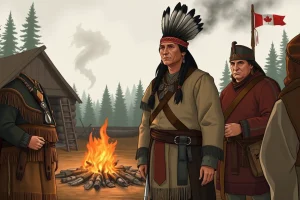
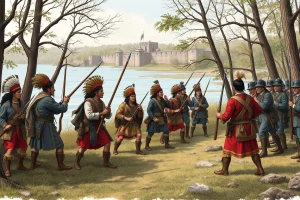
At this critical moment, John Norton—adopted Mohawk chief and British captain—took command of approximately eighty Grand River warriors and moved them toward the heights from the west. Rather than repeating Brock’s frontal assault, Norton climbed the escarpment at a point farther inland, where the climb was less steep, and approached the American right flank through wooded terrain on the relatively flat ground at the top. Though outnumbered by more than ten to one, the warriors attacked with disciplined fire, sniping, and feinted assaults, disrupting the Americans’ efforts to form ordered defensive lines. For several hours they kept the invaders contained, preventing them from advancing inland and forcing them to exhaust ammunition against an elusive enemy hidden among trees and bushes.
While the warriors held the Americans in place, Major-General Roger Hale Sheaffe marched from Fort George with British regulars, Canadian militia, and Runchey’s Corps of Coloured Men, a company of free Black soldiers. Sheaffe used the same inland route Norton had pioneered, approaching the Americans from the rear. When British regulars launched the final attack in the afternoon, the exhausted and demoralized Americans—many of whom had already begun drifting back toward the river—collapsed. By evening, more than 950 Americans had surrendered, ending the battle in a comprehensive British victory.
Among the Indigenous casualties were Cayuga chiefs Ayanete and Kayentatirhon, Onondaga warrior Ta Kanentye, and Oneida warriors Kayarawagor and Sakangonguquate, all of whom fought and died at the heights that day.
Why It Matters
The victory at Queenston Heights ended the American offensive of 1812 on the Niagara frontier. Coming after the captures of Forts Mackinac and Detroit, the battle consolidated British control of Upper Canada and helped unify much of the province’s population behind the war effort. For Indigenous nations, the battle demonstrated both the value and the cost of their military alliance with the Crown: warriors played a decisive role in the outcome, but several lost their lives, and Indigenous communities in Upper Canada would ultimately pay a heavy human and economic price as the war continued.
Historical memory of Queenston Heights has long centred on Isaac Brock, whose death transformed him into a celebrated figure in Canadian history. For many decades, the contribution of the Indigenous warriors was underemphasized in mainstream accounts. Since the late twentieth century, however, historians including Carl Benn have reassessed the battle, arguing that without Norton and his warriors, Sheaffe might have arrived too late to trap the Americans; the battle’s outcome, and perhaps the war’s course in 1812, could have been different. The Canadian government’s 2012 bicentennial commemoration explicitly recognized Indigenous contributions, presenting commemorative banners and medals to successor First Nations and Métis communities as an official acknowledgment of their role.
Definition
The “Indigenous forces” at Queenston Heights comprised approximately eighty warriors from Haudenosaunee communities on the Grand River—principally Mohawks, but also Cayuga, Oneida, Onondaga, and Delaware—who fought as allies of the British Crown. They were commanded by Mohawk chiefs John Norton (Teyoninhokarawen) and John Brant (Ahyonwaeghs), the son of Joseph Brant. Most had been recruited by Norton in the weeks after the war began, following earlier British victories that had swung majority opinion on the Grand River toward alliance with the Crown.
Background
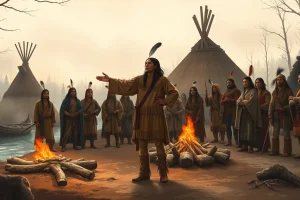
The Anglo-Indigenous alliance on the Grand River had deep roots in the American Revolution. Six Nations refugees who had fought for the Crown had been granted land along the Grand River in 1784 by Governor Frederick Haldimand in recognition of their services. The community maintained strong ties with the Indian Department of Upper Canada and viewed an independent, expansionist United States as the principal threat to their lands and sovereignty. During the summer of 1812, Norton and other leaders made the strategic calculation that British victory was both preferable and more likely, especially after Mackinac and Detroit fell. Those victories demonstrated that alliance with the Crown could protect Indigenous lands.
Tactics and Actions at Queenston Heights
The warriors did not participate in Brock’s initial frontal assault. After Brock’s death, Norton made the decisive tactical decision to approach the heights from the west along a route that bypassed the most dangerous climbing. Operating in the forest that covered the heights, Norton’s warriors employed a containing action: harassing fire, loud war cries, sudden rushes, and tactical withdrawals—all designed to keep the American infantry pinned in place, deny them time to dig in or advance, and erode their morale. The warriors’ fighting style, which combined skirmishing tactics with psychological intimidation and intimate knowledge of the local terrain, was central to their success. Contemporary accounts, including Norton’s own memoir, describe the Americans as kept under constant fire and unable to form secure defensive lines during the hours before Sheaffe arrived.
Competing Viewpoints
Historians differ in how closely they weigh the warriors’ contribution against that of the British regulars and militia. Traditional narratives, dominant in the nineteenth and early twentieth centuries, focused almost exclusively on Brock and Sheaffe, treating Indigenous participation as auxiliary. Modern works by Carl Benn and others argue that the warriors were operationally indispensable—that Norton’s stand bought the decisive time. Some scholars, however, caution that the American position was already tenuous—militia discipline was collapsing, and logistical failures had left many troops without food or dry ammunition—and that Sheaffe’s well-executed maneuver, rather than the warriors’ sniping, was the decisive factor. The differing interpretations hinge on evaluating how close the Americans came to consolidating their position and whether they, or the British, were more likely to collapse first.
Role in the War of 1812
The Queenston Heights action was one of the first major tests of the British-Indigenous military alliance in the Niagara theatre. Its success affirmed the willingness of Grand River communities to fight for the Crown and encouraged other Indigenous groups to join. Through 1813 and 1814, warriors from the Six Nations and elsewhere served as scouts, guides, and line troops at Stoney Creek, Beaver Dams, and Lundy’s Lane, and in the defence of Fort George. The alliance was central to British strategy throughout the war, and Britain achieved few significant victories without Indigenous support, although the extent of that support varied by region and community.
Consequences and Historical Interpretation
In the short term, the victory at Queenston Heights secured the Niagara frontier for 1812. In the longer term, however, the war’s outcome was ambiguous for the Grand River Haudenosaunee. The Treaty of Ghent (1814) promised to restore Indigenous nations to the “status quo ante bellum,” but subsequent British-American negotiations did not restore the territories that communities had lost to American expansion. Grand River leaders argued that the Crown’s failure to honour its commitments undermined the very reasons that had led them to fight. By the 1820s, tensions were rising between the Six Nations and the provincial administration over land concessions. In historical memory, however, the contribution at Queenston Heights came to symbolize the importance of Indigenous peoples in the defence of what became Canada.
Primary Sources
John Norton’s own memoir, completed in 1816 but not published until 1970 as the Journal of Major John Norton (Champlain Society), is the most detailed contemporary account of the warriors’ role at Queenston Heights. Norton describes the tactical decisions, the terrain, and the fighting with precision, but his account is necessarily partisan—Norton was a participant advocating for his own contribution and that of his men. A modern edition, A Mohawk Memoir from the War of 1812, edited by Carl Benn (University of Toronto Press, 2019), annotates Norton’s text and provides contextual corrections.
Other contemporary accounts include the official reports of Major-General Roger Hale Sheaffe, submitted to Governor George Prevost immediately after the battle, and the American correspondence of Major-General Stephen Van Rensselaer and his staff. These documents, available in printed collections of Canadian and American archives, give the formal command perspective and generally acknowledge—though often briefly—the role of the “Indian warriors.” Limitations of bias apply to all of these accounts: military reports sought to justify command decisions, and Norton, writing after the fact, sought to present his own actions in the most favourable light.
Further Reading
- Carl Benn, ed. A Mohawk Memoir from the War of 1812: John Norton—Teyoninhokarawen. Toronto: University of Toronto Press, 2019.
- Carl F. Klinck and James J. Talman, eds. Journal of Major John Norton. Toronto: Champlain Society, 1970.
- J. Mackay Hitsman. The Incredible War of 1812: A Military History. Toronto: University of Toronto Press, 1965; revised 1999.
- Parks Canada. “Culture and History: Queenston Heights National Historic Site.” https://www.parks.canada.ca/lhn-nhs/on/queenston/culture.
- The Canadian Encyclopedia. “Battle of Queenston Heights.” https://thecanadianencyclopedia.ca/en/article/battle-of-queenston-heights.
- Anthony Wilson-Smith. “John Norton and the War of 1812.” The Canadian Encyclopedia. https://thecanadianencyclopedia.ca/en/article/john-norton-and-the-war-of-1812.
References
- Parks Canada. “Culture and History: Queenston Heights National Historic Site.” https://www.parks.canada.ca/lhn-nhs/on/queenston/culture.
- The Canadian Encyclopedia. “Battle of Queenston Heights.” https://thecanadianencyclopedia.ca/en/article/battle-of-queenston-heights.
- Anthony Wilson-Smith. “John Norton and the War of 1812.” The Canadian Encyclopedia. https://thecanadianencyclopedia.ca/en/article/john-norton-and-the-war-of-1812.
- Carl Benn, ed. A Mohawk Memoir from the War of 1812: John Norton—Teyoninhokarawen. Toronto: University of Toronto Press, 2019.
- Friends of Fort York. “Leading the warriors on Queenston Heights: The account of Teyoninhokarawen.” October 31, 2019. https://friendsoffortyork.ca/newsletter/leading-the-warriors-on-queenston-heights-the-account-of-teyoninhokarawen/.
- Indigenous and Northern Affairs Canada. “Exhibit: Indigenous Contributions to the War of 1812.” https://rcaanc-cirnac.gc.ca/eng/1348771334472/1607906032957.
FAQ
How many Indigenous warriors fought at Queenston Heights?
Approximately eighty Haudenosaunee and Delaware warriors, drawn mostly from the Grand River settlements, fought on the British side under John Norton and John Brant.
What was John Norton's background?
Norton was born in Scotland around 1760 to a Cherokee father and Scottish mother, served in the British army, deserted, and was later adopted into the Mohawk nation of the Grand River, becoming a chief through the sponsorship of Joseph Brant.
Why did Indigenous nations fight alongside the British at Queenston Heights?
Haudenosaunee communities on the Grand River shared with the Crown a common goal of resisting American westward expansion, which they saw as a direct threat to their lands and sovereignty, and they expected British military success to protect their territories.
Leave a Reply