
Short Answer
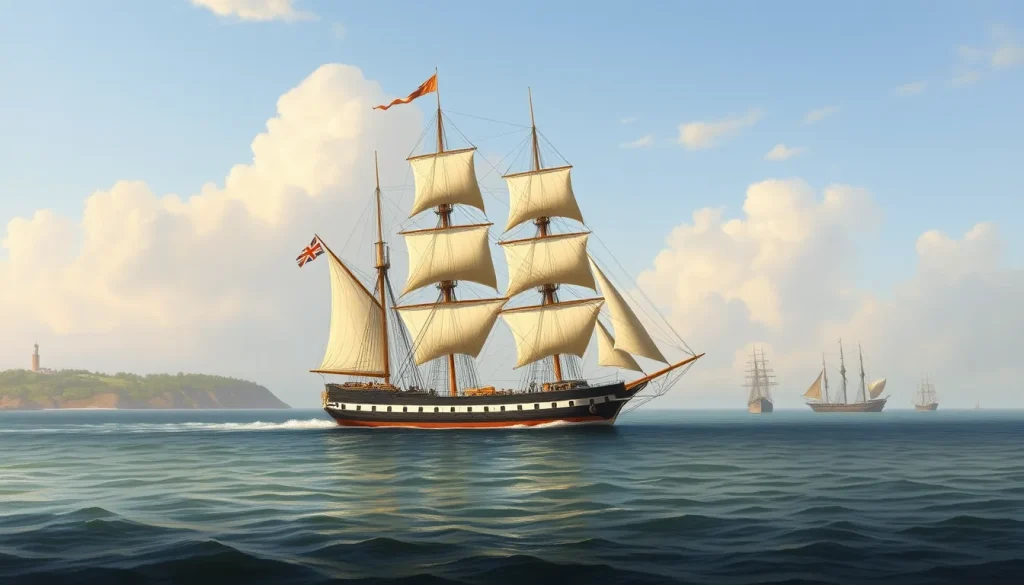
Lake Ontario, the smallest of the Great Lakes, became a pivotal naval theater during the War of 1812. Its waters and shoreline saw a sustained competition between the United States and Great Britain for control of a vital supply route linking the St. Lawrence River to the Niagara frontier. The struggle for Lake Ontario directly shaped military operations in Upper Canada and ultimately influenced the war’s outcome.
Historical Context
The geography of Lake Ontario made it strategically indispensable. It provided the most efficient corridor for moving troops, supplies, and communications between Kingston, at the lake’s eastern end, and the Niagara Peninsula, the western gateway to Upper Canada. Whoever commanded the lake could sever an opponent’s logistics and launch amphibious attacks with speed and surprise. For the British, control of Lake Ontario protected the St. Lawrence River, their primary lifeline to Montreal and Quebec. For the Americans, winning the lake offered a pathway to invade and conquer Canada, which President Madison’s administration initially believed would be swift.
At the war’s outset, neither side had a powerful naval presence. The British relied on the Provincial Marine, a transport-oriented force under the army’s Quartermaster General, with a few armed vessels at Kingston. The United States possessed only one commissioned warship on the lake, the brig Oneida, based at Sackets Harbor. Recognizing the lake’s importance, both sides began rapid naval construction programs that would transform Lake Ontario into a shipbuilding race.
What Happened
During the early months of 1812, British forces under Major-General Isaac Brock seized the initiative, capturing Detroit and Michilimackinac, while American naval preparations lagged. On Lake Ontario, Commodore Isaac Chauncey took command of American naval forces in October 1812 and established a major shipyard at Sackets Harbor. The British, under the Provincial Marine, maintained their base at Kingston. In 1813, the focus shifted to aggressive operations. On April 27, an American fleet under Chauncey and General Henry Dearborn crossed the lake and captured York (present-day Toronto), although the retreating British blew up their magazine, causing numerous American casualties. A follow-up attack on Fort George on May 27 succeeded, forcing British troops to withdraw from the Niagara frontier. In response, a British force under Sir George Prevost launched a night attack on Sackets Harbor on May 28-29, but was repulsed with heavy losses.
Throughout 1813, Yeo and Chauncey avoided a decisive fleet action. They maneuvered for advantage, but engagements such as the running fight near Burlington Bay on September 28 proved inconclusive. Both commanders were criticized for caution, but each understood that losing their squadron would be catastrophic. Instead, they raced to build larger warships. By the end of 1813, the Americans had launched the corvette Madison and the ship Pike, while the British had built the Royal George, Wolfe, and Moira. The arms race escalated dramatically in 1814. Chauncey added the Superior, mounting 62 guns, and the Mohawk with 42 guns. Yeo responded by constructing the St. Lawrence, a first-rate ship of the line with 112 guns, launched in September 1814. Larger than Nelson’s flagship Victory, the St. Lawrence gave the British unchallenged supremacy, but it never fired in anger. The war ended before either side could force a decisive battle on Lake Ontario.
Why It Matters
The failure to achieve naval command on Lake Ontario had profound strategic consequences. It prevented either side from launching a decisive invasion through the St. Lawrence or the Niagara frontier. The British retained control of Kingston, safeguarding their supply line, while the Americans maintained Sackets Harbor, blocking a British advance into New York. This stalemate contributed to the overall strategic deadlock on the northern front. The enormous expenditure on shipbuilding drained resources from other theaters and reflected the industrial-scale commitment both nations were willing to make. After the war, the Rush-Bagot Agreement of 1818 demilitarized the Great Lakes, limiting each side to a small number of armed vessels, turning Lake Ontario into a peaceful boundary. This agreement laid the foundation for over a century of undefended border between the United States and Canada.
Historical Map Context
Lake Ontario sits between the province of Ontario to the north and New York State to the south. Key strategic points included Kingston, at the lake’s northeastern shore where the St. Lawrence River begins, and Sackets Harbor, on the American side near the eastern end. York (Toronto) lay on the northwestern shore, while Fort George and Fort Niagara guarded the Niagara River outlet to the west. The lake’s length of about 193 miles and width of 53 miles allowed for significant naval maneuvers. Control of these coastal bases determined access to the lake.
Modern Location
Today, Lake Ontario remains a major freshwater lake shared by Ontario, Canada, and New York, USA. The sites of the 1812 naval bases are preserved as historical locations. Kingston, Ontario, is home to the Royal Military College and the site of the former naval dockyard at Point Frederick, now part of the Kingston Royal Naval Dockyard National Historic Site. Sackets Harbor, New York, is a village with a battlefield state historic site and museum. Many other battlefields, such as the site of York (now Toronto), are marked with plaques and monuments.
Events at the Site
Major events on, or directly adjacent to, Lake Ontario included the American capture of York in April 1813; the landing at Fort George in May 1813; the British attack on Sackets Harbor in May 1813; and the running naval actions between Chauncey and Yeo during the 1813 season. In 1814, the launch of HMS St. Lawrence at Kingston effectively sealed the lake for the British, although no major battle occurred. The shipbuilding yards themselves were sites of intense activity, with workers and shipwrights constructing vessels on both shores.
Associated People
The central figures were Commodore Sir James Lucas Yeo, commander of British naval forces on Lake Ontario from 1813, and Commodore Isaac Chauncey, his American counterpart. Others included Major-General Isaac Brock, who recognized the lake’s importance early on; General Henry Dearborn, who led American land forces at York and Fort George; and shipwrights and officers like Captain Andrew Gray, who oversaw construction of the St. Lawrence. On the British side, the Provincial Marine was initially led by officers under the Quartermaster General, but after 1813 the Royal Navy took direct command.
Surviving Monuments and Site
Several sites preserve the legacy of the Lake Ontario naval conflict. In Kingston, the Royal Military College stands where the dockyard once operated, and the nearby Fort Henry and the Cataraqui River still evoke the past. Sackets Harbor Battlefield State Historic Site in New York includes the original harbor, a visitors center, and remnants of the naval yard. Many markers along the lake commemorate the battles and shipbuilding efforts. The HMS St. Lawrence itself, though dismantled after the war, is remembered through models and exhibits at Canadian museums, including the Kingston Naval Museum.
Primary Sources
Key contemporary documents include the official correspondence of Commodore Isaac Chauncey and Sir James Lucas Yeo, which detail strategic calculations and shipbuilding progress. The report of Lieutenant Colonel A.H. Pye to Governor-General Prevost, dated December 7, 1811, provides a detailed assessment of the Provincial Marine’s condition and limitations, offering insight into British naval readiness. American Secretary of the Navy Paul Hamilton’s letters to Chauncey also document the American build-up. The Naval War of 1812: A Documentary History, Volume 1, edited by William S. Dudley, contains many of these documents, preserving them for research. Each source reflects the perspective of its author and must be read with attention to military and political biases.
Further Reading
- Barry M. Gough, “War on the Lakes in the War of 1812,” The Canadian Encyclopedia.
- Donald R. Hickey, The War of 1812: A Forgotten Conflict (University of Illinois Press, 1989).
- Andrew Lambert, The Challenge: Britain Against America in the Naval War of 1812 (Faber and Faber, 2012).
- Jon Latimer, 1812: War with America (Harvard University Press, 2007).
- Robert Malcomson, Lords of the Lake: The Naval War on Lake Ontario, 1812-1814 (Robin Brass Studio, 1998).
- W.A.B. Douglas, Gunfire on the Lakes: The Naval War of 1812-1814 on the Great Lakes and Lake Champlain (Ottawa, 1977).
References
- Barry M. Gough, “War on the Lakes in the War of 1812,” The Canadian Encyclopedia, accessed [date], link.
- American Battlefield Trust, “The Great Lakes in the War of 1812,” link.
- “The Lake Ontario Arms Race – War of 1812,” link.
- Royal Military College of Canada, “Strategic Importance,” link.
- William S. Dudley, ed., The Naval War of 1812: A Documentary History, Volume 1 (Naval Historical Center, 1985).
FAQ
Why was control of Lake Ontario so important in the War of 1812?
Lake Ontario was the main supply route between Kingston and the Niagara frontier, and controlling it enabled an army to move troops and supplies quickly, potentially deciding the fate of Upper Canada.
Did a major naval battle take place on Lake Ontario?
No, despite numerous maneuvers and minor engagements, Commodore Chauncey and Sir James Yeo both avoided a decisive fleet action, making the campaign a stalemate.
What was the largest warship built on Lake Ontario?
HMS St. Lawrence, a 112-gun first-rate ship of the line launched at Kingston in September 1814, was the largest warship ever built on the Great Lakes.



Leave a Reply