
Short Answer
The War of 1812 on Lake Ontario was characterized by a massive naval arms race between American and British squadrons, yet no decisive fleet battle was ever fought. Despite both sides building powerful warships and recognizing the lake’s strategic importance, commanders avoided a conclusive engagement. This article explains the reasons behind this naval stalemate and its significance for the war’s outcome.
Historical Context
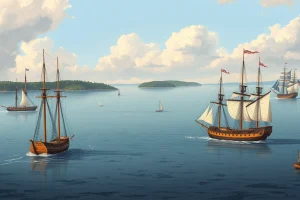
Lake Ontario occupied a central position in the Anglo-American conflict of 1812–1815. Control of the lake was essential for moving troops, supplies, and artillery between the United States and Upper Canada. The American strategy of invading and annexing Canada depended on secure water transportation, while the British defense of Upper Canada required maintaining communication and supply lines from Kingston to the Niagara frontier and beyond. The lake’s geography, with the American naval base at Sackets Harbor on the eastern shore and the British base at Kingston at the northeastern end, made it a natural arena for naval competition. At the outbreak of war, the United States had only the 16-gun brig USS Oneida on the lake, while the British Provincial Marine operated a small but more numerous collection of armed merchant vessels. Both sides recognized from the outset that naval supremacy on Lake Ontario would be a decisive factor in the land campaigns.
As the war escalated, the Madison administration committed substantial resources to building a powerful naval force on the lakes. Meanwhile, the Royal Navy dispatched a detachment of seasoned officers and sailors under Commodore Sir James Lucas Yeo to take control of the Provincial Marine and construct a proper fighting squadron. The result was an intense shipbuilding competition that produced increasingly large warships, but no major fleet action in which either side was destroyed or forced to surrender.
What Happened
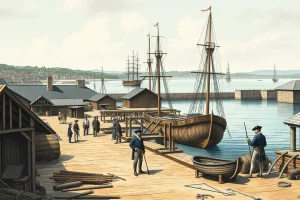
In October 1812, Commodore Isaac Chauncey arrived at Sackets Harbor with orders to build a fleet. Within months, he had assembled a squadron of converted merchant schooners and newly constructed vessels, including the corvette USS Madison. In the spring of 1813, Yeo assumed command at Kingston and began systematic improvements to the British squadron, bringing in experienced Royal Navy personnel and constructing larger warships such as HMS Wolfe, HMS Royal George, and HMS Moira.
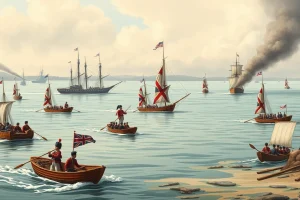
During the 1813 campaign, the two squadrons met on several occasions, but neither commander pressed for a decisive engagement. The first significant contact occurred from August 7 to 10, 1813, when Chauncey and Yeo manoeuvred for tactical advantage off the western end of the lake. The action was inconclusive, with both fleets retiring to their bases. On September 28, 1813, the squadrons met again off York (present-day Toronto) in an encounter popularly known as the “Burlington Races.” The British fleet, commanded by Yeo, and the American fleet, under Chauncey, engaged in a running fight as Yeo retreated toward Burlington Bay. Although American ships outnumbered the British, the action ended indecisively, with both sides maintaining their squadrons intact.
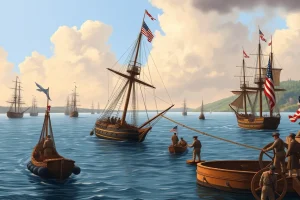
After these encounters, both commanders became markedly more cautious. Neither was willing to risk the loss of his fleet, which would have exposed his own bases and land forces to attack. Instead, they focused on completing larger vessels to overmatch the opponent. In 1814, Chauncey launched USS Superior (62 guns) and USS Mohawk (42 guns), while Yeo began construction of HMS St. Lawrence, a first-rate ship of the line mounting 112 guns, launched at Kingston in September 1814. The St. Lawrence was larger than Nelson’s Victory and gave the British overwhelming local superiority, but she was never tested in combat. The war ended with no decisive fleet battle on Lake Ontario.
Why It Matters
The absence of a decisive fleet battle on Lake Ontario had significant strategic consequences. Control of the lake remained contested, which prevented either side from mounting a decisive campaign in Upper Canada. The American invasions of 1813 and 1814 were hampered by the inability to secure the lake’s transportation routes, while the British were unable to use naval power to destroy the American base at Sackets Harbor. The stalemate forced both armies to operate with constant supply difficulties and contributed to the overall military stalemate on the Niagara frontier.
Historians have debated the reasons for the lack of a decisive action. Some emphasize the cautious temperament of Chauncey and Yeo, both of whom valued preservation of their fleets over aggressive action. Others point to the near-equality of the forces, the difficulties of fighting on a confined freshwater lake, and the high stakes—a single defeat could have lost the war for either side. The arms race consumed enormous resources, including timber, guns, and skilled labor, which were in short supply for both nations. The eventual Rush-Bagot Agreement of 1817, which limited naval forces on the Great Lakes, grew directly out of this experience and represented a recognition that maintaining large fleets on the lakes was costly and destabilizing.
Definition
A “decisive fleet battle” on Lake Ontario would have been a naval engagement in which one squadron was destroyed or captured, thereby giving the victor unchallenged control of the lake and a decisive advantage in the land campaign. No such battle occurred; the largest encounters were inconclusive skirmishes.
Background
Both nations realized that naval control of Lake Ontario was the key to winning the war in Upper Canada. The American plan to conquer Canada hinged on moving armies across the lake, while the British defense relied on supplying and reinforcing their forces from Kingston. This strategic imperative led to a rapid military build-up on both sides.
How It Worked
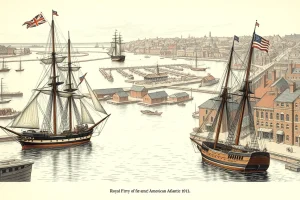
The naval competition resembled a technological arms race. Each side constructed ships that were larger and more heavily armed than those of the adversary. Shipyards at Sackets Harbor and Kingston worked around the clock, using local timber and imported guns. Commanders sought to gain a numerical or qualitative advantage that would allow them to defeat the enemy without risking an uncertain battle. When the squadrons did meet, their actions were generally short and ended when one side had the advantage of wind or position. The difficulties of maintaining formation with heterogeneous ship types, particularly the converted American schooners, also limited their ability to fight decisively.
Competing Viewpoints
Historians have disagreed over whether the commanders were overly cautious or acted rationally. Some argue that Chauncey’s administrative mindset and Yeo’s aggressive reputation were tempered by the realization that a single lost battle would be catastrophic. Others contend that both missed opportunities to win the war, pointing to the American advantage in long guns and the British advantage in carronades. The discovery of HMS Wolfe’s log in the U.S. National Archives has allowed a more precise reconstruction of the 1813 encounters, showing that the weather and wind conditions were not as extreme as previously suggested, and that both commanders had valid tactical reasons for breaking off action.
Role in the War of 1812
The stalemate on Lake Ontario prevented either side from achieving a decisive victory in the central front of the war. American attempts to invade Upper Canada via the Niagara Peninsula were thwarted partly because the lake could not be secured. British plans to recapture American positions or raid the American shore were similarly constrained. The war in this theater became a prolonged and indecisive struggle, with both sides ultimately accepting the pre-war boundary lines in the Treaty of Ghent.
Consequences and Historical Interpretation
The naval arms race on Lake Ontario left a lasting legacy. The construction of HMS St. Lawrence demonstrated the extreme lengths to which both nations would go, but the ship was never used in battle and was laid up after the war. The experience contributed to the Rush-Bagot Agreement, which demilitarized the Great Lakes. In historical memory, the Lake Ontario campaign is often overshadowed by the Battle of Lake Erie and the Battle of Plattsburgh, but it is increasingly recognized as a decisive strategic stalemate that shaped the war’s outcome.
Primary Sources
Key primary sources for understanding the Lake Ontario naval campaign include the log book of HMS Wolfe, the British flagship in 1813, which was discovered in the U.S. National Archives in 1971 and provides a daily record of the squadron’s movements and encounters. Commodore Isaac Chauncey’s correspondence to the Secretary of the Navy, housed at the Clements Library at the University of Michigan, documents American strategic thinking and the construction program. Commodore James Lucas Yeo’s dispatches to Admiral Warren and the Admiralty detail British plans and evaluations of the American fleet. These records, while valuable, must be used with attention to their authors’ perspectives and the limitations of contemporary reporting.
Further Reading
- Williamson, Robert J. “The Burlington Races Revisited: A Revised Analysis of an 1813 Naval Battle for Supremacy on Lake Ontario.” Canadian Military History 8, no. 4 (1999): 7-15.
- Williamson, Robert J. “The First Encounter: Fighting for Naval Supremacy on Lake Ontario, 7–10 August 1813.” Canadian Military History 11, no. 3 (2002): 15-30.
- Brodine, Charles E., Jr. “The War’s Most Challenging Theater.” Naval History 27, no. 5 (October 2013).
- Hickey, Donald R. The War of 1812: A Forgotten Conflict. University of Illinois Press, 1989.
- Lambert, Andrew. The Challenge: Britain Against America in the Naval War of 1812. Faber & Faber, 2012.
References
- The Lake Ontario Arms Race – War of 1812. https://thewarof1812.org/battles/the-lake-ontario-arms-race/
- Brodine, Charles E., Jr. “The War’s Most Challenging Theater.” Naval History Magazine, October 2013. https://www.usni.org/magazines/naval-history-magazine/2013/september/wars-most-challenging-theater
- Williamson, Robert J. “The Burlington Races Revisited: A Revised Analysis of an 1813 Naval Battle for Supremacy on Lake Ontario.” Canadian Military History 8, no. 4 (1999). https://scholars.wlu.ca/cgi/viewcontent.cgi?article=1271&context=cmh
- “The War of 1812: A Bicentennial Exhibition, Case 9.” Clements Library, University of Michigan. https://clements.umich.edu/exhibit/the-war-of-1812/case-9/
- Williamson, Robert James. “The First Encounter: Fighting for Naval Supremacy on Lake Ontario, 7–10 August 1813.” Canadian Military History 11, no. 3 (2002). http://scholars.wlu.ca/cmh/vol11/iss3/3
FAQ
Why didn't the fleets fight a major battle on Lake Ontario?
Both commanders were cautious because the loss of their fleet would have been catastrophic for their entire war effort. Additionally, the navies were often evenly matched, and tactical conditions did not favor a decisive action.
What was the Burlington Races?
It was the most significant encounter between the American and British squadrons on Lake Ontario, fought on September 28, 1813. It ended inconclusively, with Yeo withdrawing to Burlington Bay.
How did the arms race end?
The arms race ended with the Treaty of Ghent and the subsequent Rush-Bagot Agreement of 1817, which limited naval forces on the Great Lakes.
Leave a Reply