
Short Answer
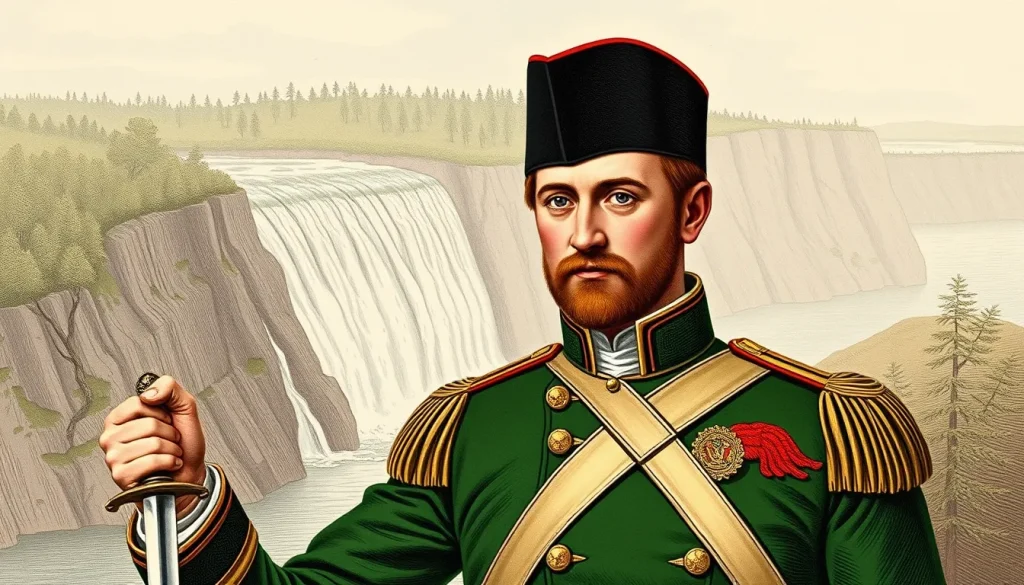
James FitzGibbon (16 November 1780 – 10 December 1863) was an Irish-born soldier in the British Army who spent nearly 45 years in the Canadas, becoming a noted officer during the War of 1812. He is best remembered for leading irregular guerrilla operations on the Niagara frontier, receiving Laura Secord’s warning before the Battle of Beaver Dams, and bluffing a larger American force into surrender. FitzGibbon’s career spanned the Napoleonic Wars, the War of 1812, and Canada’s later political unrest, making him a lasting symbol of loyalty and resourcefulness.
Historical Context
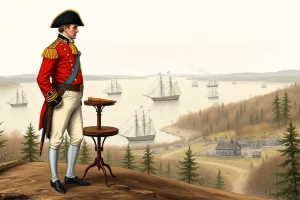
The War of 1812 pitted the United States against Great Britain and its North American colonies. The Niagara Peninsula, separating Lake Ontario and Lake Erie, was a critical invasion route. British regulars, Canadian militia, and Indigenous allies defended Upper Canada against repeated American offensives. FitzGibbon arrived with the 49th Regiment of Foot in 1802, joining a force tasked with holding this frontier. The British command structure, combined with Indigenous military traditions and local knowledge, shaped the small-unit actions in which FitzGibbon would excel.
What Happened
FitzGibbon served in the 49th Regiment under Lieutenant-Colonel Isaac Brock, whose mentoring accelerated his promotions. In August 1812, FitzGibbon escorted vital supply boats through the St. Lawrence rapids past American observers. The following January, he led a sled convoy carrying stores from Kingston to Niagara through the Canadian winter. After the American capture of Fort George in May 1813, FitzGibbon received permission to raise fifty chosen men for independent action. His “Green Tigers” harried American outposts and gathered intelligence from a base near Beaver Dams. On 22 June 1813, Laura Secord walked nearly twenty miles to warn FitzGibbon of an impending American strike. On 24 June, Lieutenant-Colonel Charles Boerstler’s 500-man force was ambushed by approximately 400 Mohawk and Odawa warriors. FitzGibbon then exaggerated his numbers, inducing Boerstler to surrender 462 prisoners. Promoted captain in the Glengarry Light Infantry Fencibles, FitzGibbon later fought at Lundy’s Lane in 1814, where friendly fire nearly killed him.
Why It Matters
The victory at Beaver Dams secured the Niagara frontier for the remainder of 1813 and bolstered British morale. FitzGibbon became a celebrated hero in Upper Canada, his name linked to Laura Secord’s courage. His later career in public service and his role in the 1837 Rebellion underscored the endurance of his colonial connections. Historians have debated the precise credit due to FitzGibbon versus the Indigenous warriors and to Laura Secord, reflecting broader questions about agency and memory in Canadian history.
Early Life
James FitzGibbon was born on 16 November 1780 in Glin, County Limerick, Ireland, to Garrett FitzGibbon and Mary Widenham. His father was a farmer and weaver with a small holding. At fifteen, FitzGibbon joined the Knight of Glin’s Yeomanry Corps, earning promotion to sergeant. He later enlisted in the Tarbert Infantry Fencibles, an Irish home service regiment, before being recruited into the British Army’s 49th Regiment of Foot.
Role Before the War
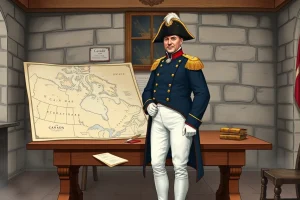
FitzGibbon saw his first combat at Egmond aan Zee in Holland (1799) and served as a marine at the Battle of Copenhagen (1801), receiving the Naval General Service Medal. The 49th Regiment deployed to Canada in 1802. Isaac Brock recognized FitzGibbon’s abilities and encouraged his education, securing his promotion from sergeant-major to ensign and adjutant in 1806, and lieutenant in 1809.
Role During the War
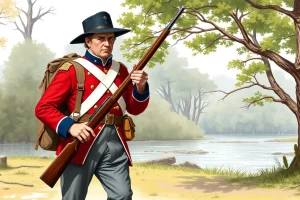
In June 1813, FitzGibbon fought at the Battle of Stoney Creek. Shortly thereafter, he formed his guerrilla company. Operating from John DeCou’s stone house near Beaver Dams, his men wore green uniforms and became known as the “Green Tigers” or “Bloody Boys.” After Laura Secord’s warning, FitzGibbon positioned his forces and, during the ensuing battle, bluffed the Americans into surrender. Later in the war, he conducted reconnaissance and served at Lundy’s Lane.
Major Actions
FitzGibbon’s most notable action was the Battle of Beaver Dams on 24 June 1813. A force of about 400 Indigenous warriors, led by Captains William Kerr and Dominique Ducharme, ambushed the American column. FitzGibbon arrived mid-battle and persuaded Boerstler to capitulate by inflating his numbers and claiming reinforcements were imminent. FitzGibbon’s own report later acknowledged that the Indigenous warriors had done the “beating” and that he only offered protection from the tomahawk. He also participated in the supply convoys of 1812–1813 and the Battle of Lundy’s Lane.
Contemporary Accounts
Contemporary praise came from General Edward Baynes, who called FitzGibbon’s exploit “most judicious & spirited,” and from the Montreal Gazette, which praised his “cool determination and hardy presence of mind.” Laura Secord’s role was corroborated by FitzGibbon’s testimonials in 1820, 1827, and 1837. However, FitzGibbon also deflected credit to the Indigenous warriors, writing in 1818 that they “beat the American detachment into a state of terror.”
Later Life
FitzGibbon remained in Canada after the war, serving as clerk in the adjutant general’s office, then as assistant adjutant-general of militia, and from 1827 to 1841 as clerk of the Upper Canadian House of Assembly. He held various judicial and administrative posts and was a militia colonel. During the Rebellion of 1837, he raised a volunteer company and helped suppress the insurgents at Montgomery’s Tavern. FitzGibbon retired in 1846 and moved to England, becoming a military knight of Windsor in 1850. He died at Windsor Castle on 10 December 1863.
Historical Legacy
FitzGibbon’s legacy is tied to the defence of Upper Canada and to Laura Secord’s fame. Scholars have debated whether he exaggerated his role at Beaver Dams, but his own candour about the Indigenous contribution and his repeated certification of Secord’s feat complicate the heroic narrative. FitzGibbon’s career also illustrates the limited prospects for non-commissioned officers in the British Army and the importance of patronage. He is remembered as a resourceful, loyal, and occasionally self-promoting soldier.
Primary Sources
- FitzGibbon’s Letter to Captain Kerr, 1818 – FitzGibbon acknowledges the Indigenous warriors’ role at Beaver Dams, a key corrective to later accounts.
- Certificates for Laura Secord (1820, 1827, 1837) – FitzGibbon confirms the intelligence brought by Secord, vital evidence for her story.
- Weekly State of the 49th Regiment by Adjutant James FitzGibbon – a military administrative record preserved in Canadian archives.
- An Appeal to the People of the Late Province of Upper Canada (1847) – FitzGibbon’s pamphlet detailing his military and public service and claims of unrewarded loyalty.
Further Reading
- McKenzie, Ruth. “FitzGibbon, James.” Dictionary of Canadian Biography.
- McKenzie, Robert. James FitzGibbon: Defender of Upper Canada (1983).
- The Canadian Encyclopedia, s.v. “James FitzGibbon.”
- Benn, Carl. The Iroquois in the War of 1812 (University of Toronto Press, 1998).
References
- The Canadian Encyclopedia, “James FitzGibbon,” https://thecanadianencyclopedia.ca/en/article/james-fitzgibbon.
- Wikipedia, “James FitzGibbon,” https://en.wikipedia.org/wiki/James_FitzGibbon.
- Dictionary of Canadian Biography, “FitzGibbon, James,” http://www.biographi.ca/en/bio.php?BioId=38548.
- Library of Congress Name Authority, “FitzGibbon, James, 1780-1863,” https://id.loc.gov/authorities/names/n85192182.html.
- Répertoire du patrimoine culturel du Québec, “FitzGibbon, James,” https://www.patrimoine-culturel.gouv.qc.ca/detail.do?id=17174.
FAQ
What was James FitzGibbon's role at the Battle of Beaver Dams?
FitzGibbon commanded a small detachment and, after an Indigenous ambush had disorganized the American force, he bluffed the American commander into surrendering by exaggerating his numbers and threatening reinforcements.
How did Laura Secord warn FitzGibbon?
Laura Secord walked about 20 miles from Queenston to Beaver Dams on 22 June 1813 to inform FitzGibbon of an American expedition preparing to attack his base. FitzGibbon later confirmed this intelligence in several written testimonials.
Did FitzGibbon receive proper recognition after the war?
Despite being promoted to captain and receiving a gold medal from his fellow officers, FitzGibbon felt unrewarded for his services. His 1847 pamphlet argued that he had saved Upper Canada for the Empire, but he received no further preferment.
Leave a Reply