Short Answer
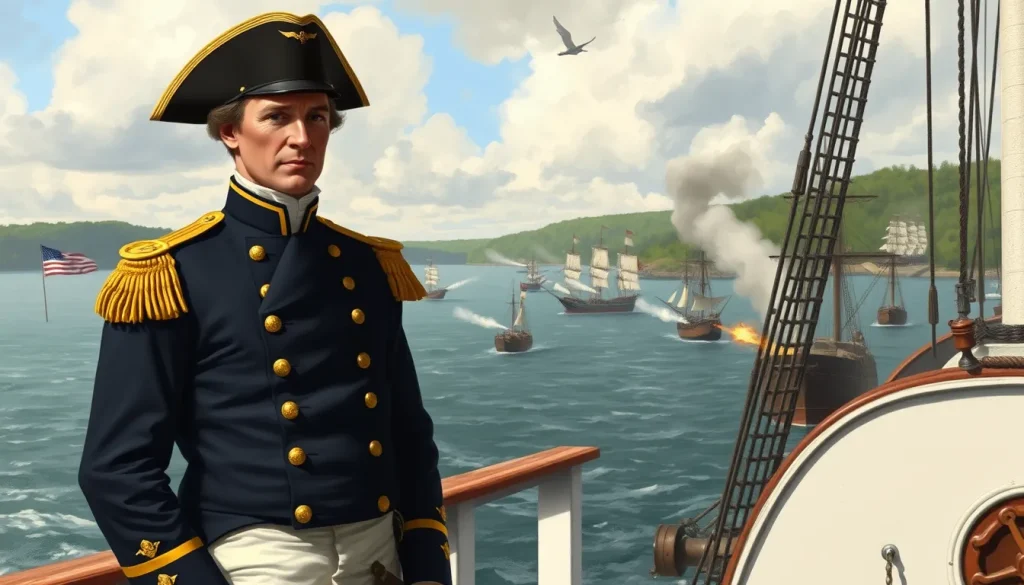
Isaac Chauncey (1772–1840) was a U.S. Navy officer who commanded American naval forces on Lake Ontario throughout the War of 1812. Appointed in September 1812, he oversaw the rapid construction of a squadron at Sackets Harbor, New York, and led it in combined operations with the army, including the capture of York in April 1813. His leadership was crucial to maintaining an American presence on the lake, yet a series of inconclusive engagements with British Commodore Sir James Lucas Yeo has fueled a long‑standing debate about his aggressiveness and strategic judgment.
Historical Context
When the War of 1812 began, the United States planned to invade and annex British North America, a strategy that depended on control of the Great Lakes. Lake Ontario formed the central corridor between the American invasion routes along the Niagara Peninsula and the St. Lawrence River. At the war’s outset, the U.S. possessed only one armed vessel on the lakes—the brig USS Oneida—while the British maintained a small naval presence at Kingston. In the summer of 1812, after the fall of Detroit, President James Madison’s administration made naval supremacy on the lakes a priority. Secretary of the Navy Paul Hamilton ordered Chauncey, then commandant of the New York Navy Yard, to proceed to Lake Ontario and “obtain command of the Lakes Ontario & Erie.” The logistical challenge was steep: Sackets Harbor was a backwoods settlement with no shipbuilding infrastructure, and all materials had to be hauled over poor roads or by river from New York City. The British simultaneously began reinforcing their own squadron at Kingston, setting the stage for a naval arms race.
What Happened
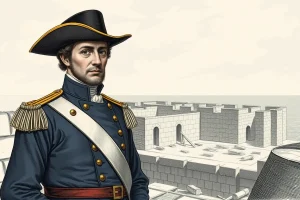
Chauncey arrived at Sackets Harbor in October 1812 and immediately began building a fleet. He contracted shipwrights, imported cannons and naval stores, and directed the construction of sloops and schooners, many converted from merchant vessels. By spring 1813, he had assembled a squadron that included the new corvette USS Madison and the flagship USS General Pike. In April 1813, Chauncey cooperated with Major General Henry Dearborn to mount an amphibious assault on York (now Toronto), the provincial capital of Upper Canada. The attack succeeded, capturing supplies and destroying a British ship under construction, though the American army suffered casualties when the retreating British blew up a powder magazine.
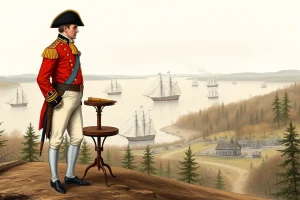
Throughout 1813, Chauncey and Yeo maneuvered on Lake Ontario, each trying to gain a decisive advantage while avoiding serious damage to their fleets. They clashed on 10 August and again on 11 September 1813 in long-range gunnery duels that neither side could turn into a decisive victory. On 28 September, near Burlington Bay, Chauncey’s flagship severely damaged Yeo’s Wolfe, but the American commodore called off the chase, citing the onset of a gale and the poor sailing qualities of his converted schooners. British commander William Mulcaster’s covering fire allowed Yeo to escape. After this action, neither fleet risked a major engagement for the remainder of the season.
In 1814, the naval race intensified as both sides launched larger ships. Chauncey’s health declined, and command responsibilities were often shared with subordinates. He supported Major General Jacob Brown’s invasion of the Niagara Peninsula by transporting troops and supplies, but he refused to risk his ships in the shallow waters near Fort Niagara, and he grew frustrated by repeated army requests for transport that diverted his warships. The strategic stalemate on Lake Ontario persisted until the end of the war, with the American fleet remaining at Sackets Harbor and the British at Kingston.
Why It Matters
Chauncey’s role was central to the war on the northern frontier. His ability to build and maintain a fleet at a remote site gave the United States a credible deterrent against a British counterattack and enabled amphibious operations such as the capture of York. Yet his reluctance to accept battle unless conditions were overwhelmingly favorable has been criticized by many historians, including Theodore Roosevelt, Henry Adams, and Alfred Thayer Mahan, who compared him unfavorably with Oliver Hazard Perry and Thomas Macdonough. More recent scholarship, such as that by Charles E. Brodine Jr., has argued that Chauncey’s caution was rational given his mixed fleet of converted merchantmen, his need to preserve naval superiority, and the immense administrative burden he carried. The naval arms race he oversaw on Lake Ontario had no parallel in scale; by 1814, the squadron included ships of unprecedented size for inland waters, and it forced the British to divert scarce resources to Kingston. The failure to achieve mastery of the lake left the strategic outcome undecided in that theater, but Chauncey’s logistical achievements laid the foundation for the postwar American navy.
Early Life
Isaac Chauncey was born on 20 February 1772 in Black Rock, Connecticut. He went to sea as a youth, and by age nineteen he was commanding merchant vessels for John Jacob Astor. In 1799, he was appointed a lieutenant in the U.S. Navy during the Quasi‑War with France. He later served in the Mediterranean against the Barbary pirates, where he distinguished himself by helping to extinguish a fire aboard the flagship Philadelphia in 1803. He was promoted to captain in 1806 and took a furlough to command the merchant ship Beaver on a voyage to China, during which he resisted a British impressment search.
Role Before the War
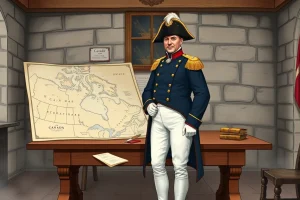
After returning from China in 1807, Chauncey became commandant of the New York Navy Yard in Brooklyn. This position gave him extensive experience in ship construction, procurement, and administration, and it was a key reason Secretary Hamilton selected him for the lakes command. His reputation as a “practical seaman” and an organizer made him the natural choice to build a fleet from scratch in the wilderness.
Role During the War
Chauncey held the title of Master Commandant, later Commodore, and he was the senior U.S. naval officer on the Great Lakes. He oversaw the construction and outfitting of the squadron at Sackets Harbor, managed recruitment and supplies, and directed operations. He personally commanded the fleet in engagements with Yeo and supported army operations. His duties also included administering the naval hospital, negotiating with state authorities, and corresponding with the Navy Department. This triple role—administrator, squadron commander, and joint‑operations collaborator—was unprecedented for a U.S. officer at the time.
Major Actions
Chauncey’s most notable success was the capture of York in April 1813, where his fleet landed 1,700 troops and provided naval fire support. He also destroyed British supplies and the nearly completed ship Duke of Gloucester. On the lake, his engagements with Yeo on 10 August, 11 September, and 28 September 1813 were inconclusive. In 1814, he transported General Brown’s army to the Niagara Peninsula but declined to cooperate in the attack on Fort Niagara because of navigational concerns. He also directed the building of the giant ship USS New Orleans (launched after the war) and the frigate Superior, which contributed to the arms race but never saw action.
Contemporary Accounts
Contemporary observers praised Chauncey’s energy and organization but also noted his caution. After the 28 September 1813 action, his flag captain Arthur Sinclair expressed frustration that Chauncey had not pursued the British more aggressively. In his own reports, Chauncey emphasized the condition of his ships and the weather as reasons for breaking off combat. British officers, including Yeo, respected their opponent’s fleet but considered the American commodore overly defensive. The press on both sides often criticized the lack of a decisive naval victory on Lake Ontario.
Later Life
After the war, Chauncey commanded the Portsmouth Navy Yard in Maine, then the Mediterranean Squadron from 1816 to 1818. He served on the Board of Navy Commissioners and as commandant of the New York Navy Yard again. He became President of the Board of Navy Commissioners in 1837 and died in Washington, D.C., on 27 January 1840. Three U.S. Navy ships have been named in his honor.
Historical Legacy
Chauncey’s legacy is intertwined with the contested question of whether he could have achieved a Perry‑style victory on Lake Ontario. For over a century, the dominant interpretation, shaped by Roosevelt, Adams, and Mahan, held that his timidity allowed the British to maintain a stalemate. However, later scholars have argued that his caution was a calculated response to the fragility of his makeshift squadron, the strategic need to avoid a defeat that would expose the American frontier, and the overwhelming administrative demands of his post. Historical assessments now recognize his logistics and shipbuilding acumen as among the war’s most significant contributions, even if tactical glory eluded him.
Primary Sources
Key primary sources include Chauncey’s official correspondence with Secretaries of the Navy Paul Hamilton and William Jones, which documents the challenges of building and supplying the fleet. His after‑action reports for the engagements of 1813 are reprinted in The Naval War of 1812: A Documentary History, edited by William S. Dudley. The letter Chauncey wrote on October 6, 1812, describing his arduous journey to Sackets Harbor is preserved in the National Archives. Additionally, the logbooks of vessels such as the USS Sylph and the journal of Master’s Mate Peter W. Spicer provide eyewitness perspectives on the battles. These sources are valuable but carry the bias of participants who wished to justify their decisions.
Further Reading
- Brodine, Charles E., Jr. “The Cautious Commodore?” Naval History 27, no. 5 (September/October 2013).
- Malcomson, Robert. Lords of the Lake: The Naval War on Lake Ontario, 1812–1814. Toronto: Robin Brass Studio, 1998.
- Malcomson, Robert, ed. Sailors of 1812: Memoirs and Letters of Naval Officers on Lake Ontario. Toronto: Robin Brass Studio, 1997.
- Dudley, William S., ed. The Naval War of 1812: A Documentary History. Washington, D.C.: Naval Historical Center, 1985.
- National Park Service, “Isaac Chauncey.” Service Biography. NPS.gov.
- Syrett, David. The Royal Navy in North American Waters, 1775–1815. Aldershot: Scolar Press, 1989.
References
- Brodine, Charles E., Jr. “The Cautious Commodore?” Naval History 27, no. 5 (2013). https://www.usni.org/magazines/naval-history-magazine/2013/september/cautious-commodore.
- National Park Service. “Isaac Chauncey.” https://www.nps.gov/people/isaac-chauncey.htm.
- Carmichael, David W. “Battle of the Broadaxes.” New York Archives 14, no. 2 (Fall 2014). https://www.nysarchivestrust.org/new-york-archives-magazine/magazine-highlights/fall-2014-volume-14-number-2.
- Naval Historical Center. “Commodore Isaac Chauncey, USN (1772-1840).” https://ibiblio.org/hyperwar/OnlineLibrary/photos/pers-us/uspers-c/i-chaunc.htm.
- Malcomson, Robert. “U.S. Commodore Chauncey at Burlington Bay.” War of 1812 Magazine. https://www.warof1812.ca/chauncey.htm.
FAQ
Why was Isaac Chauncey important in the War of 1812?
Chauncey was the senior U.S. naval officer on the Great Lakes, responsible for building and commanding the Lake Ontario squadron. His leadership enabled American amphibious operations like the capture of York and prevented the British from gaining full control of the lake.
Why is Chauncey often called 'cautious'?
He avoided major fleet battles unless he held a decisive superiority in men and guns, and he broke off engagements when conditions deteriorated. Critics like Theodore Roosevelt and Henry Adams saw this as overcautiousness, though later historians argue it was a rational response to his fleet's weaknesses.
What was the outcome of the naval war on Lake Ontario?
The opposing squadrons reached a strategic stalemate; neither side could decisively defeat the other. Both Chauncey and Yeo focused on building ever-larger ships, but the war ended before a major fleet action could decide control of the lake.
Leave a Reply