
Short Answer
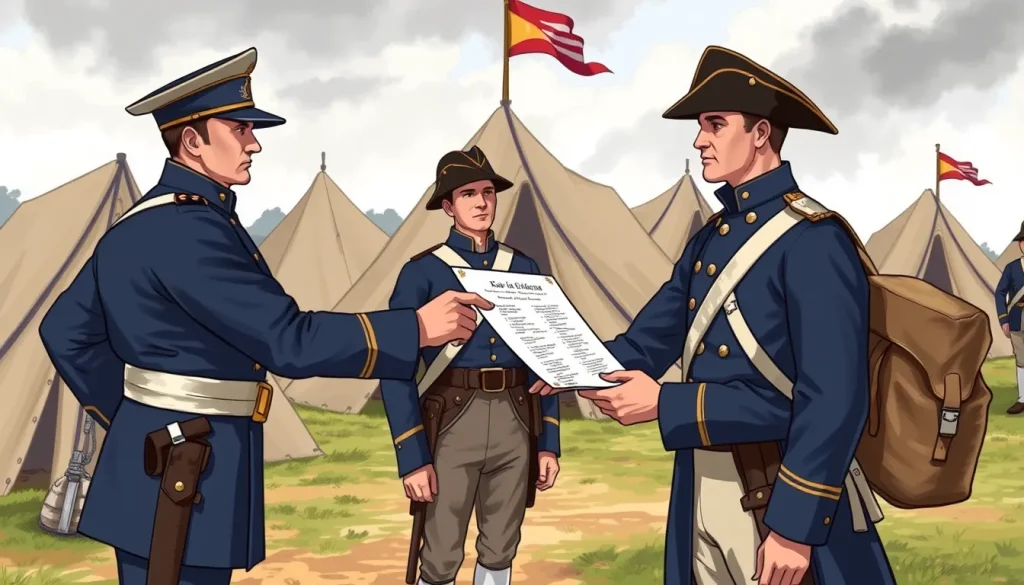
War of 1812 discharge certificates are official military documents that were issued to regular soldiers of the United States Army upon their honorable separation from the service between 1792 and 1815. Most of these certificates date from the War of 1812, when the army expanded dramatically and discharge paperwork became more standardized. They are historically significant because they provide the most detailed personal and service information available for many enlisted men of the era.
Historical Context
The War of 1812 (1812–1815) was fought between the United States and Great Britain over maritime rights, impressment, and territorial expansion. At the outbreak of war, the U.S. Regular Army numbered only about 10,000 men, many of them raw recruits. Congress quickly authorized a massive expansion: the act of June 26, 1812 (2 Stat. 764) boosted the army to 25 infantry regiments, 4 artillery, 2 dragoons, and 1 rifle regiment, with a total authorized strength of 36,700 men. A further act in January 1813 added 20 more infantry regiments. These new regiments were recruited from specific states, while rifle, artillery, and dragoon units recruited nationally.
Pay and conditions were often poor. At the start of the war, privates earned $5–$8 per month, less than civilian unskilled labor. Enlistment bounties increased from $31 and 160 acres of land to $124 and 320 acres, which helped spur enlistments. The system for paying troops was inefficient; by late 1814, soldiers were often owed six to twelve months’ back pay. Discharge certificates were part of the administrative process of mustering out soldiers at the end of their enlistment or when they were medically discharged.
What Happened
During the early nineteenth century, every soldier discharged from the U.S. Regular Army received a discharge certificate as a personal record of his service. These certificates were usually signed by a company captain or another officer and given directly to the veteran. The War Department generally did not retain a copy for its own files, which is why so few survive. However, a notable exception exists: a series of discharge certificates and related documents for more than 2,200 Regular Army soldiers from 1792 to 1815 survived and are now in the possession of the National Archives and Records Administration (NARA).
These records were originally part of the Adjutant General’s Office records, specifically Series 19, “Post Revolutionary War Papers, 1784–1815,” in Record Group (RG) 94. They were microfilmed in 2004 as NARA Microfilm Publication M1856, Discharge Certificates and Miscellaneous Records Relating to the Discharge of Soldiers from the Regular Army, 1792–1815, available on six rolls. The collection includes not just discharge certificates but also descriptive lists, certificates of death, and pay vouchers. Arranged by regiment, company, and then alphabetically by surname, the records cover most of the army’s infantry, rifle, artillery, and dragoon units from the war period.
The certificates themselves typically contain the soldier’s name, rank, physical description, age, place of birth, date and place of enlistment, and the date and reason for discharge. They also note any pay and clothing allowances owed at the time of separation. For example, John Warring, a hatter from Connecticut who enlisted in the 2nd U.S. Light Dragoons in March 1813, received an honorable discharge on March 21, 1815, due to asthma. His certificate recorded the balance of pay from October 1813, three months’ travel pay and subsistence, and a detailed list of clothing he took with him, including caps, vests, pantaloons, shirts, boots, and blankets.
Why It Matters
War of 1812 discharge certificates are invaluable because they often represent the fullest surviving record of an enlisted man’s service. Unlike compiled military service records (CMSRs) or pension files, which were created later and sometimes from incomplete sources, discharge certificates were contemporaneous and signed under oath. They provide firsthand evidence of a soldier’s physical description, occupation, and service history that can be used to trace ancestors, confirm family stories, and understand the lives of ordinary soldiers.
For historians, these documents illuminate the administrative practices of the early U.S. Army, the effects of pay delays, and the conditions under which soldiers were released. The collection is particularly important because most discharge certificates of the era were handed over to the veterans and did not survive in official records. The fact that this series exists allows researchers to study a cohort of regular soldiers in unmatched detail.
Document
The primary records are the discharge certificates and miscellaneous documents pertaining to the discharge of regular soldiers from the U.S. Army, 1792–1815. They are part of Records of the Adjutant General’s Office, 1780’s–1917 (Record Group 94), Series 19, and are reproduced as NARA Microfilm Publication M1856 (6 rolls). The collection covers more than 2,200 soldiers and includes certificates of discharge, descriptive lists, certificates of death, and pay vouchers.
Date
The records span 1792–1815, but the majority are from the War of 1812 era (1812–1815).
Author
The discharge certificates were created by officers of the U.S. Regular Army, typically company commanders, as part of the administrative process of mustering out soldiers. The records were later maintained by the Adjutant General’s Office.
Historical Context
The certificates were part of a broader system of military recordkeeping that evolved from the early republic through the War of 1812. Because the War Department did not systematically retain copies, the survival of this series is exceptional. The records likely accumulated in the Adjutant General’s Office due to administrative necessity or as duplicates from units that disbanded after the war. The certificates document the massive expansion of the army and the challenges of managing thousands of new soldiers in a short period.
Transcript
No verbatim transcript of a specific certificate is reproduced here because no reliable transcription of a complete certificate from this series is available in the provided sources. Researchers can view the original records on microfilm at NARA or its regional archives. For a detailed description of the physical format and content, see the National Archives descriptive pamphlet for M1856.
Modernized Transcript
As with the transcript, a modernized transcription is not provided due to the lack of a verified original document in the supplied source material. The best method for accessing the content is to consult the microfilm or request a copy through NARA’s reproduction services.
What the Document Tells Us
These discharge certificates provide details about a soldier’s name, age, physical stature (height, complexion, hair and eye color), birthplace, civilian occupation, date and place of enlistment, company and regiment, and the date and reason for discharge. They also record the soldier’s financial settlement, including back pay, travel pay and subsistence, and clothing drawn. For example, the certificate of John Warring noted his discharge due to asthma and his travel allowance from Greenbush Cantonment to Danbury, Connecticut. Such documents are among the most complete and personal sources available for enlisted men of the War of 1812.
Limitations and Bias of the Source
The collection only covers Regular Army soldiers; it does not include volunteers or state militia, who comprised a significant portion of American forces. Because the War Department gave originals to the soldiers, the surviving records represent only a fraction of those who served—likely those that never left the War Department for administrative reasons. The reasons for discharge are often terse (e.g., “disability,” “expiration of term”), and the certificates do not provide combat narratives. Furthermore, the records are biased toward soldiers who served long enough to be formally discharged; deaths, desertions, and other separations are not fully documented.
Citation
National Archives and Records Administration, Discharge Certificates and Miscellaneous Records Relating to the Discharge of Soldiers from the Regular Army, 1792–1815, Microfilm Publication M1856, 6 rolls, Records of the Adjutant General’s Office, Record Group 94, National Archives, Washington, D.C.
Primary Sources
The core primary sources are the discharge certificates themselves in Record Group 94 at the National Archives. They are available on microfilm M1856. Additionally, compiled military service records (CMSRs) and pension files provide complementary information, but they are later compilations. For context on pay and service, contemporary regulations and correspondence exist in War Department records. The Prologue article by John P. Deeben and Claire Prechtel-Kluskens (“Leaving the Army During Mr. Madison’s War,” Fall 2011) offers a useful guide to the collection.
Further Reading
- Deeben, John P., and Claire Prechtel-Kluskens. “Leaving the Army During Mr. Madison’s War.” Prologue 43, no. 3 (Fall 2011).
- Hickey, Donald R. The War of 1812: A Forgotten Conflict. Urbana: University of Illinois Press, 1989.
- National Archives and Records Administration. “War of 1812 Discharge Certificates.” Accessed [current date]. https://www.archives.gov/research/military/war-of-1812/1812-discharge-certificates/discharge-certificates.html.
- Pendell, Lucille H., and Elizabeth Bethel, comps. Preliminary Inventory of the Records of the Adjutant General’s Office. Preliminary Inventory 17. Washington, DC: National Archives and Records Service, 1949.
References
- National Archives. “War of 1812 Discharge Certificates.” Accessed March 15, 2025. https://www.archives.gov/research/military/war-of-1812/1812-discharge-certificates/discharge-certificates.html.
- National Archives. “War of 1812.” Accessed March 15, 2025. https://www.archives.gov/research/military/war-of-1812.
- Deeben, John P., and Claire Prechtel-Kluskens. “Leaving the Army During Mr. Madison’s War.” Prologue 43, no. 3 (Fall 2011). Accessed March 15, 2025. https://www.archives.gov/publications/prologue/2011/fall/discharge-certs.html.
- National Archives. “Regular and Volunteer United States Military Service Between the Revolutionary War and the War of 1812.” Accessed March 15, 2025. http://www.archives.gov/files/research/military/between-rev-and-1812.pdf.
FAQ
What are War of 1812 discharge certificates?
They are official documents issued to U.S. Regular Army soldiers upon their discharge from service between 1792 and 1815, recording personal and service information.
Where can I find War of 1812 discharge certificates?
The National Archives holds the surviving set on microfilm publication M1856, available in the NARA research rooms or for purchase.
Do the discharge certificates include militia or volunteer soldiers?
No, this collection covers only Regular Army soldiers, not volunteers or state militia.



Leave a Reply