Short Answer
Prison hulks were decommissioned Royal Navy warships moored in harbours such as Chatham, Portsmouth, and Plymouth, converted into floating prisons to hold captured enemy personnel during the Napoleonic Wars and the War of 1812. For American sailors, soldiers, and privateers taken by the British between 1812 and 1815, these vessels constituted a central element of captivity. This article examines the operation, conditions, and historical significance of prison hulks specifically as they applied to American prisoners during the conflict.
Historical Context
The War of 1812 (1812–1815) was fought between the United States and Great Britain, concurrent with the larger Napoleonic Wars in Europe. Britain, possessing the world’s dominant navy, relied on a network of prison facilities to manage thousands of captured enemies. By 1812, the British had already established an extensive system of hulks and land-based depots to confine French and allied prisoners, and after the American declaration of war, captured Americans were integrated into this existing infrastructure. The war’s naval campaigns—including frigate duels, privateering, and the blockade of American coasts—produced a steady stream of prisoners. Additionally, British forces captured American troops in land battles, such as the surrender of Detroit in August 1812 and the failed invasion of Canada. These captives were typically transported to Britain for imprisonment, as prisoner exchanges were sporadic and often stalled by disputes over treatment and status.
What Happened
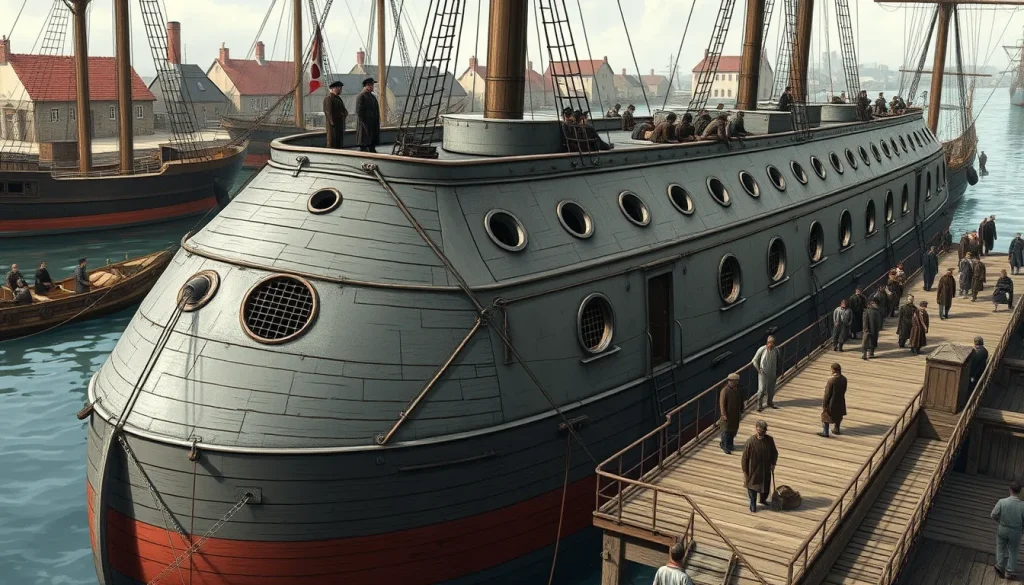
American prisoners of war experienced captivity in several venues: prison hulks, fortresses, and purpose-built land prisons. The hulks were especially common in the early years of the war, with vessels such as the Brunswick, Crown, and Vengeance moored in the Thames estuary and at Portsmouth and Plymouth. These ships had been stripped of masts and rigging, with portholes grated and heavy timbers reinforcing their decks. Prisoners were confined below the waterline in the orlop deck, where light and air were scarce. Daily rations often included bread, beef, and peas, but complaints about quality were frequent. Disease—particularly typhus and smallpox—was a constant threat, though mortality rates varied.
Most American prisoners were merchant sailors or privateer crews, but captured naval officers were usually granted parole, allowing them to live in designated towns under limited supervision. Ordinary seamen were packed into hulks, where they could spend up to sixteen hours a day below decks. They were allowed on deck for exercise, and sometimes engaged in making crafts or selling goods to supplement their rations. As the war progressed, many Americans were transferred to Dartmoor Prison in Devon, a land-based depot originally built for French prisoners. By late 1814, thousands of Americans were held at Dartmoor, which, though cold and damp, was considered less crowded and healthier than the hulks. The prison remained in use until 1816, when the last American prisoners were repatriated. A notable incident occurred on 6 April 1815 when British guards fired on American prisoners at Dartmoor, killing several and wounding others, in what became known as the Dartmoor Massacre.
Why It Matters
The captivity of American prisoners on British hulks and in prisons had immediate diplomatic and humanitarian consequences. The treatment and exchange of prisoners were recurrent issues in peace negotiations, culminating in the Treaty of Ghent (1814), which called for the release of prisoners of war. The experiences of American captives also shaped public opinion in the United States, feeding anti-British sentiment and narratives of British cruelty. Historians have long debated the severity of conditions on the hulks. Traditional accounts, often based on contemporary French or American memoirs, depict them as “floating hells” with high death tolls. More recent quantitative scholarship, such as the work of Leunig, van Lottum, and Poulsen on Danish and Norwegian captives, suggests death rates were lower than often claimed, at least for certain groups, and that food and medical care were adequate by the standards of the era. However, these studies focus on specific national cohorts, and the experience of American prisoners may have differed. Nonetheless, the prison hulk system remains a symbol of the harsh realities of war and the precarious nature of sailor’s livelihoods in the early nineteenth century.
Definition
Prison hulks were decommissioned warships or former merchant vessels that had been stripped of their masts and rigging and converted into floating prisons for captured enemy personnel. They were typically moored in sheltered harbours or estuaries, and their hulls were reinforced and partitioned to create secure, crowded living quarters for prisoners of war.
Background
The use of hulks in Britain dated to the late eighteenth century, when overcrowding of land-based gaols and a rise in the number of prisoners from the American Revolutionary Wars and the Napoleonic Wars prompted the Admiralty to convert old ships into detention facilities. By the early 1800s, dozens of hulks were in service at Chatham, Portsmouth, Plymouth, and other naval ports, holding thousands of French, Dutch, Spanish, and later American prisoners. After the outbreak of the War of 1812, the existing system was extended to accommodate American captives, who were generally considered to be of “rebel” or naval status, though the British often treated them as prisoners of war under the same regulations as European enemies.
How It Worked
Prison hulks were organized by the Transport Board, a British government agency responsible for prisoner administration. Captured American sailors were first taken to collection points in Canada or the West Indies, then transported across the Atlantic to British ports. Upon arrival, they were registered and assigned to a specific hulk or depot. On board, prisoners were divided into messes of roughly six to ten men, with hammocks slung in cramped quarters. Daily routine involved a roll call, issued rations, and limited time on deck (often one to two hours). Sanitation was rudimentary—tubs served as latrines, and washing facilities were minimal. Discipline was enforced by guards, and escape attempts were severely punished; however, escapes did occur, often through bribery or tunnelling. Officers were typically not held on hulks; they were offered parole. Those who broke parole or were captured after attempting escape were sent to hulks as punishment.
Competing Viewpoints
Contemporary accounts written by prisoners often described hulks as pestilential and brutal, with high mortality from disease and neglect. For example, the memoir The Floating Prison (a later edition of which was published in 2004) chronicles nine years of suffering on British hulks. In contrast, British authorities argued that conditions were comparable to those on board service warships, and that prisoners received adequate rations and medical care. Modern scholarship has complicated the picture. The quantitative study by Leunig, van Lottum, and Poulsen (2016) used official record books from the National Archives to analyse Danish and Norwegian prisoners on British hulks during the Napoleonic Wars, finding death rates of roughly 1–2% per year—much lower than the “floating tomb” stereotype. They also noted that privateers fared worse than merchant sailors, suggesting treatment was influenced by status and behaviour. However, the applicability of these findings to American prisoners is unclear, as Americans were often captured later in the war and may have faced different conditions, especially as peace negotiations dragged on.
Role in the War of 1812
For American prisoners, the hulks were a major part of the captive experience, particularly in the early years of the war. British naval supremacy meant that American merchant ships and privateers were easily captured on the high seas. The majority of captured Americans were sailors, many of whom had been impressed into the Royal Navy earlier or were born in Britain, making their status contentious. American prisoners often spent months or years on hulks before being exchanged or released. The exchange cartel, when it functioned, typically traded sailors on a one-for-one basis, but was frequently disrupted by disputes over the treatment of black sailors and the citizenship of naturalized Americans. In addition, thousands of American soldiers taken in Canada, such as those captured at the surrender of Detroit or at Queenston Heights, were transported to Britain and eventually placed on hulks or in Dartmoor. The hulks were used as a deterrent and a pressure tool in diplomatic negotiations.
Consequences and Historical Interpretation
The captivity experience had lasting consequences for the individuals involved and for Anglo-American relations. After the ratification of the Treaty of Ghent, prisoners were repatriated, but many had suffered lasting health problems. The Dartmoor Massacre in April 1815, which occurred after the treaty had been signed but before news reached Britain, further inflamed American public opinion. Historians have interpreted the hulks as evidence of British callousness or as a pragmatic solution to a logistical challenge, depending on perspective. The recent quantitative work suggests a more nuanced picture, where survival on hulks was possible and even likely for many, but that the psychological and physical strain was considerable. The hulks also highlight the intersection of naval warfare, prisoner rights, and humanitarian reform in the early nineteenth century.
Primary Sources
Key primary sources include the records of the British Transport Board, held at The National Archives (Kew) in series ADM 103–105, which list prisoners, their ships, and dates of capture and release. These records were used in the quantitative study by Leunig et al. Another valuable source is the memoir The Floating Prison, originally written by a French prisoner, which provides a detailed account of life on the hulks, though it concerns a different nationality and earlier period. American prisoner narratives, such as those by prisoners of war held on Dartmoor, survive in letters and journals. For example, the diary of Thomas D. B. Tucker, an American physician held at Dartmoor, offers insight into conditions there. Additionally, the papers of the American commissioners negotiating the Treaty of Ghent include discussions of prisoner exchanges and treatment.
Further Reading
- Abell, Francis. Prisoners of War in Britain 1756 to 1815. London: Oxford University Press, 1914.
- Leunig, Tim, Jelle van Lottum, and Bo Poulsen. “How Bad Were British Prison Hulks in the Napoleonic Wars?” Economic History Working Paper No. 232, London School of Economics, 2016.
- Lambert, Andrew, ed. The Floating Prison. London: Chatham Publishing, 2004.
- “Prisoners of the Napoleonic Wars.” The Napoleonic Archive. Accessed 2023. https://www.napoleonicarchive.com/stories/prisoners
References
- Abell, Francis. Prisoners of War in Britain 1756 to 1815. London: Oxford University Press, 1914. https://www.gutenberg.org/files/60321/60321-h/60321-h.htm
- Leunig, Tim, Jelle van Lottum, and Bo Poulsen. “How Bad Were British Prison Hulks in the Napoleonic Wars?” LSE Economic History Working Paper No. 232, 2016. https://www.lse.ac.uk/Economic-History/Assets/Documents/WorkingPapers/Economic-History/2016/WP232.pdf
- Leunig, Tim, Jelle van Lottum, and Bo Poulsen. “Surprisingly Gentle Confinement: British Treatment of Danish and Norwegian Prisoners of War during the Napoleonic Wars.” Scandinavian Economic History Review 66, no. 3 (2018). doi:10.1080/03585522.2018.1516235.
- Lambert, Andrew, ed. The Floating Prison (2004). King’s College London research portal. https://kclpure.kcl.ac.uk/portal/en/publications/e5ddc448-dd3c-4c7f-8728-402cfe17de4c
- “Prisoners of the Napoleonic Wars.” The Napoleonic Archive. https://www.napoleonicarchive.com/stories/prisoners
FAQ
Were prison hulks during the War of 1812 as deadly as often depicted?
Recent quantitative research on Danish/Norwegian prisoners suggests death rates were lower than commonly believed, but the experiences of American prisoners may have differed. Conditions were harsh, with disease and overcrowding, but many captives did survive.
What happened to American prisoners of war after the Treaty of Ghent?
The Treaty of Ghent called for the immediate release of prisoners of war. American prisoners were repatriated in 1815, although some incidents, like the Dartmoor Massacre, occurred before news of the peace reached Britain.
Were American officers held on prison hulks?
Generally no. Commissioned officers were typically granted parole and allowed to live in British towns under supervision. Those who broke parole could be sent to hulks as punishment.


Leave a Reply