
Short Answer
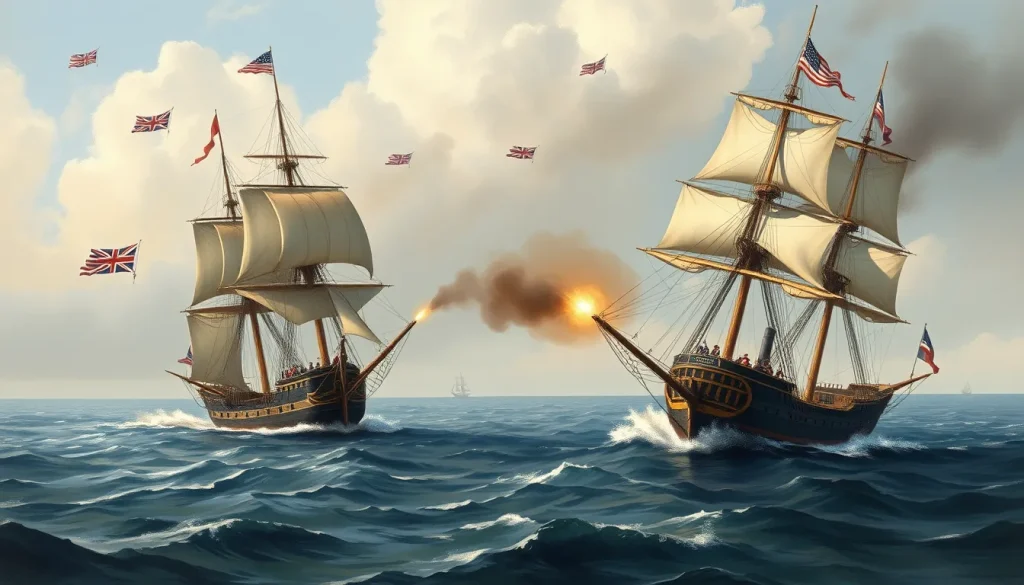
The engagement between USS Chesapeake and HMS Shannon on 1 June 1813 was one of the most celebrated single-ship actions of the War of 1812. Fought approximately 20 nautical miles east of Boston, the brief battle resulted in the capture of the American frigate by the British, reversing the string of American naval successes and demonstrating the value of training and discipline. The action also produced the famous—though disputed—last order of Captain James Lawrence, “Don’t give up the ship.”
Historical Context
By June 1813, the United States had surprised the world with a series of frigate victories over the Royal Navy. USS Constitution had captured HMS Guerriere (August 1812) and HMS Java (December 1812); USS United States had taken HMS Macedonian (October 1812); and USS Hornet had sunk HMS Peacock (February 1813). These defeats stung British pride and prompted Admiralty inquiries. In response, British captains tightened training and sought opportunities for revenge. Captain Philip Bowes Vere Broke, who had commanded HMS Shannon since 1806, was a leader in gunnery innovation. He drilled his crew in aimed fire and rapid reloading, using homemade sights and marks on the deck. In the spring of 1813, Shannon was part of the blockading squadron off Boston, where USS Chesapeake lay refitting after a commerce cruise.
What Happened
On 20 May 1813, Captain James Lawrence took command of the Chesapeake, succeeding Captain Samuel Evans. Lawrence had earned fame as captain of USS Hornet in her victory over HMS Peacock. However, Chesapeake had recently lost many experienced officers and men; a large portion of her crew were new recruits. Broke, eager for a single-ship duel, sent a formal written challenge to Lawrence, proposing a meeting between the two frigates without interference. The letter never reached Lawrence, who sailed on the afternoon of 1 June, hoisting a banner reading “Free Trade and Sailors’ Rights.”
Around 5:30 PM, the two ships approached each other about 20 miles east of Boston lighthouse. Lawrence positioned his port broadside against Shannon’s starboard battery. At roughly 6 PM, at a range of about 100 feet, the British fired first. Shannon’s gunnery was devastating: within minutes the American quarterdeck was swept by grape and round shot, mortally wounding Lawrence and killing most of the senior officers. The American ship lost control and drifted into Shannon. Broke led a boarding party onto Chesapeake’s deck, where they met disorganized resistance. After about fifteen minutes of fighting, the Chesapeake was captured. Broke himself was seriously wounded by a cutlass blow to the head but survived.
Why It Matters
The defeat was a psychological shock to the United States, which had grown accustomed to naval victories. Lawrence’s death, and his allegedly dying words—“Don’t give up the ship!”—made him a national martyr, and the phrase became a lasting U.S. Navy motto. For Britain, the victory restored confidence in the Royal Navy and validated Broke’s methods. Strategically, the loss of a heavy frigate weakened the U.S. Navy’s offensive capability and contributed to the tightening British blockade. The battle also influenced naval tactics, as British emphasis on aimed gunnery was soon adopted more widely.
Prelude
After weeks of blockade, Broke was frustrated by the refusal of American squadrons to come out. The arrival of Lawrence, an aggressive captain, presented an opportunity. Broke dispatched the frigate HMS Tenedos away to make the challenge seem more equal, and he sent a polite but pointed letter to Lawrence on May 30. Lawrence never received it because he sailed before its delivery. Nevertheless, he was determined to fight, and on the morning of 1 June he made preparations to leave Boston.
Forces and Commanders
Both ships were rated 38-gun frigates. USS Chesapeake, launched in 1799, was larger and carried a slightly heavier broadside. Her main battery consisted of 18-pounder long guns, with a complement of about 387 men. HMS Shannon, launched in 1806, was a standard Leda-class frigate with 28 × 18-pounder long guns, 4 × 9-pounders, and 16 × 32-pounder carronades, with a crew of about 320. Commanders: Captain James Lawrence (USN) vs. Captain Philip Bowes Vere Broke (RN). Lawrence had a recent victory over Peacock; Broke had spent seven years perfecting his crew’s gunnery.
Battlefield and Map Context
The engagement occurred in the Atlantic Ocean, approximately 20 nautical miles (37 km) east of Boston Lighthouse, between Cape Ann and Cape Cod. The sea was calm, the wind light, and the ships maneuvered slowly. The location was chosen to be outside the range of American shore batteries and gunboats.
Battle Chronology
~1:00 PM: Chesapeake clears President Roads, leaving Boston Harbor.
5:30 PM: The two frigates approach each other. Lawrence declines to take a raking position and instead closes to broadside range.
~5:50 PM: Shannon opens fire at close range (about 100 yards). British broadsides disable Chesapeake’s wheel and kill many officers, including Captain Lawrence.
~6:00 PM: The ships collide; Broke gives order to board. Boarding party crosses to Chesapeake.
~6:15 PM: After fierce hand-to-hand combat, the American crew surrenders. Broke is seriously wounded but the ship is secured.
Casualties and Losses
Casualty figures vary slightly among sources. USS Chesapeake lost about 60 killed and 85–90 wounded, plus nearly all senior officers. HMS Shannon suffered approximately 23–24 killed and 56–59 wounded, including Captain Broke. The American frigate was captured and taken to Halifax as a prize.
Result
Decisive British victory. HMS Shannon escorted USS Chesapeake to Halifax, arriving on 6 June 1813. The U.S. frigate was subsequently repaired and served in the Royal Navy as HMS Chesapeake.
Strategic Consequences
The victory bolstered British morale at a critical point in the war and demonstrated that American naval success could be reversed with proper training. For the United States, the loss of a heavy frigate weakened the young navy and forced a more cautious strategy. The battle also contributed to the tightening of the British blockade of American ports and influenced British gunnery standards for years afterward.
Primary Accounts
Key contemporary accounts include Captain Broke’s official report to Vice-Admiral Sir John Borlase Warren, dated 2 June 1813, describing the action. Captain Lawrence’s alleged dying words “Don’t give up the ship” are reported by witnesses, though the exact circumstances are debated. American newspapers, such as the Boston Gazette, carried accounts that shaped public perception. U.S. Navy court-martial records and letters from officers provide additional insight.
Battlefield Today
The site of the battle is open ocean, but artifacts survive. The Chesapeake’s timbers were later used to construct Chesapeake Mill in Wickham, England. HMS Shannon’s bell is displayed at the Maritime Command Museum in Halifax, Nova Scotia, and graves of Shannon’s crew are marked in Halifax cemeteries. No wreck remains.
Primary Sources
1. Broke’s Letter of Challenge (May 1813): A formal challenge from Captain Broke to Captain Lawrence, proposing a single-ship duel. The letter never reached Lawrence, but its text survives and demonstrates the chivalric conventions of the time.
2. Captain Broke’s Official Report (2 June 1813): Submitted to Vice-Admiral Sir John Borlase Warren, giving a detailed account of the engagement, including ship maneuvers, casualties, and the capture.
3. Lawrence’s Reported Last Words: Witnesses claimed Lawrence, while mortally wounded below deck, repeatedly urged, “Don’t give up the ship.” The exact wording and context are uncertain, but the phrase became a U.S. Navy battle cry.
4. Newspaper Reports: American and British newspapers, including the Boston Gazette and London Times, published reports and letters in June 1813, often with patriotic bias, which shaped public perceptions.
Further Reading
- Hickey, Donald R. The War of 1812: A Forgotten Conflict. University of Illinois Press, 1989.
- Lambert, Andrew. The Challenge: Britain Against America in the Naval War of 1812. Faber and Faber, 2012.
- Padfield, Peter. Broke and the Shannon. Hodder and Stoughton, 1968.
- Malcomson, Robert. Historical Dictionary of the War of 1812. Scarecrow Press, 2006.
- Canadian Encyclopedia article: “HMS Shannon versus USS Chesapeake, War of 1812” by James H. Marsh.
References
- Marsh, James H. “HMS Shannon versus USS Chesapeake, War of 1812.” The Canadian Encyclopedia. https://thecanadianencyclopedia.ca/en/article/hms-shannon-versus-uss-chesapeake-war-of-1812.
- Cray, Robert E. Jr. “Explaining Defeat: The Loss of the USS Chesapeake.” Naval History Magazine 21, no. 4 (August 2007). https://www.usni.org/magazines/naval-history-magazine/2007/august/explaining-defeat-loss-uss-chesapeake.
- “HMS Shannon vs USS Chesapeake.” The War of 1812 Website. https://thewarof1812.org/battles/hms-shannon-vs-uss-chesapeake/.
- Naval Historical Center. “HMS Shannon captures USS Chesapeake, 1 June 1813.” https://www.ibiblio.org/hyperwar/OnlineLibrary/photos/events/war1812/atsea/ches-sn.htm.
- “HMS Shannon and USS Chesapeake – 1st June 1813.” Naval Marine Archive. https://navalmarinearchive.com/research/pdf/shannon_chesapeake.pdf.
FAQ
Did Captain Lawrence really say 'Don't give up the ship'?
Witnesses reported that Lawrence, while mortally wounded and below deck, repeated these words. The exact circumstances are debated, but the phrase became a U.S. Navy motto and is widely associated with his death.
Why was the battle significant for the Royal Navy?
After a series of humiliating defeats to American frigates, the victory restored British confidence and validated Captain Broke's training methods, which emphasized aimed gunnery and rapid reloading.
What happened to the USS Chesapeake after her capture?
She was taken to Halifax, repaired, and commissioned into the Royal Navy as HMS Chesapeake, serving until late 1815. She was sold in 1819, and her timbers were used to build Chesapeake Mill in Wickham, England.
Leave a Reply