
Short Answer
The Battle of Lake Erie, fought on 10 September 1813 near Put-in-Bay in the western basin of the lake, was a decisive American naval victory that gave the United States uncontested control of Lake Erie. This control severed British supply lines to the Northwest, forced the retreat of British and Indigenous forces from Detroit and Amherstburg, and directly led to the Battle of the Thames and the death of the Shawnee leader Tecumseh. The battle thus marked a strategic turning point in the War of 1812, shifting the initiative in the western theatre from Britain to the United States.
Historical Context
From the war’s outbreak in 1812, Britain held a strategic advantage in the upper Great Lakes. The surrender of Detroit by American Brigadier General William Hull on 16 August 1812 gave the British control over Michigan Territory and secured a vital supply corridor between Upper Canada and the western posts. Lake Erie was the logistical backbone for British military operations and for the Indigenous allies, including Tecumseh’s confederacy, who depended on British provisions and munitions. The British established a naval squadron at Amherstburg (present-day Ontario) and held Fort Malden as a key stronghold.
The Americans, led by Master Commandant Oliver Hazard Perry, built a freshwater fleet at Presque Isle (now Erie, Pennsylvania) under the direction of shipbuilder Noah Brown. By September 1813, Perry’s squadron comprised nine vessels, including the brigs Lawrence and Niagara, armed primarily with carronades—short-range guns that were devastating at close quarters. The British squadron, commanded by Commander Robert Heriot Barclay, consisted of six vessels, many armed with long guns that had greater range but lighter projectiles. Barclay’s fleet also suffered from a shortage of trained sailors and had to be crewed by soldiers from the 41st Regiment and the Royal Newfoundland Regiment, as well as Canadian volunteers.
Control of Lake Erie was essential for both sides. For the British, it was the only practical way to supply Fort Malden, Amherstburg, and the Indigenous allies. For the Americans, gaining command of the lake would sever that supply line and open a route to invade Upper Canada from the west. The stage was set for a decisive naval engagement that would determine the fate of the Northwest.
What Happened
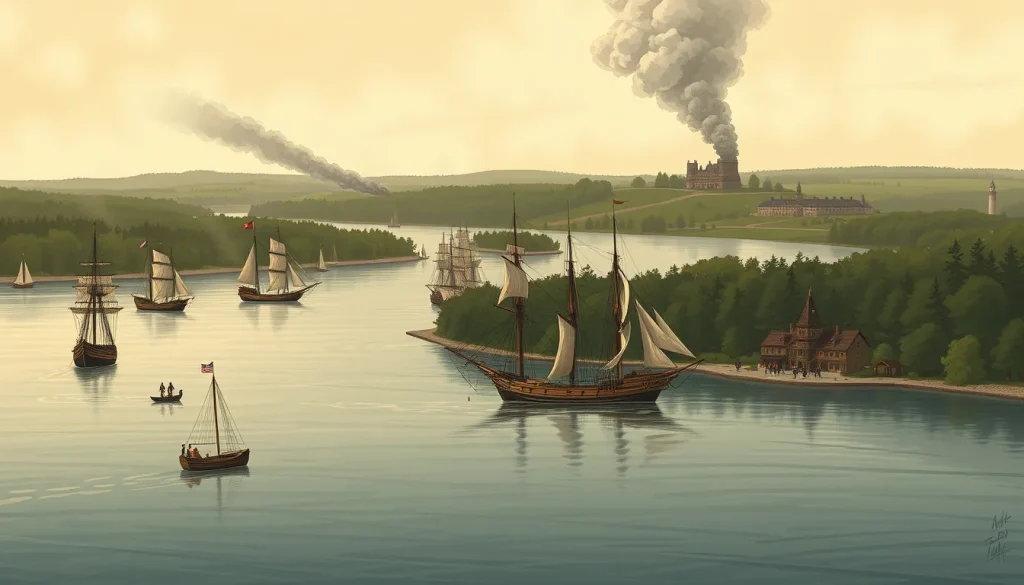
On the morning of 10 September 1813, Perry’s fleet left its anchorage at Put-in-Bay and sighted Barclay’s squadron to the northwest. The wind, initially from the west-southwest, shifted to the southeast, giving the Americans the weather gauge—position upwind—allowing them to close the distance. The battle began around 11:45 a.m. when the British flagship Detroit opened fire with long guns. Perry’s flagship, the Lawrence, bore the brunt of the British fire and was reduced to a wreck by early afternoon, with most of her crew killed or wounded.
Perry then performed the celebrated act of transferring his flag from the Lawrence to the Niagara in a small boat while under fire. Breaking through the British line, the Niagara used her carronades to devastating effect. Barclay was severely wounded, and by 2:30 p.m. all six British vessels had struck their colours. Perry’s terse dispatch to General William Henry Harrison became famous: “We have met the enemy and they are ours: two ships, two brigs, one schooner and one sloop.”
The immediate aftermath was swift. With the lake lost, British Major General Henry Procter had no way to supply his garrison at Fort Malden. He ordered the fort burned and began a retreat up the Thames River into Upper Canada, accompanied by Tecumseh and his warriors. Harrison’s army pursued, catching Procter near Moraviantown. At the Battle of the Thames on 5 October 1813, the Americans won a decisive victory, killing Tecumseh and scattering the British and Indigenous forces. The American navy then extended its reach into Lake Huron, raiding British supply posts and blockading surviving vessels, although a later attempt to recapture Fort Michilimackinac failed.
Why It Matters
The Battle of Lake Erie and its consequences transformed the western theatre of the War of 1812. It gave the United States command of the lake, enabling the recovery of Detroit and the eventual American occupation of much of the western frontier. The victory also had profound effects on Indigenous nations: the death of Tecumseh and the defeat at the Thames shattered the pan-Indian alliance that the British had nurtured, undermining resistance to American expansion in the Old Northwest. For the British, the loss of the lake forced a strategic withdrawal and removed any immediate threat to the American heartland.
Historians have debated the battle’s larger significance, especially compared to the Battle of Lake Champlain in 1814. While Lake Erie secured the Northwest, Lake Champlain protected New York and contributed to the peace negotiations. Nevertheless, contemporaries celebrated Perry as the “Hero of Lake Erie,” and the battle became a symbol of American resilience and naval prowess. The battle flag with the words “Don’t Give Up the Ship” and Perry’s report have entered American historical memory, while a 352-foot monument at Put-in-Bay commemorates the victory and the subsequent peace between the United States and Canada.
Definition
In the context of the War of 1812, “how the war changed after the Battle of Lake Erie” refers to the strategic, military, and diplomatic shifts that followed the American naval victory of 10 September 1813. These changes include the transfer of control over the lake, the retreat of British forces from the Northwest, the death of Tecumseh and the collapse of his confederacy, and the opening of American offensives into Upper Canada.
Background
The battle occurred during a period when American land forces had suffered repeated defeats, including the surrender of Detroit and failures on the Niagara frontier. The Royal Navy had dominated the Atlantic, but on the Great Lakes, the two sides were engaged in a shipbuilding race. The British, despite their experience, struggled to construct and crew vessels, while the Americans, under Perry’s leadership, built a superior force. The strategic importance of Lake Erie lay in its role as a supply route for the British western army and its Indigenous allies, as well as a gateway to the American Northwest.
How the Battle Changed the War
The victory gave the United States undisputed control of Lake Erie, severing British communication and supply links between Port Dover and Fort Malden. This forced Procter to abandon Detroit and Amherstburg, leading to the American recapture of those posts. Harrison’s pursuit culminated in the Battle of the Thames, which eliminated British military power west of the Niagara River and resulted in Tecumseh’s death. The battle also allowed the American fleet to operate freely in Lake Huron, raiding British posts and isolating Fort Michilimackinac. These developments shifted the balance of power in the Northwest, enabling the United States to consolidate its territorial claims and reducing the influence of British allies among the Indigenous peoples.
Competing Viewpoints
Historians disagree over the relative decisiveness of the Battle of Lake Erie compared to other engagements. Some, like David Curtis Skaggs and John K. Mahon, argue that Perry’s victory was a pivotal moment that secured the Northwest and was essential to the American war effort. Others, such as David Curtis Skaggs in a 2013 article, contend that the Battle of Lake Champlain (11 September 1814) had a more profound impact on the war’s outcome because it influenced the peace talks. Additionally, some British historians emphasize Barclay’s court martial and the chronic shortages that made British defeat likely, downplaying Perry’s tactical brilliance. These debates reflect the difficulty of assigning a single turning point in a war with multiple theatres.
Role in the War of 1812
The Battle of Lake Erie was part of the larger struggle for control of the Great Lakes, which was crucial for both sides. It was the first time a British naval squadron had surrendered entirely, and it gave the United States a strategic advantage in the West at a critical moment. The battle’s role extended beyond the immediate military operations; it boosted American morale at a time of frequent defeat, encouraged recruitment, and shaped the course of negotiations at Ghent, where American successes on the lakes strengthened their bargaining position.
Consequences and Historical Interpretation
The long-term consequences of the battle include the consolidation of American control over the Old Northwest and the weakening of Indigenous resistance. The death of Tecumseh and the loss of British support led to the eventual displacement of many Indigenous nations. In American memory, Perry’s victory became a symbol of courage and nationalism, celebrated in paintings, literature, and memorials such as the Perry’s Victory and International Peace Memorial. Historians now view the battle as a decisive event that helped end the war in a stalemate but preserved American territorial claims in the Northwest.
Primary Sources
Perry’s official dispatch to General Harrison, dated 10 September 1813, is the most famous primary source, containing the line “We have met the enemy and they are ours.” It is housed in the National Archives and Records Administration. Another important source is Barclay’s court-martial proceedings, held in 1814, which detailed the British squadron’s shortages and the conduct of the officers; it is available in the British National Archives. Additional contemporary accounts include Samuel Hambleton’s diary, which records Perry’s presentation of the battle flag, and the memoirs of participants such as General Harrison. These sources provide first-hand perspectives, though they should be read critically, as they reflect national biases and the fog of war.
Further Reading
- Skaggs, David Curtis, ed. The Battle of Lake Erie and Its Aftermath: A Reassessment. Kent State University Press, 2013.
- Hickey, Donald R. The War of 1812: A Forgotten Conflict. University of Illinois Press, 1989.
- Lambert, Andrew. The Challenge: Britain Against America in the Naval War of 1812. Faber and Faber, 2012.
- Berton, Pierre. The Invasion of Canada, 1812-1813. McClelland & Stewart, 1980.
- National Park Service. “The Battle of Lake Erie.” Perry’s Victory & International Peace Memorial. https://www.nps.gov/pevi/learn/historyculture/battle_erie_detail.htm
References
- National Park Service. “The Battle of Lake Erie, War of 1812.” Perry’s Victory & International Peace Memorial. Accessed October 2023. https://www.nps.gov/pevi/learn/historyculture/battle_erie_detail.htm
- Gough, Barry M. “Battle of Lake Erie (Battle of Put-in-Bay).” The Canadian Encyclopedia, 23 October 2011, last edited 25 November 2022. https://thecanadianencyclopedia.ca/en/article/battle-of-lake-erie-battle-of-put-in-bay
- Skaggs, David Curtis. “More Important Than Perry’s Victory.” Naval History Magazine, October 2013, Volume 27, Number 5. https://www.usni.org/magazines/naval-history-magazine/2013/september/more-important-perrys-victory
- Skaggs, David Curtis, ed. The Battle of Lake Erie and Its Aftermath: A Reassessment. Kent State University Press, 2013.
- “Battle of Lake Erie.” The War of 1812. Accessed October 2023. https://thewarof1812.org/battles/battle-of-lake-erie/
FAQ
Why was the Battle of Lake Erie a turning point in the War of 1812?
The American victory gave them control of Lake Erie, cutting off British supply lines to the Northwest. This forced the British to retreat from Detroit and Amherstburg, leading to the Battle of the Thames, where Tecumseh was killed and the pan-Indian alliance collapsed.
How did the battle affect Indigenous peoples?
The death of Tecumseh and the defeat of British and Indigenous forces at the Thames shattered the alliance that had resisted American expansion. It weakened Indigenous military power and political influence in the Old Northwest, ultimately facilitating American settlement.
What is the historical debate over the battle's significance?
Historians debate whether Lake Erie or Lake Champlain was more decisive. Some argue Lake Erie secured the Northwest and was crucial for American morale, while others contend Lake Champlain had a greater impact on peace negotiations. The battle also highlights the role of leadership and logistical preparedness.



Leave a Reply