
Short Answer
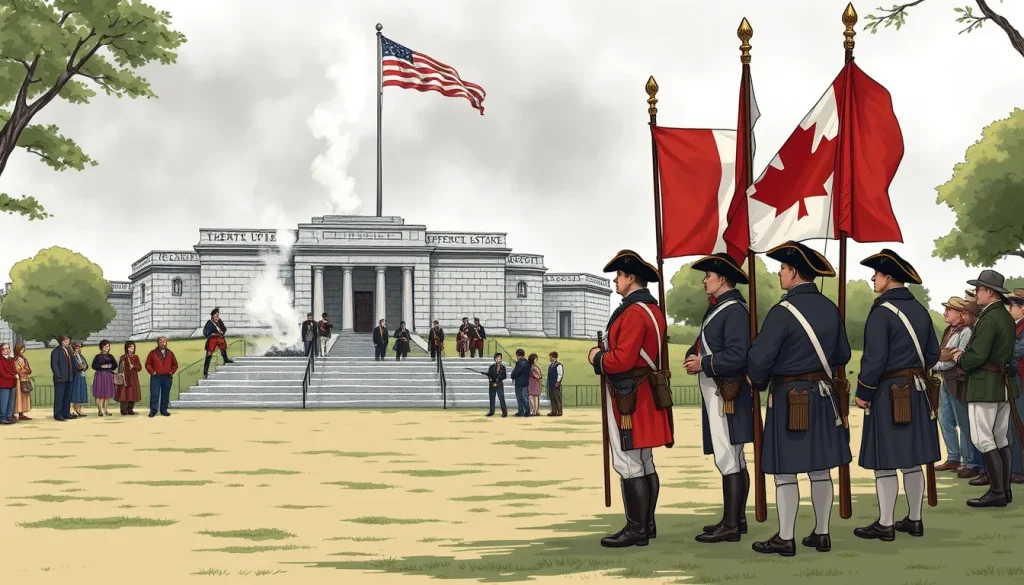
The Bicentennial Commemorations of the War of 1812 were a series of events and programs in Canada and the United States held from 2012 to 2015 to mark the 200th anniversary of the conflict. These commemorations included national and regional initiatives, military celebrations, and efforts to interpret the war’s causes, course, and legacies. They represented a significant moment of public engagement with a conflict that had often been overshadowed in popular memory and provided a platform for re-examining the war from multiple national and Indigenous perspectives.
Historical Context
The War of 1812 (1812–1815) was fought between the United States and Great Britain, with Indigenous nations allied on both sides. U.S. grievances included British impressment of American sailors, seizure of neutral ships, and support for Indigenous resistance on the frontier. The war ended with the Treaty of Ghent in 1815, restoring pre-war boundaries. Although the conflict solidified U.S. national identity and produced iconic symbols such as the Star-Spangled Banner, it received far less public attention than the American Revolution or the Civil War in later American memory. In Canada, the war is historically significant as a defense against American invasion and a foundational moment in the development of a national identity. By the early 21st century, the approaching bicentennial offered an occasion for both countries to revisit the war’s complex legacy. The U.S. had no federal coordinating body; a proposed War of 1812 Bicentennial Commission Act failed to pass Congress in 2006, and similar state-level efforts in New York were vetoed. Canada, by contrast, designated the bicentennial as a national event under the auspices of Canadian Heritage.
What Happened
Commemorations unfolded across 2012–2015, with events tied to specific anniversaries. The U.S. Navy launched its four-year commemoration on March 13, 2012, in Washington, D.C., and then participated in public events in cities such as New Orleans, Baltimore, Boston, and New York. The Navy, Marine Corps, and Coast Guard staged fleet weeks, tall-ship visits, and static displays, partnering with Operation Sail and international navies. The U.S. Army, lacking a coordinating committee, published a series of campaign booklets through its Center of Military History, focusing on first-person accounts and traditional campaign narratives. The National Park Service articulated a “Bicentennial Vision” to interpret the war’s diversity, including Indigenous, African American, British, Canadian, and American perspectives.
Canada organized national commemorations through Canadian Heritage, with provincial and local committees, notably in Ontario, New Brunswick, and other regions. Many events were held at historic sites such as Fort McHenry, Queenston Heights, and the USS Constitution. The U.S. Navy highlighted significant anniversaries: in 2013, the Battles of Lake Erie and Lake Champlain; in 2014, the writing of the Star-Spangled Banner and the burning of Washington; and in 2015, the Battle of New Orleans. The Library of Congress began a web archive in March 2012 to capture commemorative websites from local and regional projects, preserving them for researchers.
State and local initiatives varied widely. Maryland’s “Star-Spangled 200” celebration emphasized the defense of Baltimore, while Michigan, Ohio, and Kentucky created commissions. The National Park Service organized special programs at battlefields and parks, including Perry’s Victory and International Peace Memorial. In Canada, events included reenactments, educational programs, and the dedication of monuments. Indigenous communities participated in commemorations, often highlighting their own histories and the war’s impact on their nations.
Why It Matters
The bicentennial commemorations shaped public memory by bringing a often-neglected conflict to wider attention. They emphasized the war’s role in forging American nationalism and Canadian identity, while also complicating simple narratives. The absence of a U.S. federal commission highlighted the war’s secondary status in American memory, but the Navy’s prominent role reinforced its importance as a foundational moment for U.S. naval power. The commemorations also facilitated international cooperation, with British and Canadian participation in events, and provided a platform for scholarly reconsideration of the war’s causes, conduct, and consequences. The Library of Congress web archive now serves as a primary resource for studying how the bicentennial was presented online, offering insight into public history practice in the early 21st century.
Definition
The Bicentennial Commemorations of the War of 1812 were a coordinated set of public events, educational programs, and historical interpretations marking the war’s 200th anniversary. They were held in Canada and the United States between 2012 and 2015, encompassing national, state, provincial, local, and military initiatives.
Background
Before the bicentennial, memory of the War of 1812 was uneven. In the United States, it was often overshadowed by other conflicts, though certain episodes—such as the burning of Washington and the Battle of New Orleans—remained famous. In Canada, the war was commemorated as a successful defense against invasion. The bicentennial emerged from historical societies, military organizations, and heritage groups, with varying levels of government involvement. Canada’s federal government made it a national priority, while the U.S. relied on ad hoc efforts, with the Navy taking a leading role.
How It Worked
Canada’s commemorations were coordinated by Canadian Heritage, which funded cultural and educational projects. Provincial and municipal committees organized events. In the United States, the Navy and Marine Corps planned a series of public events, often partnering with local civic groups and international naval vessels. The Army contented itself with published booklets. State commissions, such as those in Maryland and Michigan, managed regional activities. The National Park Service integrated bicentennial themes into its site interpretations. Reenactments, museum exhibitions, lectures, and memorial ceremonies were the most common forms. The Library of Congress collected websites to document the commemorations.
Competing Viewpoints
Historical interpretations varied by nation and community. American narratives often stressed national sovereignty and the war as a “Second War of Independence,” while Canadian narratives emphasized successful defense and the emergence of a distinct national identity. Indigenous peoples highlighted the war’s devastating effects on their nations and the loss of territory, contesting celebrations that ignored their suffering. Some scholars criticized the commemorations for overemphasizing battles and understating slavery and the war’s role in Native dispossession. Others argued that the commemorations were insufficiently funded or coordinated, particularly in the United States, and that the war remained misunderstood.
Role in the War of 1812
While the bicentennial commemorations were not part of the original conflict, they directly addressed its history and memory. They provided a structured way to remember the war’s events, such as the burning of Washington and the defense of Baltimore, and to consider its broader implications. The commemorations reinforced the war’s significance as a turning point in U.S.–British relations, as the two nations eventually became allies. They also acknowledged the war’s Indigenous participants, albeit often unevenly, and contributed to ongoing scholarship on military, social, and diplomatic history.
Consequences and Historical Interpretation
The bicentennial encouraged new research and public engagement. It highlighted the need to interpret the war inclusively, and the Library of Congress web archive preserved a digital record for future historians. The commemorations also illustrated the challenges of national memory: the U.S. federal government’s limited role, Canada’s institutional backing, and the divergent perspectives of Indigenous nations. Long-term effects include increased academic interest in the war and the establishment of permanent exhibits and educational materials. The events demonstrated how anniversaries can serve as catalysts for revisiting complex historical legacies.
Primary Sources
Key primary sources for studying the commemorations include the websites captured in the Library of Congress’s War of 1812 Bicentennial Web Archive (2012–2015), which contains over 30 sites from regional projects. Official U.S. Navy press releases, such as the April 5, 2012 announcement titled “U.S. Navy Commemorates Bicentennial of the War of 1812,” outline the service’s plans and rationale. The National Park Service’s “Bicentennial Vision” statement from 2014 articulates interpretive goals. The U.S. Army’s campaign booklets, produced by the Center of Military History, provide traditional accounts. Canada’s Department of Canadian Heritage published program descriptions and funded projects. These sources are useful but reflect institutional viewpoints; the web archive itself captures changing digital content, while press releases convey official celebratory tones.
Further Reading
- Library of Congress, War of 1812 Bicentennial Web Archive (collection).
- U.S. Army Center of Military History, Campaign Booklets on the War of 1812 (2012–2015).
- National Park Service, Bicentennial Vision – War of 1812 (2014).
- Donald R. Hickey, The War of 1812: A Forgotten Conflict (University of Illinois Press, 1989).
- Alan Taylor, The Civil War of 1812: American Citizens, British Subjects, Irish Rebels, & Indian Allies (Knopf, 2010).
References
- Library of Congress, “About this Collection | War of 1812 Bicentennial Web Archive.” https://www.loc.gov/collections/war-of-1812-bicentennial-web-archive/about-this-collection/.
- Wikipedia, “List of War of 1812 Bicentennial.” https://en.wikipedia.org/wiki/List_of_War_of_1812_Bicentennial.
- National Park Service, “Bicentennial Vision – War of 1812.” https://www.nps.gov/subjects/warof1812/bicentennial-vision.htm.
- Gary Sheftick, “Military kicks off War of 1812 bicentennial,” U.S. Army, April 30, 2012. https://www.army.mil/article/78824/military_kicks_off_war_of_1812_bicentennial.
- U.S. Fleet Forces Command, “U.S. Navy Commemorates Bicentennial of the War of 1812,” PR Newswire, April 5, 2012. https://www.prnewswire.com/news-releases/us-navy-commemorates-bicentennial-of-the-war-of-1812-146284925.html.
FAQ
Why was there no U.S. federal War of 1812 Bicentennial Commission?
Legislation to create a federal commission failed to pass Congress in 2006, and similar state bills in New York were vetoed. As a result, commemorations were organized by military branches, state and local governments, and private organizations.
What role did the U.S. Navy play in the bicentennial?
The Navy coordinated a four-year commemoration starting in 2012, with events in multiple cities, tall-ship visits, and partnerships with international navies. It aimed to highlight the war as the Navy's foundational conflict.
How were Indigenous peoples involved in the commemorations?
Indigenous communities participated in various events, often emphasizing the war's impact on their nations. Some commemorations included Indigenous perspectives, but interpretations varied and sometimes sparked controversy over the war's legacy.



Leave a Reply