
Short Answer
The War of 1812, fought between the United States and Great Britain from 1812 to 1815, occupies a paradoxical place in American historical memory. Despite its meager military achievements and ambiguous outcome, it produced enduring national symbols and contributed to a wave of post-war nationalism. This article examines how Americans have remembered the war over two centuries, tracing the evolution from early triumphalism to its current status as one of the nation’s most overlooked conflicts.
Historical Context
The War of 1812 arose from long-standing tensions between the United States and Great Britain, including British impressment of American sailors, trade restrictions stemming from the Napoleonic Wars, and British support for Indigenous nations resisting American expansion in the Northwest. The declaration of war on June 18, 1812, was deeply controversial, with Federalists in New England opposing it and Republicans, particularly from the South and West, supporting it. The war itself was marked by a series of American defeats, including the burning of Washington, D.C., in August 1814, but also notable victories such as the defense of Baltimore, the Battle of Lake Erie, and the Battle of New Orleans. The Treaty of Ghent, signed on December 24, 1814, essentially restored the pre-war status quo, but news of the treaty arrived in the United States only after Jackson’s victory at New Orleans in January 1815, creating a false impression of triumph.
What Happened
The war’s military history was a mixed record of failure and success. American attempts to conquer Canada in 1812 and 1813 failed, with key forts like Detroit surrendering without a fight and multiple invasions repelled. However, the U.S. Navy achieved surprising single-ship victories, such as the USS Constitution’s capture of HMS Guerriere and HMS Java, boosting national pride. In 1813, Oliver Hazard Perry’s victory on Lake Erie and the subsequent Battle of the Thames secured the Northwest frontier. In 1814, the British launched a major offensive, burning Washington, but the successful defense of Fort McHenry at Baltimore inspired Francis Scott Key to write ‘The Star-Spangled Banner.’ Andrew Jackson’s rout of the British at the Battle of New Orleans in January 1815, though fought after the treaty had been signed, became a legendary triumph. The war ended with no territorial changes, but both sides claimed victory: Americans celebrated their perceived independence from British interference, while Canadians remembered it as a successful defense against invasion.
Why It Matters
The War of 1812 had immediate and long-term consequences that shaped American memory. In the short term, the war’s conclusion unleashed a wave of nationalism, known as the ‘Era of Good Feelings,’ as Americans chose to interpret the ambiguous outcome as a victory. The war’s heroes, particularly Andrew Jackson and William Henry Harrison, rode their reputations to the presidency. Long-term, the war solidified American sovereignty, ended British impressment, and encouraged westward expansion, but its memory faded as the Civil War overshadowed it. Historians have argued that the war was largely forgotten because its accomplishments were meager and it was sandwiched between the Revolution and the Civil War. Yet the war continues to resonate through its symbols, such as the national anthem, the USS Constitution, and the figure of Uncle Sam.
Definition
Public memory, in the context of the War of 1812, refers to the collective recollections, commemorations, and cultural narratives that Americans constructed about the conflict after its conclusion. This memory was not simply a factual record but a selective and often mythologized interpretation that served political and social needs.
Background
The raw material for American memory of the war was a conflict that could easily be read as a series of defeats: the burning of the national capital, humiliating surrenders, and a treaty that restored the status quo. Because the war ended ambiguously, Americans faced an interpretive challenge: how to remember a war that lacked decisive victories? This challenge was compounded by the war’s unpopularity in New England, where it was often called ‘Mr. Madison’s War.’ Over time, however, Americans constructed a narrative that emphasized naval heroism, the defense of Fort McHenry, and Jackson’s victory at New Orleans, while downplaying the failures.
How It Worked
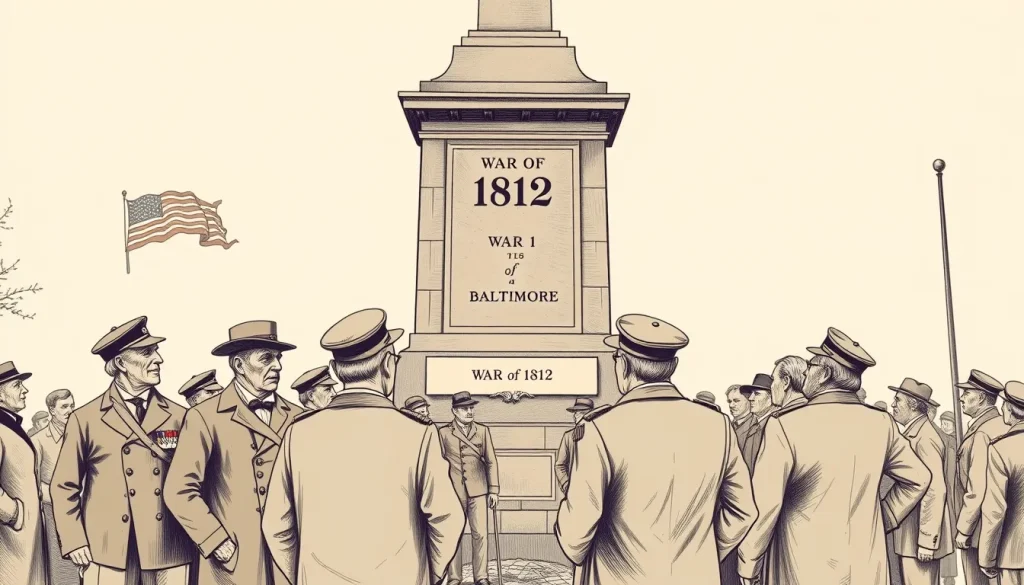
Memory of the war was built through multiple channels. Veterans’ organizations, such as the Society of the Cincinnati of the War of 1812, held reunions and collected testimonies. Monuments and memorials, like the Battle Monument in Baltimore and Perry’s Victory and International Peace Memorial, were erected to commemorate specific events. Politicians and orators incorporated the war into patriotic speeches, especially on the Fourth of July. Newspapers and popular literature celebrated heroes and reproduced the national anthem. The war’s memory was often ‘annexed’ to the American Revolution, with the conflict portrayed as a second assertion of independence, thereby aligning it with a more established national narrative. This subsumption into revolutionary memory helped to make the war’s ambiguous outcome more palatable.
Competing Viewpoints
American memory of the War of 1812 was never monolithic. Different regions, political factions, and interest groups interpreted the conflict in different ways. Federalists and New Englanders, who had opposed the war, remained skeptical of its value. Southerners and Westerners tended to celebrate Jackson’s victories. African Americans remembered the war through promises of freedom, often unfulfilled, and the British offer of emancipation. The Canadian interpretation—that the war was a successful defense of British North America against American aggression—clashed directly with the American narrative of victory. In Britain, the war was largely forgotten because it was a peripheral conflict overshadowed by the Napoleonic Wars. These competing viewpoints complicate any single ‘American’ memory, and historians continue to debate the war’s significance and meaning.
Role in the War of 1812
The events of the war itself provided the raw material for memory. The naval victories, such as the USS Constitution’s successes, gave the United States a source of pride that had been lacking in land campaigns. The defense of Fort McHenry inspired a poem that became the national anthem. The Battle of New Orleans, though fought after the peace treaty, offered a resounding victory that Americans could celebrate. The war also generated villains and heroes: Andrew Jackson emerged as a national icon, while the British burning of Washington became a rallying cry. These events were central to American memory because they were positive, dramatic, and could be woven into a narrative of national progress.
Consequences and Historical Interpretation
The legacy of American memory of the War of 1812 is multifaceted. In the decades after the war, the memory served to bolster nationalism and to obscure internal divisions, as the Project MUSE article notes. The war’s heroes were used to unite Americans across sectional lines. However, by the late nineteenth century, as the last veterans died and the Civil War displaced earlier conflicts, the War of 1812 faded from public consciousness. It came to be known as ‘the forgotten conflict,’ a term popularized by historian Donald Hickey. In the twentieth century, the war’s memory was revived in various contexts, such as the 1915 centennial, which emphasized Anglo-American friendship and peace. The bicentennial of 2012 saw a more muted commemoration, with no federal commission and limited public interest. Historians now recognize that American memory of the war was constructed and contested, serving the cultural work of nation-building while obscuring inconvenient facts.
Primary Sources
Primary sources that illuminate how Americans remembered the War of 1812 include veterans’ reunions and memoirs, newspaper editorials, patriotic songs, and commemorative monuments. For example, Francis Scott Key’s ‘The Star-Spangled Banner’ (1814) is a direct expression of wartime pride and became a national anthem only later. Dolley Madison’s letters describing the flight from the White House offer a personal account of the war. The Treaty of Ghent itself is a primary document that reveals the official outcome. However, these sources must be read critically: they are biased by their authors’ perspectives and the social context. The NPS article series ‘Legacies: The War of 1812 in American Memory’ provides a useful secondary overview of these sources and their interpretation.
Further Reading
- Matthew Dennis, ‘Legacies: The War of 1812 in American Memory,’ National Park Service, 2015, nps.gov.
- Donald R. Hickey, The War of 1812: A Forgotten Conflict (Urbana: University of Illinois Press, 1989).
- Alan Taylor, The Civil War of 1812: American Citizens, British Subjects, Irish Rebels, & Indian Allies (New York: Alfred A. Knopf, 2010).
- Nicole Eustace, 1812: War and the Passions of Patriotism (Philadelphia: University of Pennsylvania Press, 2012).
- J.C.A. Stagg, The War of 1812: Conflict for a Continent (Cambridge: Cambridge University Press, 2012).
References
- Matthew Dennis, ‘A war that looms small in American memory,’ National Park Service, updated April 2, 2015, https://www.nps.gov/articles/a-war-that-looms-small.htm.
- Matthew Dennis, ‘New nationalism in an ‘Era of Good Feelings,’ National Park Service, updated April 2, 2015, https://www.nps.gov/articles/new-nationalism-in-an-era-of-good-feelings.htm.
- Matthew Dennis, ‘Series: Legacies: The War of 1812 in American Memory,’ National Park Service, https://www.nps.gov/articles/series.htm?id=F5ACA74C-E741-C1FC-B2201DD7356BB481.
- Jasper Trautsch, ‘Whose War of 1812? Competing Memories of the Anglo-American Conflict,’ Reviews in History, no. 1387 (December 2014), https://reviews.history.ac.uk/review/1387.
- Project MUSE, ‘Reflections on a Bicentennial: The War of 1812 in American Public Memory,’ Early American Studies: An Interdisciplinary Journal, abstract, https://muse.jhu.edu/article/544586/summary.
FAQ
Why is the War of 1812 often called the 'forgotten conflict'?
Historian Donald Hickey popularized this term because the war's meager accomplishments and its positioning between the Revolution and the Civil War caused it to fade from American public memory.
What role did the Battle of New Orleans play in American memory of the war?
Although fought after the peace treaty was signed, Andrew Jackson's decisive victory on January 8, 1815, gave Americans a triumphant moment that obscured the war's indecisive outcome and helped create a sense of victory.
How did the War of 1812 contribute to American nationalism?
The war's aftermath produced a surge of patriotism, as Americans celebrated perceived victories, adopted symbols like the Star-Spangled Banner, and elevated war heroes, leading to a period known as the 'Era of Good Feelings.'


Leave a Reply