
Short Answer
William Henry Harrison’s political career after the War of 1812 transformed him from a frontier military commander into a prominent national politician, culminating in his election as the ninth president of the United States in 1840. His service in the U.S. House of Representatives, the U.S. Senate, and as minister to Colombia helped shape his image as a moderate westerner. Although his presidency lasted only thirty-two days, his career bridged the early republic’s military frontier and the emerging second-party system.
Historical Context
After the War of 1812, the United States experienced a surge of nationalism and territorial expansion. The conflict had confirmed American independence and opened the trans-Appalachian West to rapid settlement. Harrison, who had commanded the Army of the Northwest and won a decisive victory at the Battle of the Thames in 1813, returned to civilian life in 1814 as a celebrated national hero. The postwar era also saw the decline of the Federalist Party and the gradual emergence of the Democratic-Republican and, later, the Whig and Democratic parties, driven by debates over tariffs, internal improvements, and the expansion of slavery. Harrison, a Virginian by birth but an Ohioan by adoption, navigated these waters to build a political base.
What Happened
Harrison resigned from the army in 1814 and soon resumed a political career that had begun before the war. In 1816 he was elected to the U.S. House of Representatives from Ohio, filling a vacancy and then winning a full term. During his service from 1816 to 1819, he advocated for liberal pension laws, better militia organization, and improvements to navigation on the Ohio River. He also voted against the restriction of slavery in the territories, consistent with his states’ rights stance. After an unsuccessful run for the Ohio governorship in 1820, Harrison served in the Ohio state senate from 1819 to 1821. He then returned to national politics, winning election to the U.S. Senate in 1824 and serving from 1825 to 1828. In the Senate, he chaired the Committee on Military Affairs and supported Henry Clay’s American System. In 1828, President John Quincy Adams appointed him minister to Colombia, but he was recalled by President Andrew Jackson in 1829. Harrison then retired to his farm in North Bend, Ohio, but remained active in politics, helping to organize the Whig Party in opposition to Jackson. In 1836 he was one of four regional Whig candidates for president, finishing second to Democrat Martin Van Buren. Four years later, the Whigs united behind him, and he won a narrow popular-vote majority but a dominant Electoral College victory. Harrison was inaugurated on March 4, 1841, but fell ill and died on April 4, 1841.
Why It Matters
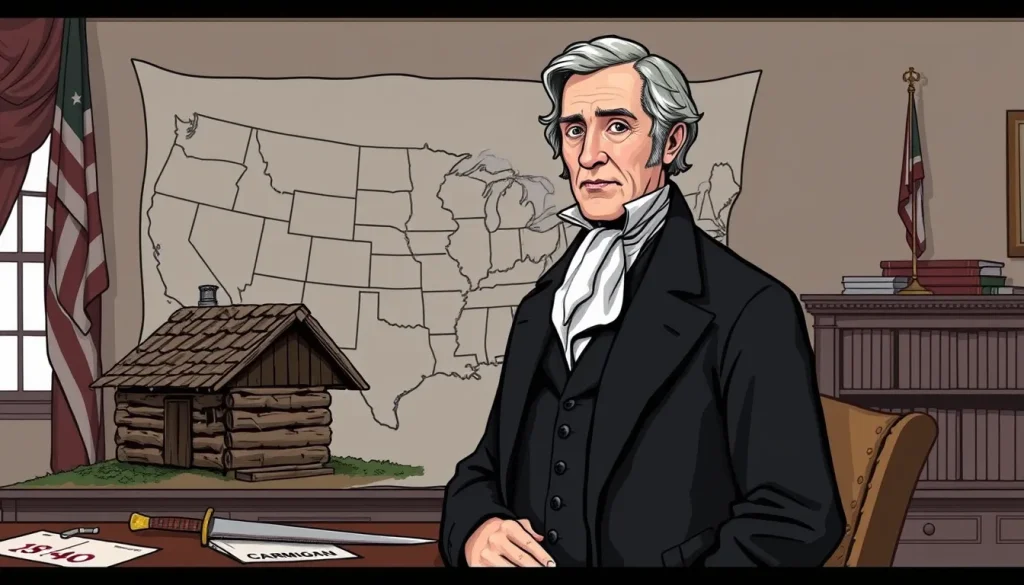
Harrison’s post-war career exemplifies how military heroes could convert martial reputation into political capital, a pattern repeated throughout American history. His 1840 campaign, with its log-cabin and hard-cider imagery, marked a turning point in American political campaigning, appealing directly to mass voters. His presidency, though brief, initiated a series of presidential deaths in office and prompted constitutional questions about succession that were later clarified by the Twenty-fifth Amendment. Historically, Harrison’s career also underscores how issues of slavery and territorial expansion remained contentious from the Era of Good Feelings through the antebellum period. His death, attributed to pneumonia after a prolonged inaugural address, has been revisited by modern historians who suggest possible typhoid contamination of the White House water supply.
Early Life
William Henry Harrison was born on February 9, 1773, in Charles City County, Virginia, to Benjamin Harrison, a signer of the Declaration of Independence, and Elizabeth Bassett Harrison. He attended Hampden-Sydney College and began studying medicine but abandoned it in 1791 to join the army after his father’s death. He served under General Anthony Wayne and fought at the Battle of Fallen Timbers in 1794. He resigned in 1798 and entered territorial politics.
Role Before the War
From 1801 to 1812, Harrison served as governor of the Indiana Territory, where he negotiated numerous treaties that transferred millions of acres of Native American land to the United States. His actions contributed to rising tensions with Tecumseh and his confederacy, leading to the Battle of Tippecanoe in 1811, where Harrison’s forces claimed victory. This battle solidified his reputation as an Indian fighter and military leader.
Role During the War
When the War of 1812 broke out, Harrison was commissioned a brigadier general and given command of the Army of the Northwest. He led American forces in the difficult campaign to recapture Detroit and won a significant victory at the Battle of the Thames on October 5, 1813, where Tecumseh was killed. This success made him a national hero and cemented his public image as “Old Tip.”
Major Actions
After the war, Harrison’s major actions centered on legislative service and party building. In the House and Senate, he supported the American System, advocating for internal improvements funded by the federal government. He voted against restricting slavery in new territories, aligning with his Virginia roots and the southern wing of his party. He also joined in attempts to censure Andrew Jackson for his actions in the First Seminole War, creating a lasting political rivalry. His appointment as minister to Colombia allowed him to observe Latin American politics, but his recall by Jackson ended his diplomatic career. His most consequential post-war action was his presidential campaigns of 1836 and 1840, the latter winning the presidency.
Contemporary Accounts
Contemporary descriptions of Harrison during his political career often emphasized his frontier experiences and military success. The 1840 campaign saw the Democratic press disparagingly suggest that Harrison preferred a log cabin and hard cider to the White House, a remark that the Whig campaign quickly turned into a symbol of the humble candidate. Harrison’s letters and speeches from this period reveal a politician careful to position himself as a moderate nationalist and a defender of the common man, while also trying to balance sectional interests over slavery. Many contemporaries viewed him as a solid, if unremarkable, figure elevated by time and circumstance.
Later Life
Harrison’s later life was dominated by his brief presidency. He was inaugurated on March 4, 1841, at the age of 68, the oldest president to that time. His inaugural address lasted nearly two hours and was delivered on a cold, wet day without an overcoat. He developed pneumonia and died exactly one month later, on April 4, 1841, becoming the first president to die in office. His grandson, Benjamin Harrison, would later become the 23rd president in 1889.
Historical Legacy
Historians view Harrison’s political career as emblematic of the early republic’s reliance on military heroes for political legitimacy. His presidency, though brief, had a lasting impact on succession rules and on Whig party cohesion, which disintegrated after his death. His campaign in 1840 is often cited as the first modern presidential campaign due to its use of slogans, rallies, and manufactured imagery. Recent scholarship has also reassessed his death, suggesting that contaminated water may have been the cause rather than a simple cold, adding a layer of complexity to his legacy. Overall, Harrison is remembered less for any legislative achievement and more for the symbolic power of his elevation and tragic end.
Primary Sources
The most relevant primary sources for Harrison’s post-war political career are his official letters and papers, held in several archives. The Library of Congress has a collection of Harrison’s papers (1734–1939) including correspondence from his military and political life. The Indiana Historical Society also holds a substantial collection, including letters to Secretaries of War and documents related to his political campaigns. The William Henry Harrison Papers, microfilm edition covering 1800–1815, is available from the Indiana Historical Society. Additionally, his inaugural address from 1841 and his campaign speeches are preserved in contemporary newspapers and Congressional records. These sources reflect his own views and the political context of the era, but should be read with awareness of his partisan objectives and the biases of nineteenth-century political communication.
Further Reading
- Freeman Cleaves, Old Tippecanoe: William Henry Harrison and His Times (New York: Scribner, 1939).
- Robert M. Owens, Mr. Jefferson’s Hammer: William Henry Harrison and the Origins of American Indian Policy (Norman: University of Oklahoma Press, 2007).
- Gail Collins, William Henry Harrison (New York: Times Books, 2012).
- David S. Heidler and Jeanne T. Heidler, The War of 1812: An Encyclopedia (New York: Garland, 1997).
- U.S. Congress, Biographical Directory of the United States Congress, s.v. “Harrison, William Henry.”
References
- Britannica Editors, “William Henry Harrison – Political career,” Britannica.com, https://www.britannica.com/biography/William-Henry-Harrison/Political-career.
- Miller Center, “William Harrison: Life in Brief,” University of Virginia, https://millercenter.org/president/harrison/life-in-brief.
- History, Art & Archives, U.S. House of Representatives, “HARRISON, William Henry,” https://history.house.gov/People/Detail/14628.
- American Battlefield Trust, “William Henry Harrison,” https://www.battlefields.org/learn/biographies/william-henry-harrison.
- George W. Bush White House Archives, “Biography of William Henry Harrison,” https://georgewbush-whitehouse.archives.gov/history/presidents/wh9.html.
FAQ
What positions did William Henry Harrison hold after the War of 1812?
After the war, Harrison served in the U.S. House of Representatives (1816–1819), in the Ohio state senate (1819–1821), in the U.S. Senate (1825–1828), and as minister to Colombia (1828–1829). He also ran for president in 1836 and won in 1840.
How did Harrison's military career influence his political career?
Harrison's victory at the Battle of the Thames and his earlier role at Tippecanoe made him a national hero. His military fame, especially in the West, provided a base of support that he used to win elections throughout his career, ultimately culminating in his presidential victory.
Why is Harrison's presidency significant?
Harrison's presidency lasted only 32 days, making it the shortest in U.S. history. His death raised questions about presidential succession that were not resolved until the 25th Amendment. His 1840 campaign also set precedents for modern political campaigning.



Leave a Reply