
Short Answer
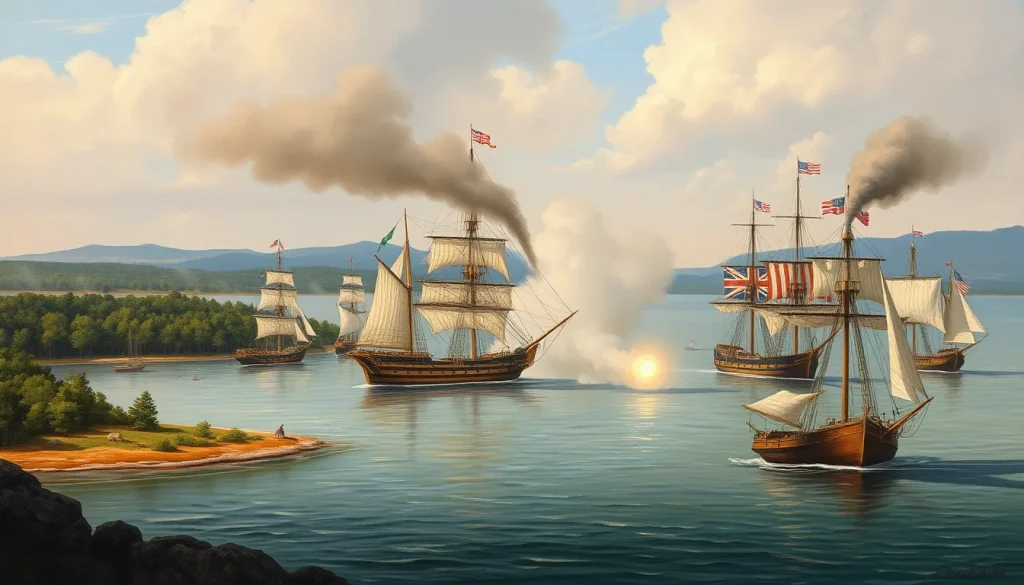
The Battle of Lake Champlain, also commonly known as the Battle of Plattsburgh, was a combined land and naval engagement fought on 11 September 1814 near Plattsburgh, New York, on the western shore of Lake Champlain. It was the final major British offensive of the War of 1812 and resulted in a decisive American victory. The battle checked British attempts to advance down the Champlain corridor, which would have cut off New England from the rest of the United States, and it materially shaped the terms of a peace treaty at Ghent.
Historical Context
By early 1814, the War of 1812 had reached a strategic turning point. In Europe, Napoleon Bonaparte’s abdication in April freed large numbers of British regulars, many of them Peninsular War veterans, for overseas service. The British government dispatched some 16,000 troops to Canada, under the command of Lieutenant-General Sir George Prevost, the Governor-in-Chief of the Canadas. Prevost decided to use these forces to invade the United States along the traditional invasion route from Montreal to New York, via the Richelieu River and Lake Champlain. Control of the lake was essential to support any land advance, as it would allow supply, reinforcement, and naval fire support.
American forces in the region were concentrated at Plattsburgh, a small but strategically important port. The U.S. Army garrison, commanded by Brigadier-General Alexander Macomb, numbered roughly 1,500 to 1,700 regulars, supplemented by about 2,000 to 2,500 militia. The U.S. naval squadron on Lake Champlain, under Master Commandant Thomas Macdonough, consisted of the corvette Saratoga (26 guns), the brig Eagle (20), the schooner Ticonderoga (17), the sloop Preble (7), and ten gunboats. Macdonough prepared a defensive position in Plattsburgh Bay, employing spring anchors to allow his ships to swing and present fresh broadsides without weighing anchor.
What Happened
On 1 September 1814, Prevost’s army of about 10,000 regulars and militia crossed the border into New York, moving south along Lake Champlain’s western shore. The British naval squadron, commanded by Captain George Downie, consisted of the frigate Confiance (36 guns), the brig Linnet (16), the sloops Chubb and Finch, and twelve gunboats. Downie had been pressed by Prevost to attack before the Americans were fully prepared.
At dawn on 11 September, Downie’s squadron rounded Cumberland Head and entered Plattsburgh Bay, engaging Macdonough’s anchored line. The initial exchange was fierce. The American flagship Saratoga suffered heavy damage from the Confiance, but Macdonough’s use of spring cables allowed him to turn his ship around and deliver a fresh broadside, a maneuver he had rehearsed. The Confiance was crippled, Downie was killed, and within a few hours the British squadron struck its flags. The American gunboats and artillery on shore also drove off the British galleys. On land, Prevost’s troops attempted a crossing of the Saranac River but were repulsed by Macomb’s regulars and militia. When Prevost saw the naval defeat, he ordered a retreat back to Canada, abandoning the invasion. The American victory was complete.
Why It Matters
The American victory at Lake Champlain was strategically significant. It preserved the territorial integrity of the United States by thwarting a large-scale British invasion that threatened to separate New England from the rest of the union. It also strengthened the American negotiating position at Ghent, where British commissioners had sought territorial concessions based on uti possidetis (retaining territory held at war’s end). The defeat at Plattsburgh deprived Britain of any claim to Champlain valley or New York territory, and the Treaty of Ghent, signed in December 1814, restored all pre-war boundaries.
Historians have long interpreted the battle as a turning point. Contemporary observers, including British naval officers, described the fighting as equal to Trafalgar in intensity. Prevost’s decision to retreat despite his land superiority has been debated. Some historians blame his cautious leadership; others argue that without the naval squadron, his army could not be supplied and the invasion was doomed. The American innovation in naval tactics under Macdonough is widely praised as a model of defensive seamanship.
Prelude
The British plan called for a synchronized land and naval assault on Plattsburgh. Prevost’s army would attack the American fortifications along the Saranac River while Downie’s squadron destroyed or drove off the American fleet. The British land forces included three brigades of Peninsular veterans from the 3rd, 5th, 27th, 39th, 58th, 76th, and 88th Regiments of Foot, supported by artillery. Prevost crossed the border on 1 September and skirmished with American militia before reaching Plattsburgh on 6 September. He paused to await Downie, who had been assembling a naval force at Isle aux Noix.
In the meantime, Secretary of War John Armstrong had diverted some American regulars westward, leaving Macomb with a small force. Macomb organized hasty defences along the Saranac and ordered Macdonough to take a defensive position in Plattsburgh Bay, which provided a narrow approach and masked the British advantage in long guns.
Forces and Commanders
British: Naval squadron under Captain George Downie (killed in action), including Confiance (frigate), Linnet (brig), Chubb and Finch (sloops), and 12 gunboats. Land army under Lieutenant-General Sir George Prevost, comprised of roughly 10,000 regulars and militia, commanded by Major-Generals de Rottenburg, Robinson, Brisbane, and Power.
American: Naval squadron under Master Commandant Thomas Macdonough, with Saratoga, Eagle, Ticonderoga, Preble, and ten gunboats. Land forces under Brigadier-General Alexander Macomb, with about 1,500 to 1,700 regulars and up to 2,500 militia.
Battlefield and Map Context
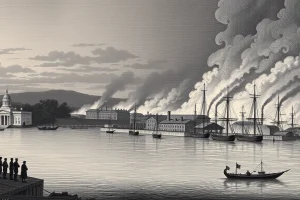
Lake Champlain is a long, narrow lake forming part of the border between New York and Vermont. Plattsburgh Bay, on the western shore, was the anchor point for the American squadron. The bay was wide enough for Macdonough’s line, but its entrance from Cumberland Head was narrow, forcing the British to approach in single file and limiting their tactical flexibility. The surrounding land was hilly, with the Saranac River crossing the town. Control of the lake was the key to supply and communication along the invasion route. The American position was chosen to negate the British advantage in long-range guns, bringing the fight into short range where carronades aboard American ships were effective.
Battle Chronology
- 1 September: Prevost’s army crosses the border; skirmishes with American militia.
- 6 September: British advance guard reaches Plattsburgh; sporadic skirmishing.
- 10 September: Downie’s squadron moves from Isle aux Noix towards Plattsburgh Bay.
- 11 September, dawn: British squadron appears off Cumberland Head. Macdonough’s ships are at anchor in battle order.
- Around 9 a.m.: Downie orders the attack; the British ships approach and open fire.
- 10:30 a.m.: Eagle cuts her cable to reposition, exposing Saratoga. Macdonough uses spring anchors to turn his ship, presenting a fresh broadside.
- Shortly after: Confiance surrenders; Downie is killed. The rest of the British squadron strikes.
On land, Prevost’s troops attempt to cross the Saranac but are repulsed. - That afternoon: Prevost gives the order to retreat to Canada.
Casualties and Losses
Exact figures vary among sources, but the most commonly cited totals are: American naval casualties of about 104 killed and 116 wounded; American land casualties about 115 killed and 130 wounded. British naval losses were around 168 killed, 220 wounded, with 317 captured; British land casualties were about 200 killed, wounded, and missing, with an additional 234 desertions during the campaign. The entire British naval squadron (four warships) was captured or destroyed.
Result
Decisive American victory. The British invasion of New York via Lake Champlain was repelled, and the British expeditionary force retreated to Lower Canada. The battle is considered one of the most complete naval–military successes of the War of 1812, effectively ending any threat of a British breakthrough in the north.
Strategic Consequences
The victory at Lake Champlain, alongside the successful defence of Baltimore earlier in September, undercut British territorial demands at the peace negotiations in Ghent. It also safeguarded the American north-eastern states and prevented the isolation of New England. In the longer term, the battle established American naval credibility on the lakes and reinforced the U.S. claim to the Champlain valley. It also contributed to Prevost’s recall to Britain, where he died before a court martial could be convened.
Primary Accounts
The most important American primary account is the dispatch of Thomas Macdonough, dated 13 September 1814, to Secretary of the Navy William Jones, describing the action in detail. Macdonough’s report credits the use of spring anchors and the morale of his crews. Another account is the official report of Brigadier-General Alexander Macomb, who detailed the land defences and the repulse of the British infantry. A civilian witness, J.C. Hubbell, also left a vivid description of the artillery fire.
On the British side, no official after-action report was written, as Captain Downie perished. Later memoirs and officers’ correspondence, particularly from members of the Peninsular brigades, criticized Prevost’s conduct and praised the determination of the American navy.
Battlefield Today
The battlefield at Plattsburgh is commemorated at the Battle of Plattsburgh Association and the Plattsburgh Memorial, which includes a museum and interpretive trails. The site of the naval engagement is on the waters of Lake Champlain, designated as a National Historic Landmark. The American fortifications along the Saranac still retain some earthworks. The city of Plattsburgh, New York, holds an annual remembrance ceremony each September. Macdonough’s flagship Saratoga was later salvaged, but parts of its hull are preserved in a museum.
Primary Sources
Macdonough’s Dispatch to Secretary Jones (13 September 1814) – This official report, written a day after the battle, describes the engagement in chronological order, the spring-anchor tactic, and the surrender of the British squadron. It is available in American State Papers and the Naval Documents series.
Macomb’s Report to Secretary of War (11 September 1814) – Reports on the land defence, casualties, and the retreat of Prevost’s army. It is preserved in the National Archives.
Prevost’s Despatch to the Colonial Office (11–12 September 1814) – Prevost’s own account justifies his retreat, attributing it to the loss of naval superiority. It is held in the Public Record Office, Kew.
J.C. Hubbell’s Reminiscence – A civilian’s memoir that vividly describes the roar of the guns and the smoke, providing a ground-level perspective.
These documents are reproduced in standard collections such as Naval Documents of the War of 1812 (Naval Historical Center) and The War of 1812: A Documentary History.
Further Reading
- Donald R. Hickey, The War of 1812: A Forgotten Conflict (University of Illinois Press).
- Andrew Lambert, The Challenge: Britain Against America in the Naval War of 1812 (Faber and Faber).
- John R. Elting, Amateurs to Arms! A Military History of the War of 1812 (Algonquin Books).
- R.A. Bowler, The War of 1812 (Holt, Rinehart and Winston).
- National Park Service, “Autumn 1814: The British Navy suffers a decisive defeat at the Battle of Lake Champlain” (online article).
References
- National Park Service, “Autumn 1814: The British Navy suffers a decisive defeat at the Battle of Lake Champlain,” (2016). https://www.nps.gov/articles/battle-of-lake-champlain.htm
- Jason Ridler, “Battle of Plattsburgh,” The Canadian Encyclopedia (2011, updated 2026). https://thecanadianencyclopedia.ca/index.php/en/article/battle-of-plattsburgh
- “Battle of Plattsburgh – War of 1812,” The War of 1812 website. https://thewarof1812.org/battles/battle-of-plattsburgh/
- “Capture of the British Fleet on Lake Champlain,” American State Papers, 13th Cong., 3d sess., No. 112 (1814). https://ibiblio.org/pha/USN/1814/18141006Champlain.html
- “Battle of Plattsburgh,” Wikipedia, last modified 2025. https://en.wikipedia.org/wiki/Battle_of_Plattsburgh
FAQ
Who commanded the American forces at Lake Champlain?
The American naval squadron was commanded by Master Commandant Thomas Macdonough, and the land forces by Brigadier-General Alexander Macomb.
Why is the battle also known as the Battle of Plattsburgh?
Because the land engagement took place at the town of Plattsburgh, New York, and the naval action occurred in the adjacent bay on Lake Champlain. Both names are used interchangeably.
What was the strategic impact of the battle?
It stopped the final British invasion of the northern United States, prevented the separation of New England, and weakened British territorial claims at the Ghent peace negotiations.


Leave a Reply