
Short Answer
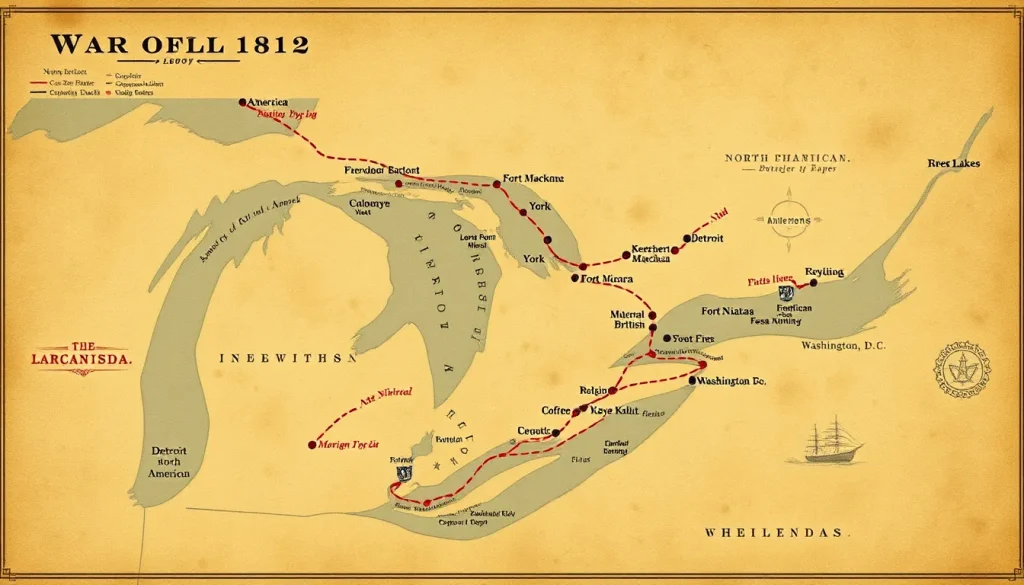
The War of 1812 (1812–1815) saw frequent shifts in territorial control along the Great Lakes, the Niagara frontier, the Chesapeake, and the Atlantic coast. Forts and settlements were captured, occupied, and sometimes destroyed, but the war ended with the Treaty of Ghent restoring all boundaries to their pre-war lines. This article examines the territories that changed hands during the conflict, the causes of these exchanges, and why the war produced no lasting territorial adjustments.
Historical Context
The War of 1812 arose from long-standing American grievances against British actions such as impressment of American sailors, interference with trade, and support for Indigenous resistance on the northwestern frontier. The United States, lacking a standing army and faced with a powerful British Navy, planned to seize British North America (present-day Canada) as a bargaining chip. Britain, preoccupied with the Napoleonic Wars in Europe, initially maintained a defensive posture. The border between the United States and British North America stretched from the Atlantic to the Great Lakes, marked by forts and trading posts that were strategically significant. Indigenous nations, particularly in the Old Northwest, sided with the British, viewing them as allies against American expansion.
What Happened
Territorial control changed hands early and repeatedly. In 1812, British forces and their Indigenous allies captured Fort Mackinac (present-day Michigan) in July, shortly after war was declared. Soon after, Brigadier General William Hull surrendered Detroit on August 16, 1812, without a shot, giving the British control of the Michigan Territory. American attempts to recapture Detroit failed, and the British also took Fort Dearborn (Chicago) and other posts. In 1813, American forces regained Detroit after the Battle of Lake Erie in September, leading to the British evacuation of Detroit and the death of Tecumseh at the Battle of the Thames. York (present-day Toronto), the capital of Upper Canada, was captured and burned by Americans in April 1813. The British retaliated by capturing Fort Niagara in December 1813 and burning Lewiston, New York. In 1814, British forces raided the Chesapeake, capturing and burning Washington D.C. in August, but failed to take Baltimore in September. Along the Canadian border, battles at Chippawa, Lundy’s Lane, and Plattsburgh produced no lasting changes. By the end of 1814, both sides held essentially the same territories they had at the start, aside from temporary occupations.
Why It Matters
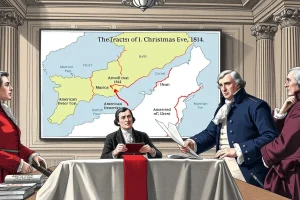
The territorial exchanges of the War of 1812 demonstrated the limits of military power on the North American continent. Despite significant battles and occupations, the Treaty of Ghent (signed December 24, 1814) mandated a return to the status quo ante bellum—all captured territory was to be mutually restored. This outcome reinforced the existing borders and shaped the future development of the United States and British North America. For Indigenous nations, the war’s end was disastrous; they lost their British ally and faced intensified American expansion. Historians debate whether the war was a military stalemate, a British victory, or an American victory, but the territorial dimension was a clear failure for both sides to achieve permanent conquests.
Definition
“Territory changed hands” in the context of the War of 1812 refers to the temporary military occupation or capture of forts, towns, and frontier regions by opposing forces. These changes were often brief, lasting weeks or months, and were reversed by subsequent counteroffensives or by the Treaty of Ghent. No permanent boundary changes resulted from the war.
Background
The border between the United States and British North America was contested and poorly defended at the outset of the war. The American army was small, and the navy was minuscule compared to Britain’s. The British, fighting Napoleon in Europe, could spare limited forces for North America. Indigenous peoples, especially those of the Shawnee, Potawatomi, and other nations, saw an opportunity to resist American encroachment. The strategic areas were the Great Lakes, where control of key forts like Mackinac and Detroit enabled control of the fur trade and the interior. The Niagara River corridor was a natural invasion route, and the Chesapeake Bay was vulnerable to naval raids. These geographic realities shaped where territory changed hands.
How It Worked
Territory changed hands through a combination of sieges, battles, and surrenders. For example, Fort Mackinac fell to a British-Indian force that landed on the island in 1812. Detroit was surrendered by General Hull after his army was threatened with massacre. York was taken after a naval attack and land assault, and American troops burned the provincial buildings. Fort Niagara was captured by a night assault. Washington D.C. was captured after the Battle of Bladensburg, and British troops set fire to public buildings. In many cases, control reverted after supply lines were cut or after defeats elsewhere. The war was characterized by raids and counter-raids rather than sustained conquest, and both sides frequently abandoned captured posts to conserve resources.
Competing Viewpoints
Historians differ on the significance of these territorial exchanges. American historians traditionally emphasized the defense of the nation and the successes at Plattsburgh, Baltimore, and New Orleans, while downplaying the loss of Detroit and the burning of Washington. British and Canadian historians stress the successful defense of British North America and the repulse of American invasions. Indigenous perspectives highlight the devastation of their lands and the loss of British support after the war. The Treaty of Ghent itself is interpreted either as a diplomatic compromise or as a British victory because the United States gained none of its stated war aims.
Role in the War of 1812
Territorial control was central to the war’s course. The American strategy of invading Canada was based on the belief that conquering Quebec and Montreal would win the war. The British used Indigenous allies to check American expansion. The capture of Detroit in 1812 shattered American morale and led to changes in military command. The American recapture of Detroit in 1813 and the burning of York demonstrated both sides’ willingness to use territorial conquest as a means of pressuring the enemy. The British capture of Washington D.C. in 1814 was a humiliation but had little strategic impact. Overall, territorial gains and losses shaped public perception and political will, even though they did not alter the final settlement.
Consequences and Historical Interpretation
The immediate consequence was that all territory was returned to its original owners under the Treaty of Ghent, which did not address the causes of the war. Later historical interpretation has emphasized that the war reinforced the border between the United States and British North America, leading to decades of peace and demilitarization. For Indigenous peoples, the war marked a turning point, as they lost their British alliance and were increasingly subjected to American land seizures. The war is often called America’s “second war of independence,” but it resulted in no territorial gains. Scholars also note that territorial changes during the war were ephemeral, reflecting the limits of military power and the logistical challenges of campaigning in North America.
Primary Sources
Relevant primary sources include the Treaty of Ghent itself, which explicitly restored all territory to the pre-war possession. Official correspondence from commanders, such as General Hull’s surrender papers and British reports on the capture of Fort Mackinac, provide contemporary accounts. American officers’ letters and diaries, like those of John Norton (Teyoninhokarawen), who fought with the British, give insight into Indigenous participation. The narrative of the burning of Washington is documented in British and American reports. These sources are available in archives such as the Library of Congress, the National Archives of the United Kingdom, and Library and Archives Canada.
Further Reading
- Donald R. Hickey, The War of 1812: A Forgotten Conflict (University of Illinois Press, 1989).
- Alan Taylor, The Civil War of 1812: American Citizens, British Subjects, Irish Rebels, & Indian Allies (Alfred A. Knopf, 2010).
- J. Mackay Hitsman, The Incredible War of 1812: A Military History (University of Toronto Press, 1965).
- Jon Latimer, 1812: War with America (Harvard University Press, 2007).
- Treaty of Ghent, December 24, 1814, U.S. National Archives.
References
- Treaty of Ghent, December 24, 1814, National Archives and Records Administration, Washington, DC.
- Donald R. Hickey, The War of 1812: A Forgotten Conflict (University of Illinois Press, 1989).
- Alan Taylor, The Civil War of 1812 (Alfred A. Knopf, 2010).
- J. Mackay Hitsman, The Incredible War of 1812 (University of Toronto Press, 1965).
- Robert Malcomson, Capital in Flames: The American Attack on York, 1813 (Naval Institute Press, 2008).
FAQ
Did the United States gain any territory from the War of 1812?
No. The Treaty of Ghent restored all boundaries to their pre-war lines; the United States gained no new territory from the conflict.
What territories were captured and recaptured during the war?
Examples include Fort Mackinac, Detroit, York (present-day Toronto), Fort Niagara, and Washington D.C., which were taken by one side and sometimes regained by the other.
Why did territorial control change so frequently?
The war was characterized by raids and counteroffensives, with limited forces and long supply lines. Both sides lacked the resources to hold large areas, so control often shifted after decisive battles or logistical exhaustion.


Leave a Reply