
Short Answer
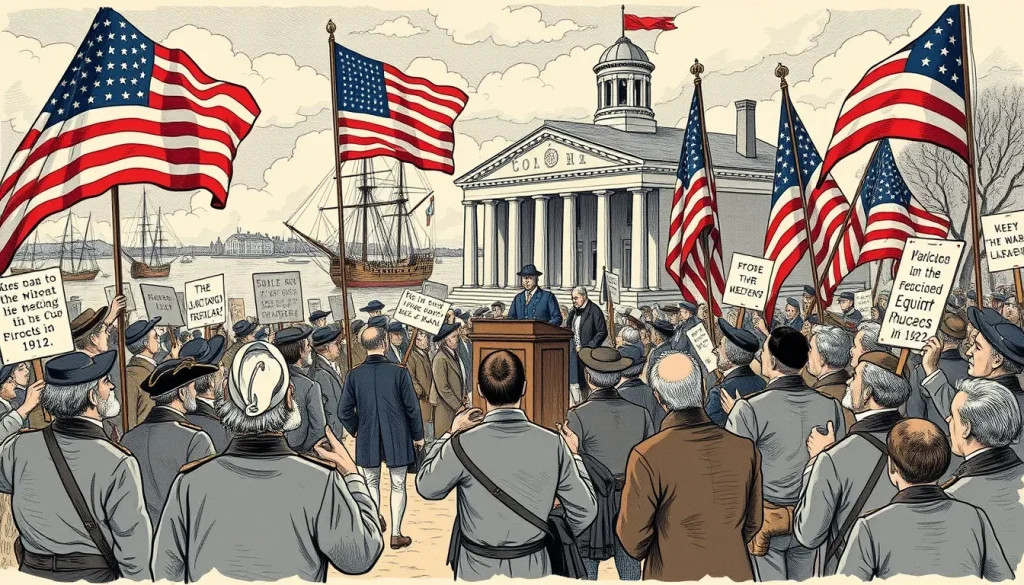
The New England opposition to the War of 1812 was a significant political movement led by the Federalist Party, which dominated the region’s politics. From 1812 to 1815, opposition manifested through legislative resistance, refusal of militia service, public protests, and the Hartford Convention of 1814–1815. This opposition influenced the war’s conduct, contributed to the Federalist Party’s decline, and raised questions about federal versus state authority that would echo in later American history.
Historical Context
The roots of opposition lay in the ongoing European wars and American trade restrictions. The British and French blockades disrupted American commerce, and the British practice of impressment—seizing American sailors for the Royal Navy—outraged many. In response, President Thomas Jefferson enacted the Embargo Act of 1807, which banned almost all American exports, devastating New England’s maritime economy. The subsequent Non-Intercourse Act and Macon’s Bill No. 2 continued to restrict trade. Federalists, who dominated New England, favored trade with Britain and saw the embargoes and later the war as detrimental to their interests.
The Federalist Party, once powerful nationally, had been out of office since 1801. Its support now centered in New England, where it opposed the Democratic-Republican policies of Jefferson and James Madison. By 1812, the party’s leaders viewed the war as a Republican scheme to favor France and to expand southern and western influence, which would further erode Federalist power.
What Happened
When Madison requested a declaration of war in June 1812, New England’s Federalist congressmen voted overwhelmingly against it. In the House and Senate, Federalists opposed war-related measures about 90 percent of the time. The war was widely labeled “Mr. Madison’s War,” a term popularized by Boston pamphleteer John Lowell. Opposition moved beyond Congress. Governors of Massachusetts, Connecticut, and Rhode Island refused to provide state militia for the planned invasion of Canada, arguing that the Constitution permitted militia use only for repelling invasion, not for offensive operations. In Massachusetts, Governor Caleb Strong went so far as to secretly negotiate with British officials about a separate peace for New England.
Throughout the region, state legislatures issued resolutions condemning the war, town meetings passed memorials, and Federalist newspapers called for resistance, with some editors even suggesting secession. The Baltimore riots of 1812, in which a mob attacked a Federalist newspaper office, intensified Federalist grievances, as they saw the violence as aimed at silencing dissent. By 1814, the British blockade and the devastating economic impact of the war had increased discontent. In October, Massachusetts Federalists called for a convention to address grievances.
The Hartford Convention met from December 15, 1814, to January 5, 1815, in Hartford, Connecticut. Twenty-six delegates from Massachusetts, Connecticut, Rhode Island, Vermont, and New Hampshire attended. Meeting in secret, they issued a report that listed grievances and proposed seven constitutional amendments, including limiting embargoes to sixty days, requiring a two-thirds congressional majority for trade restrictions, declarations of war, and admission of new states, abolishing the three-fifths clause, and limiting presidents to one term. The convention rejected secession, but the report did not shy from criticizing the administration. However, the news of the Treaty of Ghent, signed on December 24, 1814, and Andrew Jackson’s victory at New Orleans in January 1815 undercut the convention’s impact, making the opposition appear unpatriotic.
Why It Matters
The New England opposition had immediate effects on the war effort. The refusal of militia deprived the army of thousands of troops, hindering invasions of Canada. The region’s financial community also withheld funds, contributing to the near-bankruptcy of the national treasury. American negotiators at Ghent felt the dissent weakened their position, as the British were aware of it. Albert Gallatin, one of the commissioners, wrote that the attitude of Massachusetts had “a most unfavorable effect” on the negotiations.
Long-term, the opposition contributed to the Federalist Party’s demise. The Hartford Convention was ridiculed by Republicans, and the war’s successful conclusion, seen in the light of Jackson’s victory and the Treaty of Ghent, made the Federalists appear treasonous. The party fielded its last presidential candidate in 1816 and soon faded from national politics. The opposition also reinforced sectional tensions, with New England’s states’ rights stance anticipating later nullification and secession debates. Historians differ on whether the opposition was a principled defense of local interests or an example of partisan obstructionism, but all agree it shaped the war’s outcome and the early republic’s political system.
Definition
New England opposition to the War of 1812 encompassed the organized resistance by Federalist politicians, state governments, and citizens in the six New England states to President James Madison’s war policies. It included legislative obstruction, refusal of militia service, public protests, and the Hartford Convention, which sought constitutional reform.
Background
The Federalist Party, rooted in commercial and shipping interests, viewed Britain as a vital trading partner and France as a revolutionary threat. The Jeffersonian embargoes and the war were seen as attacks on New England’s prosperity. The party had also lost national influence, and its leaders saw the war as a Republican ploy to cement their power through territorial expansion and military mobilization. The region’s geographic position made it vulnerable to British naval power, and the war disrupted trade and fishing.
How It Worked
Opposition operated through multiple channels. Federalist governors, like Caleb Strong of Massachusetts and Roger Griswold of Connecticut, used their constitutional authority over the militia to deny federal requisitions. State legislatures passed resolutions and memorials, urging citizens to resist enlistment. Town meetings and county conventions issued petitions. Federalist newspapers, such as the Columbian Centinel, published editorials attacking the war. Some Federalists withheld investment in government bonds, exacerbating Treasury shortages. The Hartford Convention was the most organized effort, producing a list of grievances and proposed amendments designed to protect New England’s interests and reduce the power of the southern and western states.
Competing Viewpoints
Federalists argued that the war was unnecessary, unconstitutional, and fought for French interests, and that state militias could not be compelled to serve outside defensive roles. They believed the administration was infringing on states’ rights. Republicans and war supporters saw the opposition as obstructionist and near-treason, especially after the Hartford Convention met while the war was still ongoing. Later historians have viewed the opposition as legitimate political dissent rooted in real economic grievances, while others point to the secessionist rhetoric of some radicals as an overreach. The debate centers on whether Federalist actions were a principled defense of constitutional principles or a self-interested attempt to regain power.
Role in the War of 1812
The opposition weakened the United States’ war effort. The refusal to provide militia reduced the size of American armies and contributed to failed invasions of Canada. The Federalist opposition also encouraged British leaders to believe that New England might withdraw from the union, which they attempted to exploit by blockading the region and offering separate peace terms. At Ghent, the American commissioners believed that domestic dissent strengthened Britain’s bargaining position, leading to a treaty that ended the war without addressing the issues of impressment or neutral rights. The opposition also contributed to the financial strain, as Treasury borrowing faced resistance from Federalist-leaning merchants.
Consequences and Historical Interpretation
The immediate consequence was the Federalist Party’s collapse. The Hartford Convention’s proposals were ignored, and the party was branded disloyal. By 1816, the Federalists had virtually disappeared from national elections. The opposition also reinforced the idea of states’ rights, particularly the power of governors to withhold militia, and set a precedent for sectional protest. Historically, it is seen as a major factor in the war’s unpopularity, and some scholars argue it influenced the British decision to negotiate at Ghent. The memory of the convention also shaped later interpretations of the war, with President James Monroe’s “Era of Good Feelings” marking a brief period of one-party dominance. New England’s opposition remains a case study in political dissent during a time of national crisis.
Primary Sources
Key primary sources include John Lowell’s 1812 pamphlet “Mr. Madison’s War,” which articulated Federalist arguments; the resolutions and memorials from Massachusetts and Connecticut legislatures; Governor Caleb Strong’s correspondence, including his secret overtures to British officials; reports of town meetings and county conventions; and the Hartford Convention’s official report, published in 1815. Federalist newspapers like the Columbian Centinel and the New England Palladium provide contemporary commentary. The records of the Hartford Convention were not kept verbatim, but the official report and the speeches of delegates like Harrison Gray Otis survive.
Further Reading
- Hickey, Donald R. The War of 1812: A Forgotten Conflict. University of Illinois Press, 1989.
- Hickey, Donald R. “New England’s Defense Problem and the War of 1812.” New England Quarterly (1978).
- Morison, Samuel Eliot. The Maritime History of Massachusetts, 1783-1860. Houghton Mifflin, 1921.
- Archer, Richard. “Dissent and Peace Negotiations at Ghent.” American Studies (journal), 1971.
- American Battlefield Trust, “The Hartford Convention,” battlefields.org.
References
- National Park Service, “Federalists Oppose Madison’s War,” accessed 2025, https://www.nps.gov/articles/federalist-opposition-to-the-war.htm.
- Archer, Richard. “Dissent and Peace Negotiations at Ghent,” American Studies, https://journals.ku.edu/amsj/article/download/2285/2244.
- Mahnken, Kevin. “Fractures of 1812,” Humanities, Vol. 33, No. 6 (2012), https://www.neh.gov/article/fractures-1812.
- American Battlefield Trust, “The Hartford Convention,” https://www.battlefields.org/learn/articles/hartford-convention.
- Bailey, Jeremy D. “The Hartford Convention,” Bill of Rights Institute, https://billofrightsinstitute.org/essays/the-hartford-convention/.
FAQ
Why did New England oppose the War of 1812?
New England Federalists opposed the war because it disrupted their trade with Britain, was seen as favoring French interests, and was viewed as a Republican plot to expand southern and western power. They also believed the war was unconstitutional and that state militias could not be used for offensive operations.
What was the Hartford Convention?
The Hartford Convention was a meeting of 26 Federalist delegates from New England held in December 1814 to address grievances against President Madison's wartime policies. It proposed constitutional amendments to limit embargoes, require supermajorities for war and trade restrictions, and reduce southern power, but rejected secession.
How did New England opposition affect the war?
Opposition weakened the American war effort by withholding militia and financial support, hindering invasions of Canada. It also encouraged British expectations of a separate peace and influenced the American negotiators at Ghent to accept a treaty that did not address impressment.



Leave a Reply