
Short Answer
The Battle of New Orleans was the final major land engagement of the War of 1812, fought on January 8, 1815, between British forces under Major General Sir Edward Pakenham and American forces under Major General Andrew Jackson. The battle took place near Chalmette Plantation, about five miles southeast of New Orleans, and resulted in an overwhelming American victory. Although the Treaty of Ghent had been signed on December 24, 1814, it had not yet been ratified, and the engagement determined the fate of the city and the Mississippi Valley.
Historical Context
After Napoleon’s defeat in the spring of 1814, Britain redirected its full military might toward the war in North America. With the Royal Navy dominant, British strategists sought to capture New Orleans, a vital port through which one-third of American produce passed and a gateway to the newly acquired Louisiana Territory. Control of New Orleans would give Britain command of the Mississippi River and potentially undo the Louisiana Purchase. In August 1814, Vice-Admiral Sir Alexander Cochrane proposed a campaign against New Orleans to the Admiralty, and the British government authorized the expedition despite ongoing peace negotiations at Ghent. The British also hoped to use New Orleans as a bargaining chip to extract concessions in the peace treaty.
On the American side, the commander of the Seventh Military District, Major General Andrew Jackson, had gained fame for his defeat of the Creek people in 1814. Jackson arrived in New Orleans on December 1, 1814, to organize its defense. The city was a cosmopolitan mix of French, Spanish, free African Americans, slaves, and recent American immigrants, and Jackson declared martial law to secure order and gather resources. He assembled a force of regulars, militia from Tennessee and Kentucky, free men of color, Choctaw warriors, pirates under Jean Lafitte, and sailors—around 5,700 men in total.
What Happened
British Vice-Admiral Cochrane’s fleet anchored off Ship Island, about 60 miles east of New Orleans, on December 8. A British naval force destroyed the American gunboat flotilla on Lake Borgne on December 14, clearing the way for an amphibious landing. On December 23, British troops under Major General John Keane landed at the Villere Plantation, about nine miles south of New Orleans. That evening Jackson launched a surprise night attack, catching the British off guard and then withdrawing to the Rodriguez Canal, a dry millrace, where he constructed a defensive earthwork famously known as Line Jackson. The line extended from the Mississippi River to an impassable swamp, about three-quarters of a mile.
Lieutenant General Sir Edward Pakenham arrived on Christmas Day and took command. Over the following week, British attempts to break the American line included an artillery bombardment on January 1, which failed. On January 8, Pakenham launched a full-scale frontal assault. British columns advanced in the face of devastating American artillery and rifle fire. Pakenham was killed and his second-in-command, Major General Samuel Gibbs, was mortally wounded. The British suffered more than 2,000 casualties in about thirty minutes, while American losses were only seventy-one. A secondary attack on the west bank succeeded in capturing an American battery, but after the main assault failed, the British withdrew. The British remained in front of Jackson’s line until January 18, when they re-embarked and sailed away.
Why It Matters
The American victory at New Orleans had immediate and long-reaching effects. It repelled the British invasion, preserved American control of the Mississippi River, and boosted national morale at the end of a war often marked by American defeats. The battle made Andrew Jackson a national hero, directly contributing to his election as president in 1828. It also became a symbol of American democracy defeating European aristocracy. Notably, the battle was fought after the Treaty of Ghent had been signed but before its ratification, meaning it had no effect on the treaty’s terms, which restored the prewar status quo. Nevertheless, the victory solidified American claims to the Louisiana Purchase and deterred future British designs on the region. In the 19th century, January 8 was celebrated as a national holiday, equal to the Fourth of July.
Prelude
The British plan to seize New Orleans originated from Vice-Admiral Cochrane’s proposal in August 1814. The British assembled a fleet in Jamaica and made rendezvous at Ship Island. After destroying the American gunboats on Lake Borgne, the British chose to approach New Orleans through Lake Borgne and the bayous, landing below the city. Jackson, aware of the British movements, decided to attack rather than wait for an assault. The night battle of December 23 was a sharp but inconclusive engagement, but it bought Jackson time to fortify his position at the Rodriguez Canal.
Forces and Commanders
American forces, under Major General Andrew Jackson, numbered approximately 5,700 men. They included regular U.S. infantry and artillery, Tennessee and Kentucky militia, Louisiana militia (including free men of color), Choctaw warriors, and the privateers of Jean Lafitte. British forces, commanded by Lieutenant General Sir Edward Pakenham, numbered around 8,000 men, many experienced in the Napoleonic Wars. Key British commanders included Major Generals Samuel Gibbs and John Keane, with Major General John Lambert succeeding Pakenham after his death. Vice-Admiral Cochrane commanded the naval forces.
Battlefield and Map Context
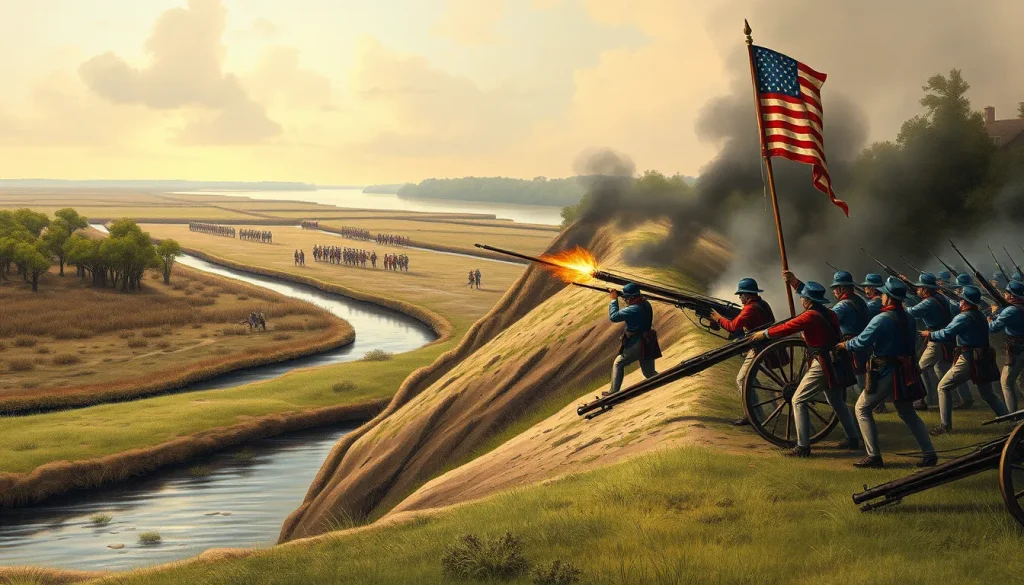
The battle was fought at the Chalmette Plantation, about five miles southeast of New Orleans, along a strip of land between the east bank of the Mississippi River and a cypress swamp. The Rodriguez Canal ran perpendicular to the river, and Jackson’s men widened it into a ditch, using the soil to build a seven-foot-high earthen rampart reinforced with timber and cotton bales. The position was later known as Line Jackson. The battlefield’s geography forced the British into a narrow frontal assault, minimizing the advantage of their numbers.
Battle Chronology
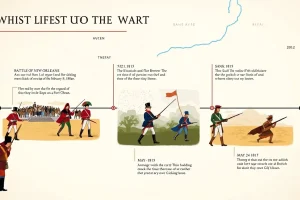
After the British landing on December 23 and Jackson’s night attack, British forces advanced to the Chalmette Plantation on December 27. On December 28, a heavy British skirmish was repulsed. On January 1, a massive British artillery duel failed to damage the American line. The decisive assault came on January 8, 1815, at dawn. British columns advanced on both sides of the line, with a small force crossing the river to attack American batteries on the west bank. The main column, led by Gibbs and Keane, was cut down by concentrated American artillery and musketry within minutes. Pakenham and Gibbs were killed. The west-bank attack captured a battery, but after the main assault failed, Lambert ordered a retreat, and the British eventually withdrew from the field on January 18.
Casualties and Losses
American losses were exceptionally light: 13 killed, 39 wounded, and 19 missing or captured, for a total of 71. British casualties were catastrophic: approximately 285 killed, 1,265 wounded, and 484 missing or captured, totaling around 2,034. The disparity illustrates the effectiveness of the American defensive position against a frontal assault.
Result
The Battle of New Orleans was a decisive American victory. The British army, having suffered more than 2,000 casualties in a failed frontal attack, abandoned its attempt to take New Orleans. The British re-embarked on their ships and sailed out of the Gulf of Mexico. The victory secured the city and confirmed American control over the mouth of the Mississippi.
Strategic Consequences
The battle ended the British Gulf Campaign and the last major military operation of the War of 1812. The Treaty of Ghent was ratified by the United States on February 16, 1815, ending the war. The battle did not change the treaty’s terms, but it strongly reinforced American claims to the Louisiana Purchase and demonstrated that the United States could successfully defend its territory. The victory boosted American national identity and prestige, and it elevated Jackson to a military fame that would lead to the presidency. It also discouraged future British military intervention in the region.
Primary Accounts
Several contemporary accounts and visual records survive. The battle is depicted in an oil painting by Jean Hyacinthe de Laclotte, a Louisiana militia officer who sketched the scene during the fight. A later painting by E. Percy Moran shows Jackson standing triumphantly. Soldiers’ letters and diaries, such as the Kentucky soldier who described the battlefield as a ‘sea of blood,’ provide immediate impressions. British military dispatches record the failure and the deaths of senior officers. These sources are preserved in archives such as the National Archives of the United States and the British National Archives.
Battlefield Today
The Chalmette Battlefield is preserved as a unit of Jean Lafitte National Historical Park and Preserve, operated by the National Park Service. Visitors can see the remains of Line Jackson, the Rodriguez Canal, and the Chalmette National Cemetery. A monument and interpretive displays commemorate the battle. The battlefield is located in Chalmette, Louisiana, about six miles southeast of the French Quarter.
Primary Sources
The most important primary sources include official reports by Andrew Jackson to the U.S. Secretary of War, written shortly after the battle, and the British after-action reports by Admiral Cochrane and surviving officers. Jackson’s report details the defensive positions and the enemy’s repulse. The British account, including the court-martial and correspondence, offers an alternative perspective on the operation’s failure. Letters from participants, such as the famous ‘sea of blood’ quote from a Kentucky soldier, are compiled in state historical collections. The Laclotte painting serves as a visual primary source. These documents are accessible at the National Archives (both in the U.S. and U.K.) and the Library of Congress.
Further Reading
Books:
- Remini, Robert V. The Battle of New Orleans. New York: HarperCollins, 2001.
- Hickey, Donald R. The War of 1812: A Forgotten Conflict. University of Illinois Press, 2012.
- Kilmeade, Brian, and Don Yaeger. Andrew Jackson and the Miracle of New Orleans. Sentinel, 2017.
- Drez, Ronald J. The War of 1812: The Battle of New Orleans. Louisiana Public Broadcasting, 2015.
Online Resources:
- American Battlefield Trust article on the Battle of New Orleans
- History.com’s Battle of New Orleans overview
- National Park Service, Jean Lafitte National Historical Park
References
- American Battlefield Trust, “Battle of New Orleans: The Last Battle of the War of 1812”, last updated July 29, 2024. Accessed: [current date]. URL
- HISTORY.com, “Battle of New Orleans: War of 1812 & Andrew Jackson”, last updated May 28, 2025. URL
- American Battlefield Trust, “New Orleans Battle Facts and Summary”. URL
- Wikipedia, “Battle of New Orleans”. URL
FAQ
Was the Battle of New Orleans fought after the Treaty of Ghent?
Yes, the treaty was signed on December 24, 1814, but it had not yet been ratified by the United States. The battle took place on January 8, 1815, and the treaty was ratified on February 16, 1815.
Who was Jean Lafitte and how did he contribute?
Jean Lafitte was a privateer who commanded a band of smugglers in Barataria Bay. Jackson accepted his offer of assistance, and Lafitte provided knowledge and manpower to help defend New Orleans.
How many casualties were there?
American forces suffered 71 casualties (13 killed, 39 wounded, 19 missing). British forces suffered about 2,034 casualties (285 killed, 1,265 wounded, 484 missing or captured).
Leave a Reply