
Short Answer
The diplomacy of the War of 1812 encompasses the negotiations, proposals, and treaties that shaped the conflict between the United States and Great Britain from 1812 to 1815. Rooted in unresolved maritime disputes and frontier tensions, diplomatic efforts sought to address American grievances over impressment, trade restrictions, and British support for Indigenous resistance. The eventual Treaty of Ghent, signed on December 24, 1814, restored pre-war borders and marked the end of the war without resolving the original causes.
Historical Context
The diplomatic backdrop to the War of 1812 lay in the prolonged European conflict between Great Britain and Napoleonic France. Both belligerents interfered with American neutral shipping, but British maritime policies proved particularly galling to the United States. The British Orders in Council (issued in November 1807) blockaded European ports under French control, effectively restricting American trade with the continent. Additionally, the Royal Navy’s practice of impressment—forcibly removing sailors from American vessels and pressing them into British service—outraged Americans, especially after the Chesapeake Affair of 1807, when the British frigate HMS Leopard fired on the USS Chesapeake to recover deserters.
Efforts to resolve these issues through diplomacy had a mixed record. Jay’s Treaty (1794) had eased tensions but expired in 1805, and subsequent attempts like the Monroe-Pinkney Treaty (1806) failed when President Jefferson rejected it because it did not address impressment. Meanwhile, American reliance on economic coercion—through the Embargo Act of 1807 and later the Non-Intercourse Act and Macon’s Bill No. 2—proved ineffective. By 1812, President James Madison and many Republicans believed that only war could force Britain to respect American neutral rights. In June 1812, the British government rescinded the Orders in Council as a concession to American diplomacy, but the news arrived too late to prevent the American declaration of war on June 18, 1812.
What Happened
Once war began, diplomatic efforts continued alongside military operations. Initially, the United States hoped that a quick military victory in Canada would strengthen its negotiating position, but early invasions failed and the war dragged on. In 1813, Czar Alexander I of Russia offered to mediate between the United States and Great Britain, a proposal the American government eagerly accepted. Although Britain initially declined, the offer eventually led to formal peace negotiations at Ghent (modern-day Ghent, Belgium) beginning in August 1814.
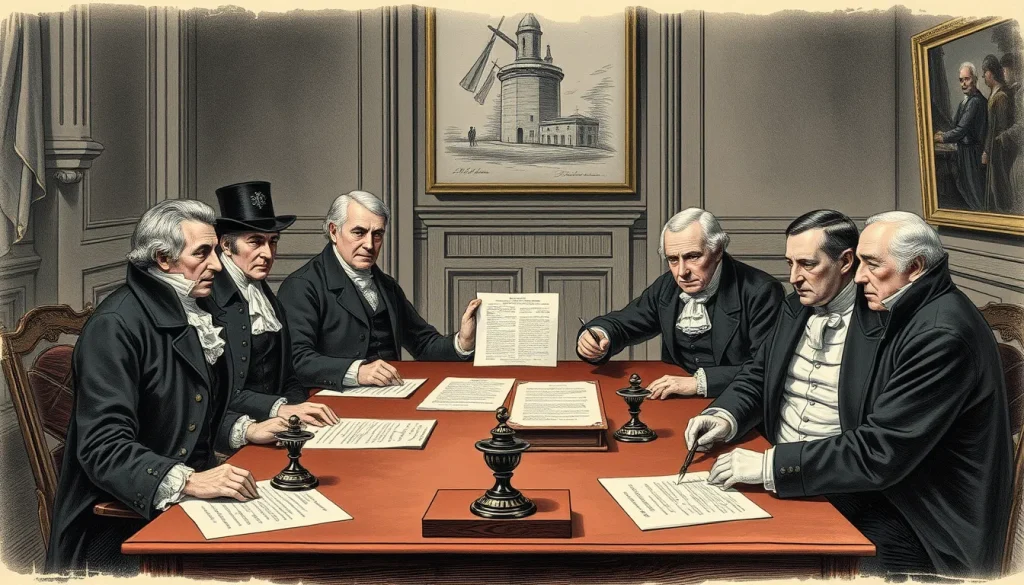
The American delegation included John Quincy Adams, Albert Gallatin, Henry Clay, James A. Bayard, and Jonathan Russell. The British commissioners, led by Admiral Lord James Gambier, Henry Goulburn, and William Adams, initially demanded the creation of an Indian buffer state in the Northwest, adjustments to the Canadian border, and exclusive naval rights on the Great Lakes. These demands were unacceptable to the Americans, who insisted on a return to the status quo ante bellum. After months of deadlock and with shifting military fortunes—including the British burning of Washington in August 1814 and the American victory at Plattsburgh in September—both sides moderated their positions. The Treaty of Ghent, signed on December 24, 1814, simply restored all territory to its pre-war state, established commissions to resolve boundary disputes, and made no mention of impressment, Orders in Council, or neutral rights. The U.S. Senate unanimously ratified the treaty on February 16, 1815.
Why It Matters
The Treaty of Ghent ended the War of 1812 without addressing its stated causes, but it nonetheless had significant consequences. For the United States, the war confirmed the nation’s independence and led to a new sense of national identity. For Britain, the war was a sideshow to the larger Napoleonic conflict, but the peace freed resources and fostered a more cooperative relationship with the United States. Subsequent diplomacy, such as the Rush-Bagot Agreement of 1817 and the Convention of 1818, resolved lingering military and territorial issues and laid the foundation for the longest unfortified border in the world. Historians debate whether the war was a diplomatic success or failure: some argue that the status quo ante bellum was a prudent resolution to an avoidable conflict, while others contend that the failure to secure neutral rights made the war a futile exercise.
Definition
In the context of the War of 1812, diplomacy refers to the formal and informal negotiations between the United States and Great Britain—and occasionally intermediaries such as Russia—conducted to prevent, manage, or resolve the conflict. It includes treaty-making, diplomatic correspondence, and peace initiatives, as well as the broader diplomatic efforts to influence foreign policy and military strategy.
Background
The diplomatic conflict grew directly from unresolved issues of the earlier Anglo-American relationship. After the American Revolution, disputes over trade, navigation, and the Canadian border remained. The French Revolutionary and Napoleonic Wars intensified British restrictions on neutral commerce, leading to a series of crises. American attempts to secure Britain’s recognition of neutral rights—through the Monroe-Pinkney Treaty and other initiatives—failed because the British refused to surrender impressment. Simultaneously, British support for Indigenous nations resisting American expansion in the Northwest and South fueled American suspicions of British machinations on the frontier. These intertwined issues created a diplomatic impasse that war seemed unable to break.
How It Worked
Diplomatic practice during the war followed established European conventions. Envoys exchanged instructions and drafts, negotiators met face-to-face, and third parties sometimes mediated. In the Ghent negotiations, the American and British commissioners met in regular sessions, exchanging notes and proposals. Diplomacy was complicated by slow communication across the Atlantic, which meant that negotiators had to act on instructions that might be months old. The Russian mediation offer, though declined by Britain, helped bring the two sides to the table. The negotiation process at Ghent was further complicated by British demands for territorial concessions and an Indian buffer state, which reflected the influence of British allies and strategic goals. Ultimately, both sides compromised because the military situation had stabilized and continued war offered little advantage.
Competing Viewpoints
Americans and Britons held fundamentally different views on the central issues. For the United States, impressment was an affront to national sovereignty and the rights of its citizens; Secretary of State James Monroe insisted that Britain renounce it as a condition of peace. The British, however, regarded impressment as a vital naval policy necessary to man the Royal Navy, and they were unwilling to concede the principle. Similarly, the Orders in Council were seen in London as a legitimate belligerent measure against France, while Americans viewed them as an illegal restraint on neutral trade. On the frontier, Americans accused Britain of inciting Indigenous attacks, while Britain defended its relationship with Native American nations as protective treaties. These competing perspectives meant that neither side was willing to abandon its foundational claims, leading to a peace that simply deferred the issues to later negotiation.
Role in the War of 1812
Diplomacy shaped both the outbreak and conduct of the war. The American decision to declare war was itself a diplomatic tool—aimed at coercing Britain into respecting American rights. Once fighting began, military operations were often designed to strengthen diplomatic leverage, as seen in the invasion of Canada, which was intended to secure territorial bargaining chips. Conversely, diplomatic setbacks, such as the failure to negotiate a cease-fire in 1813, prolonged the war. The turning point came with the opening of the Ghent negotiations, which provided a face-saving exit for both sides. The peace treaty, though silent on the issues that caused the war, allowed each nation to claim victory and move toward a more stable relationship.
Consequences and Historical Interpretation
The Treaty of Ghent’s failure to mention impressment or neutral rights has been a subject of historical debate. Some scholars, like Frank A. Updyke, argue that the war was a diplomatic stalemate and that the treaty was a pragmatic compromise. Others, like Donald R. Hickey, emphasize that the war, while militarily indecisive, solidified American independence and opened a new era of Anglo-American cooperation. The war also had significant diplomatic repercussions for Indigenous peoples, who were excluded from the negotiations and lost British support after the treaty. Over time, the war and its diplomacy have been interpreted as a second war of American independence, but modern historians recognize that the real gains were not the explicit treaty terms but the improved relations that followed the peace.
Primary Sources
Among the most important primary sources are President James Madison’s war message to Congress (June 1, 1812), which listed American grievances; the Treaty of Ghent itself; and the extensive diplomatic correspondence between Secretary of State James Monroe and British minister Augustus John Foster, as well as the records of the American and British commissioners at Ghent. Another key source is The Diplomacy of the War of 1812 by Frank A. Updyke, a scholarly study based on primary documents, which remains a standard reference. These sources reveal the positions, concerns, and internal debates of the negotiators, offering insight into the difficulties of diplomatic bargaining in the early nineteenth century.
Further Reading
- Updyke, Frank Arthur. The Diplomacy of the War of 1812. Baltimore: Johns Hopkins Press, 1915.
- Stagg, J.C.A. The War of 1812: Conflict for a Continent. Cambridge: Cambridge University Press, 2012.
- Hickey, Donald R. The War of 1812: A Forgotten Conflict. Urbana: University of Illinois Press, 1989.
- Perkins, Bradford. Prologue to War: England and the United States, 1805–1812. Berkeley: University of California Press, 1961.
- Treaty of Ghent, 1814, National Archives and Records Administration.
References
- Updyke, Frank Arthur. The Diplomacy of the War of 1812. Baltimore: Johns Hopkins Press, 1915. Accessed via Internet Archive: https://archive.org/details/diplomacyofwarof02updy
- Stagg, J.C.A. The War of 1812: Conflict for a Continent. Cambridge: Cambridge University Press, 2012.
- Hickey, Donald R. The War of 1812: A Forgotten Conflict. Urbana: University of Illinois Press, 1989.
- “The Diplomacy of the War of 1812.” The American Historical Review 21, no. 1 (1915): 155–156. doi:10.2307/1836719.
- Quaife, M.M. “Review of The Diplomacy of the War of 1812.” The Mississippi Valley Historical Review 2, no. 4 (1916): 574–575. doi:10.2307/1886918.
FAQ
What were the main diplomatic issues in the War of 1812?
The primary issues were impressment of American sailors into the British Navy, the Orders in Council restricting neutral trade, and British support for Indigenous resistance on the American frontier.
Why did the Treaty of Ghent not address impressment?
Both sides were exhausted from the war, and the British refused to concede on impressment, while the Americans prioritized ending the war. The treaty simply restored the status quo ante bellum, leaving the issue for future discussions, which were eventually resolved diplomatically.
How did diplomacy influence the course of the War of 1812?
Diplomatic efforts, including failed negotiations and mediation attempts, shaped American military strategy and the timing of peace. The American invasion of Canada was partly aimed at gaining leverage, and the Russian mediation offer helped bring the parties to the negotiating table at Ghent.



Leave a Reply