
Short Answer
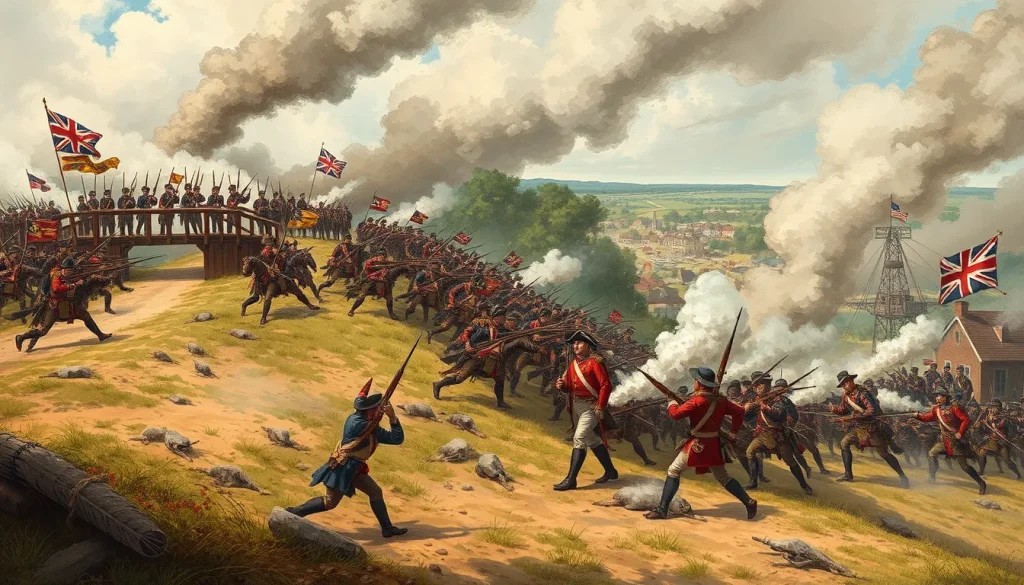
The “Bladensburg Races” is the derisive name given to the rout of American forces at the Battle of Bladensburg, Maryland, on August 24, 1814. In a brief engagement during the War of 1812’s Chesapeake campaign, a British army of regulars and Royal Marines defeated a larger but hastily assembled American force of militia, regulars, sailors, and Marines, opening the road to Washington, D.C. The collapse of the American militia—and the subsequent British burning of the capital—made Bladensburg one of the war’s most consequential and contested episodes.
Historical Context
For the first two years of the War of 1812, Britain’s war with Napoleonic France limited its ability to reinforce North America. After Napoleon’s abdication in April 1814, however, Britain could send veteran troops across the Atlantic. In the Chesapeake, Rear Admiral George Cockburn had already raided towns and established a base at Tangier Island. In August 1814, a British expeditionary force under Major General Robert Ross landed at Benedict, Maryland, and marched north. Its target was uncertain to American officials: Washington or Baltimore?
The United States had few regular troops in the region. Defense relied heavily on state militia, part-time citizen soldiers who were often poorly trained, short-term, and unevenly equipped. President James Madison and Secretary of War John Armstrong disagreed about the danger to Washington; Armstrong considered Baltimore the more likely target. Madison created the Tenth Military District and appointed Brigadier General William H. Winder to command it. Winder was a political appointee with limited high-command experience, and Secretary of State James Monroe also intervened in troop placement. These command arrangements shaped the battle.
Bladensburg, Maryland, sat about ten miles northeast of Washington on the Eastern Branch of the Potomac River, now called the Anacostia. A wooden bridge crossed the river into the town, and heights west of the bridge offered a natural defensive position. No Indigenous nations played a significant combat role at Bladensburg, although Indigenous allies and adversaries were central to other theaters of the war. The British force included the Corps of Colonial Marines, composed largely of formerly enslaved men from the Chesapeake who had sought freedom with the British.
What Happened
On August 19, 1814, British troops landed at Benedict, Maryland. As they advanced, American forces under Winder moved uncertainly, trying to cover both Washington and Baltimore. On August 23, Secretary of State James Monroe warned Madison that the enemy was marching on Washington and urged that bridges be prepared for destruction. By dawn on August 24, it was clear that Bladensburg was the immediate objective, and Winder’s exhausted troops hurried there.
The Americans arrived first and deployed on the heights west of Bladensburg in three lines. The first line, with artillery, covered the bridge and town. Monroe placed a second line about 500 yards behind the first, too far to support it effectively. Commodore Joshua Barney commanded a third line of about 400 flotillamen, 114 U.S. Marines, and some militiamen. President Madison and members of his cabinet were present on the field. Estimates of troop numbers vary: most modern accounts place the British at roughly 4,000–4,500 and the Americans at over 6,000, though one National Park Service summary gives a smaller British attacking force. The Americans had numerical advantage, but many were raw militia facing British veterans of the Peninsular War.
Ross and Cockburn surveyed the American lines and saw gaps and poor support between units. Cockburn argued that the militia would not stand, and Ross ordered an immediate attack. British troops stormed the bridge; after an initial repulse, they also crossed the river north of the bridge and threatened the American left flank. Congreve rockets added to the confusion. The first American line collapsed, and its panic spread to the second. Only Barney’s third line, with sailors and Marines, made a sustained stand, holding long enough to check the British advance before being outflanked. Barney was wounded and taken prisoner.
The American retreat became a rout. Soldiers fled toward Washington or back toward their homes; a British naval officer quoted by the National Park Service observed that the Americans fled too quickly for many to be captured. British casualties were about 64 killed and 185 wounded. American losses were much smaller in killed and wounded—roughly 10–26 killed, 40–51 wounded—but included about 100–120 captured. The British occupied Washington that night and burned the Capitol, the presidential mansion, and other public buildings on August 24–25.
Why It Matters
The defeat at Bladensburg left Washington undefended and led directly to the only foreign capture and burning of the United States capital. It also damaged American morale and intensified criticism of the Madison administration and of reliance on militia. The phrase "Bladensburg Races" appeared in an October 7, 1814, newspaper article and became common enough that it titled a popular January 1815 poem about President Madison’s flight.
Historians treat the battle as a case study in the strengths and weaknesses of the early American militia system. Some emphasize the militia’s lack of training, discipline, and equipment; others stress Winder’s indecision, the interference of Madison, Monroe, and Armstrong, and the faulty placement of the three defensive lines. Still others point to the professionalism of Ross’s veterans and Cockburn’s aggressive tactics. The collapse was not simply inevitable: militia units fought credibly elsewhere in the war, and Barney’s sailors and Marines held their ground at Bladensburg. The defeat therefore reflects a combination of institutional, command, and tactical failures under specific battlefield conditions.
Definition: What "The Bladensburg Races" Means
The "Bladensburg Races" is not a formal military term but a mocking label for the American flight from the battlefield. "Races" here means a panicked running away, not an athletic contest. The phrase captured contemporary anger and humiliation. According to the National Park Service, it appeared in an October 7, 1814, newspaper article and was common by January 1815, when it became the title of a poem about the president’s retreat from the capital.
Background: Defending Washington in 1814
The battlefield must be understood within the Chesapeake campaign. After Napoleon’s defeat, Britain sent experienced forces to raid the American coast. Cockburn’s naval raids and Ross’s army aimed to divert American resources and punish the United States. Washington was not a major military center, but it was the seat of government and a powerful symbol. American defense depended on a patchwork of regulars, militia from the District of Columbia, Maryland, and Virginia, and naval forces. Winder’s command was hampered by unclear authority and conflicting advice from senior officials.
How It Worked: The Battle and the Rout
The American position looked strong on paper: high ground west of the Anacostia, artillery covering the bridge, and more men than the British. But the three lines were too far apart to support one another, and Winder had only a vague sense of where some units were placed. When the British attacked, they combined a frontal assault on the bridge with a flanking move across the river north of it. Rockets, bayonets, and the sudden appearance of British troops on the left broke the militia’s confidence. The first line fell back into the second, and the second dissolved. Barney’s third line fought on until outflanked. With no coordinated plan for retreat, the withdrawal became a chaotic flight.
Competing Viewpoints: Why the American Militia Collapsed
Historians and contemporaries have offered several explanations. One emphasizes the militia’s inadequacy: many were untrained, ill-equipped, and unprepared for battle against Wellington’s veterans. A second focuses on command failure: Winder was indecisive, political leaders countermanded him, and Monroe’s placement of the second line made mutual support impossible. A third stresses British skill and aggression: Ross attacked before all his troops were up, while Cockburn correctly judged that the militia would break. A fourth argues that the outcome was not predetermined, pointing to Barney’s stubborn defense and to other battles where American militia performed better. Most modern accounts treat these factors as overlapping rather than mutually exclusive.
Role in the War of 1812
Bladensburg was a turning point in the Chesapeake campaign. It opened Washington to British occupation and made the burning of the capital possible. The British then moved against Baltimore, where Fort McHenry’s defense in September 1814 produced a very different result. The burning of Washington did not force an American surrender, and peace negotiations at Ghent continued. The battle nonetheless shaped American military debates, reinforcing arguments for a stronger regular army while also providing critics with evidence of militia weakness. It also became a lasting symbol of national humiliation and recovery.
Consequences and Historical Interpretation
In the short term, the defeat and the burning of Washington stunned the United States. Winder’s report to the Secretary of War acknowledged that "the contest was not as obstinately maintained as could have been desired." In the longer term, the "Bladensburg Races" entered American memory as a byword for military disgrace. Later historians have debated how much blame should fall on the militia, on Winder, on Madison’s cabinet, or on British superiority. The battle is often cited as evidence of the weaknesses of a decentralized militia system, but it also shows how specific failures of deployment, communication, and leadership can turn a numerical advantage into a rout.
Primary Sources
Several contemporary sources illuminate the battle. A letter from Secretary of State James Monroe to President James Madison on August 23, 1814, warned that the British were marching on Washington and recommended destroying bridges. It shows the last-minute American awareness of the threat. Its limitation is that it reflects urgency and incomplete intelligence rather than battlefield detail.
Brigadier General William H. Winder’s report to the Secretary of War acknowledges the poor performance of his command. The National Park Service quotes his guarded phrase that the contest "was not as obstinately maintained as could have been desired." As a defending commander’s official account, it is valuable but self-protective and necessarily shaped by his need to explain defeat.
A British naval officer’s account, quoted by the National Park Service, describes the Americans fleeing too quickly for many to be captured. It offers a British perspective on the rout, but the officer’s vantage point and national bias limit its completeness. An October 7, 1814, newspaper article is the earliest identified use of the phrase "Bladensburg Races"; it documents how quickly the defeat became a term of mockery, though newspaper partisanship and limited space affect what it reports.
Further Reading
- Donald R. Hickey, The War of 1812: A Forgotten Conflict (University of Illinois Press).
- Jon Latimer, 1812: War with America (Harvard University Press).
- Anthony S. Pitch, The Burning of Washington: The British Invasion of 1814 (Naval Institute Press).
- John Stagg, Mr. Madison’s War: Politics, Diplomacy, and Warfare in the Early American Republic, 1783–1830 (Princeton University Press).
- National Park Service, Star-Spangled Banner National Historic Trail, "Battle of Bladensburg."
- American Battlefield Trust, "Bladensburg Battle Facts and Summary" and related articles.
References
- National Park Service, "Battle of Bladensburg," Star-Spangled Banner National Historic Trail, https://www.nps.gov/stsp/learn/historyculture/battle-of-bladensburg.htm.
- National Park Service, "Summer 1814: American troops flee in humiliation, leaving Washington exposed," https://www.nps.gov/articles/bladensburg-races.htm.
- American Battlefield Trust, "Bladensburg: Before the British Could Torch the Capital of the United States…," https://www.battlefields.org/learn/articles/bladensburg-british-could-torch-capital-united-states.
- American Battlefield Trust, "Bladensburg Battle Facts and Summary," https://www.battlefields.org/learn/war-1812/battles/bladensburg.
- Wikipedia, "Battle of Bladensburg," https://en.wikipedia.org/wiki/Battle_of_Bladensburg.
FAQ
What were the Bladensburg Races?
The term refers to the panicked American retreat at the Battle of Bladensburg on August 24, 1814. It became a mocking label for the rout that left Washington, D.C., open to British capture and burning.
Why did the American militia collapse at Bladensburg?
Historians point to a combination of poor training and equipment, confusing command arrangements under General Winder, faulty placement of defensive lines, and aggressive British tactics by veterans under Robert Ross and George Cockburn.
What happened after the Battle of Bladensburg?
The British marched into Washington, D.C., and burned the Capitol, the presidential mansion, and other public buildings on August 24–25, 1814. The defeat also damaged American morale and intensified debates about reliance on militia.



Leave a Reply